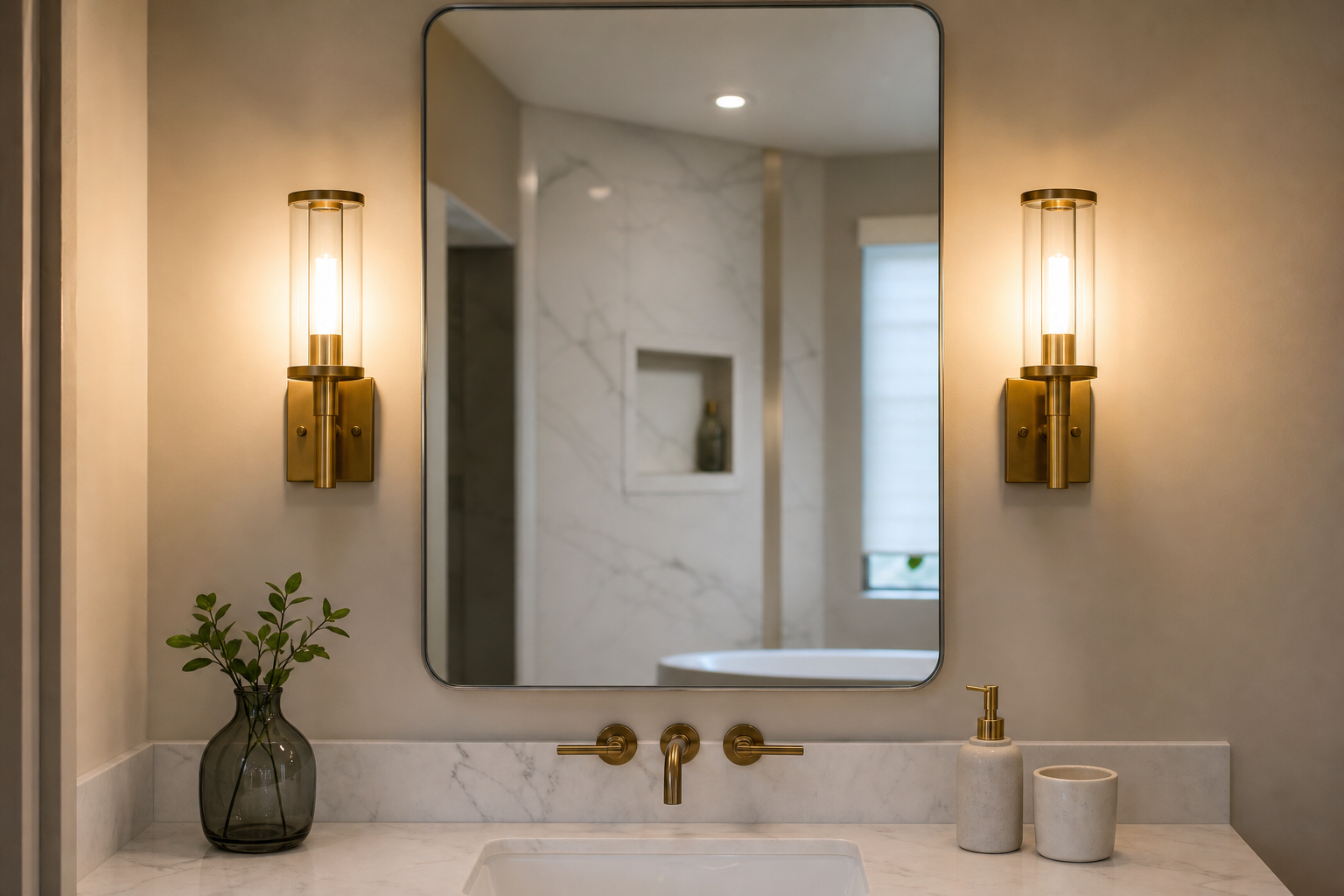
Etching on a marble or limestone counter is not a stain and cannot be removed by cleaning. It is a permanent change to the stone's surface caused by an acid dissolving the polished calcium carbonate finish, sealers do not prevent it, and the only ways to deal with it are to choose a non-reactive stone, choose a honed rather than polished finish, or understand and accept the maintenance relationship before the stone is installed.
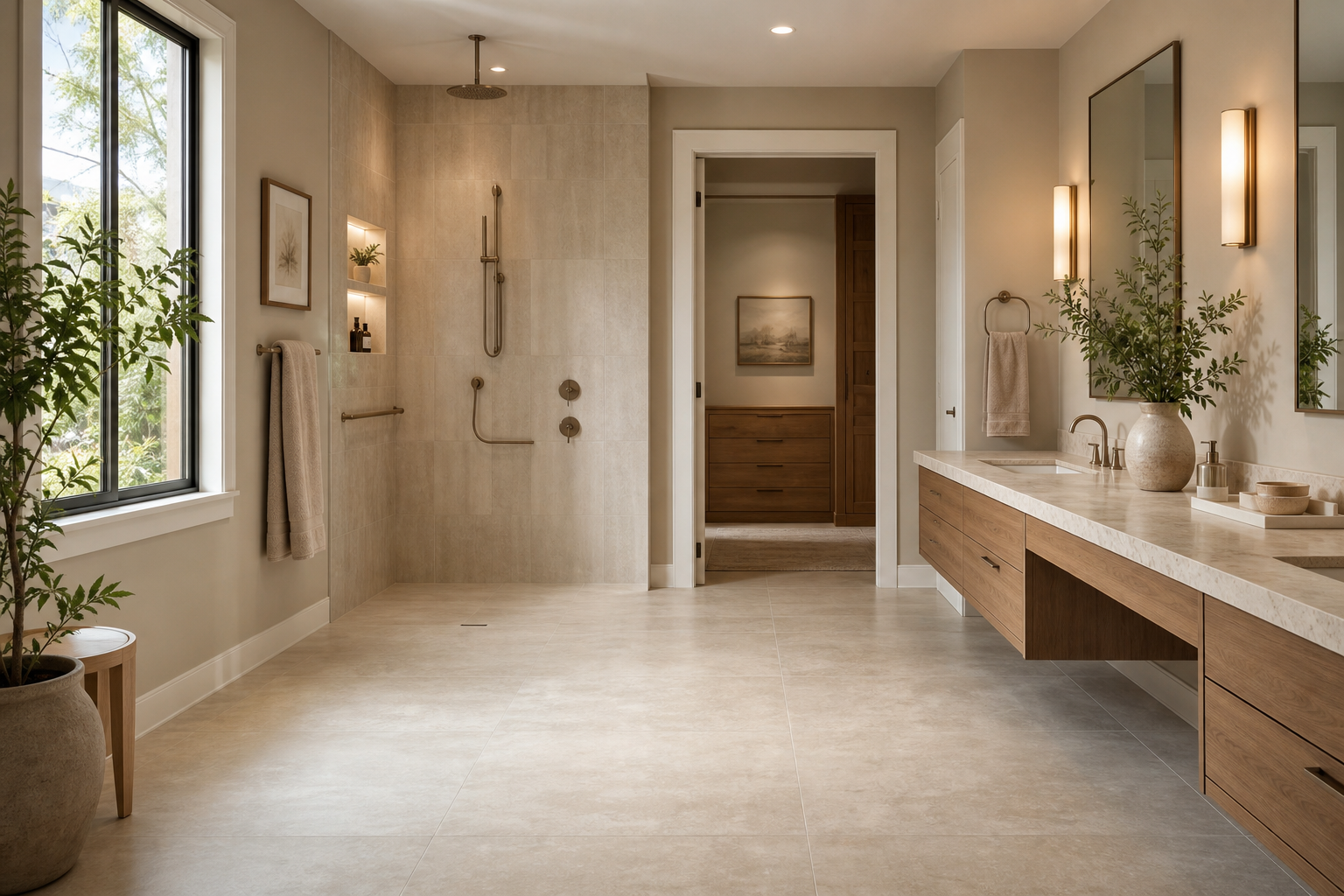
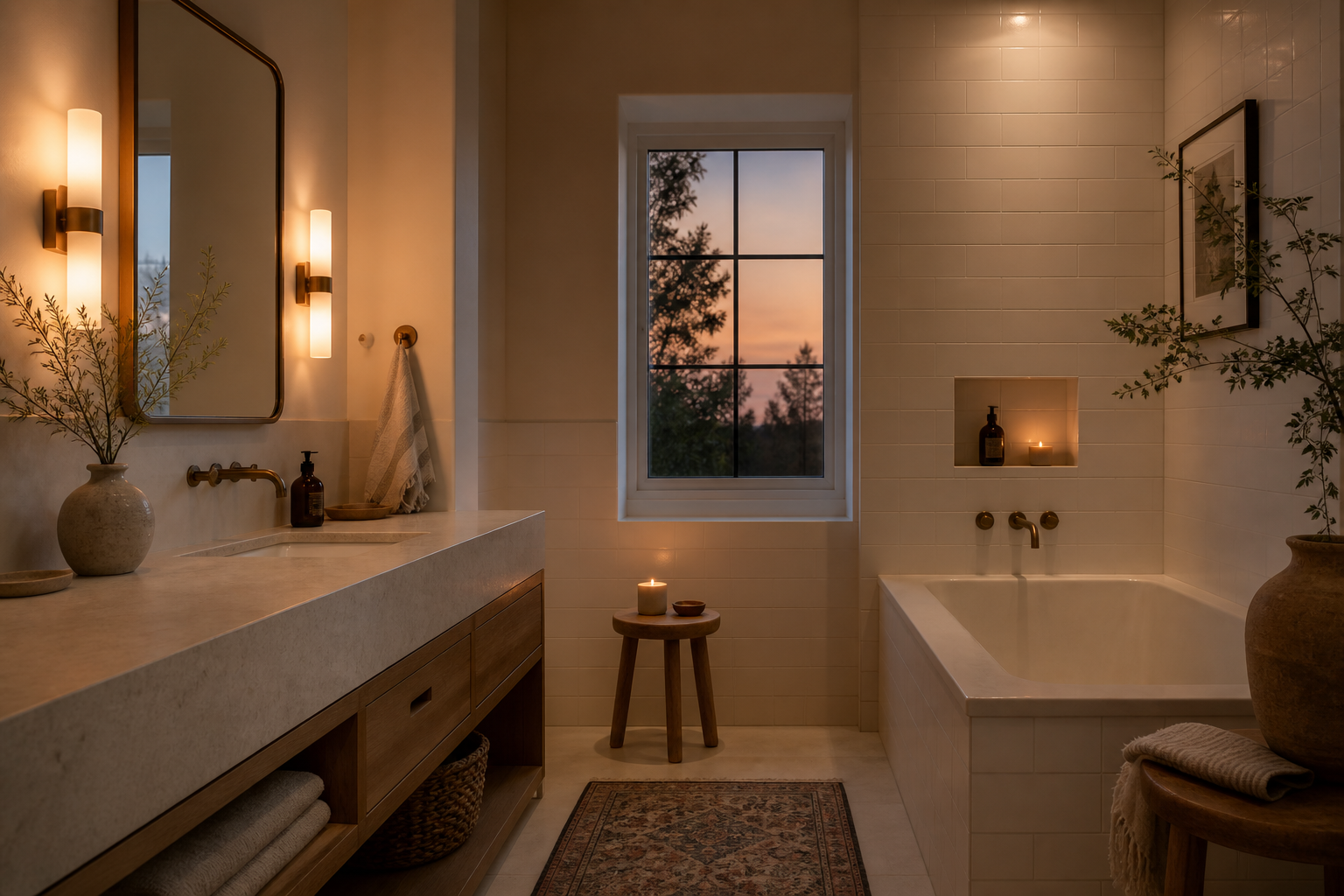
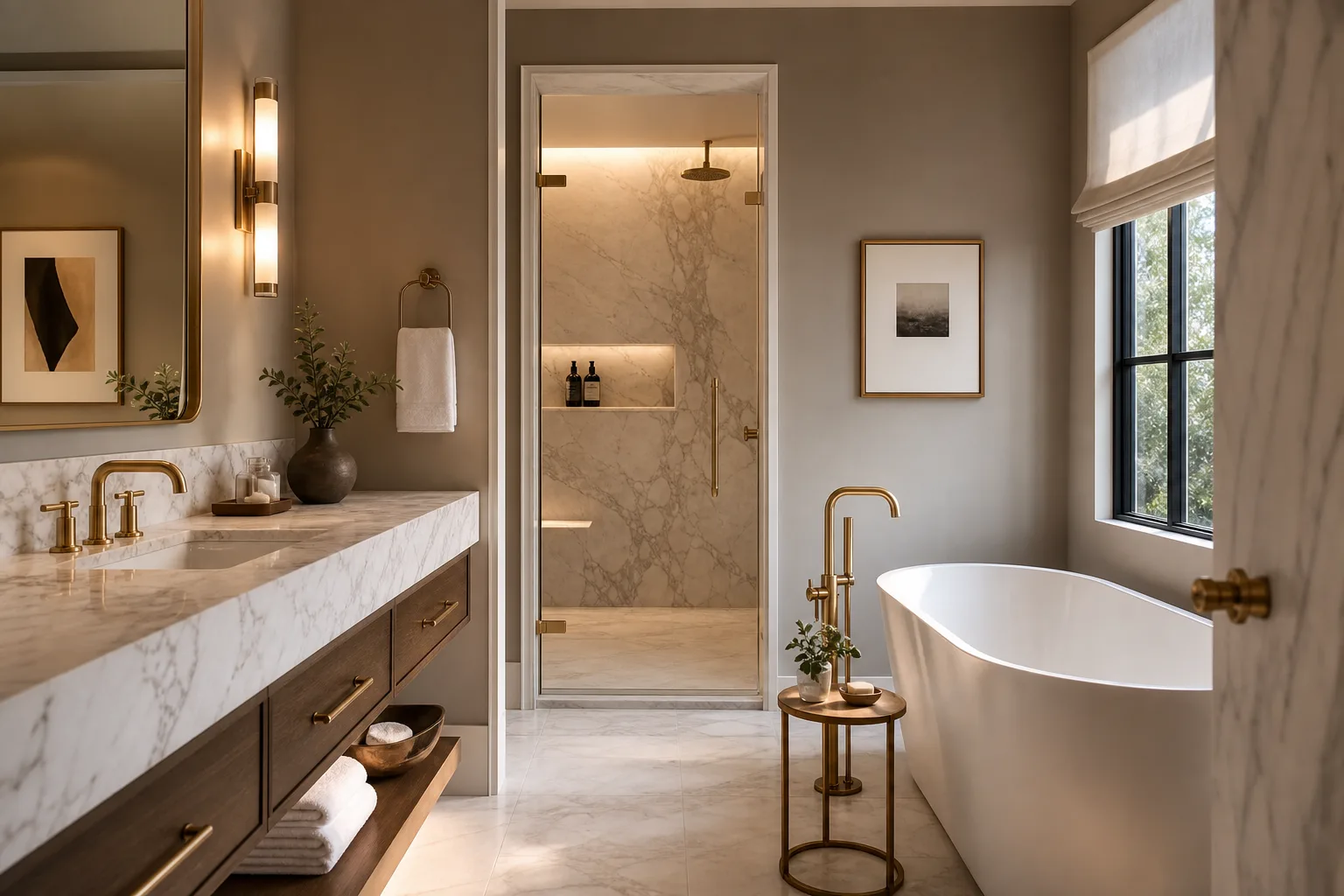
This matters because a large proportion of homeowners who choose marble or limestone for a bathroom vanity do so after seeing the material in a showroom, in a design magazine, or in a renovation that was staged and photographed within months of completion. They are choosing a stone that has not yet been etched. What they see is what it looks like before the chemistry begins. The stone they will live with is different, and how different depends entirely on the decisions made before installation.
The Chemistry Behind Etching
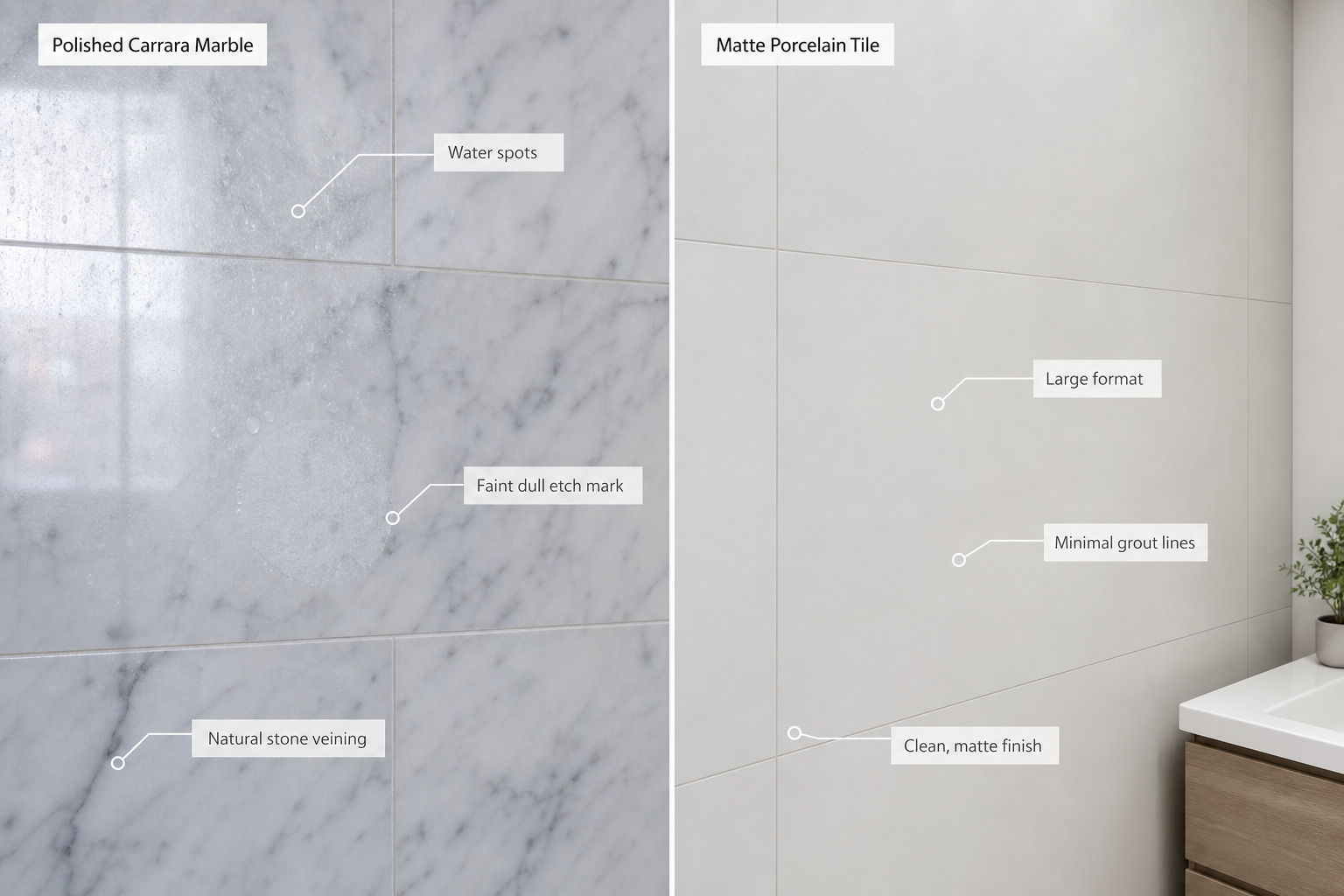
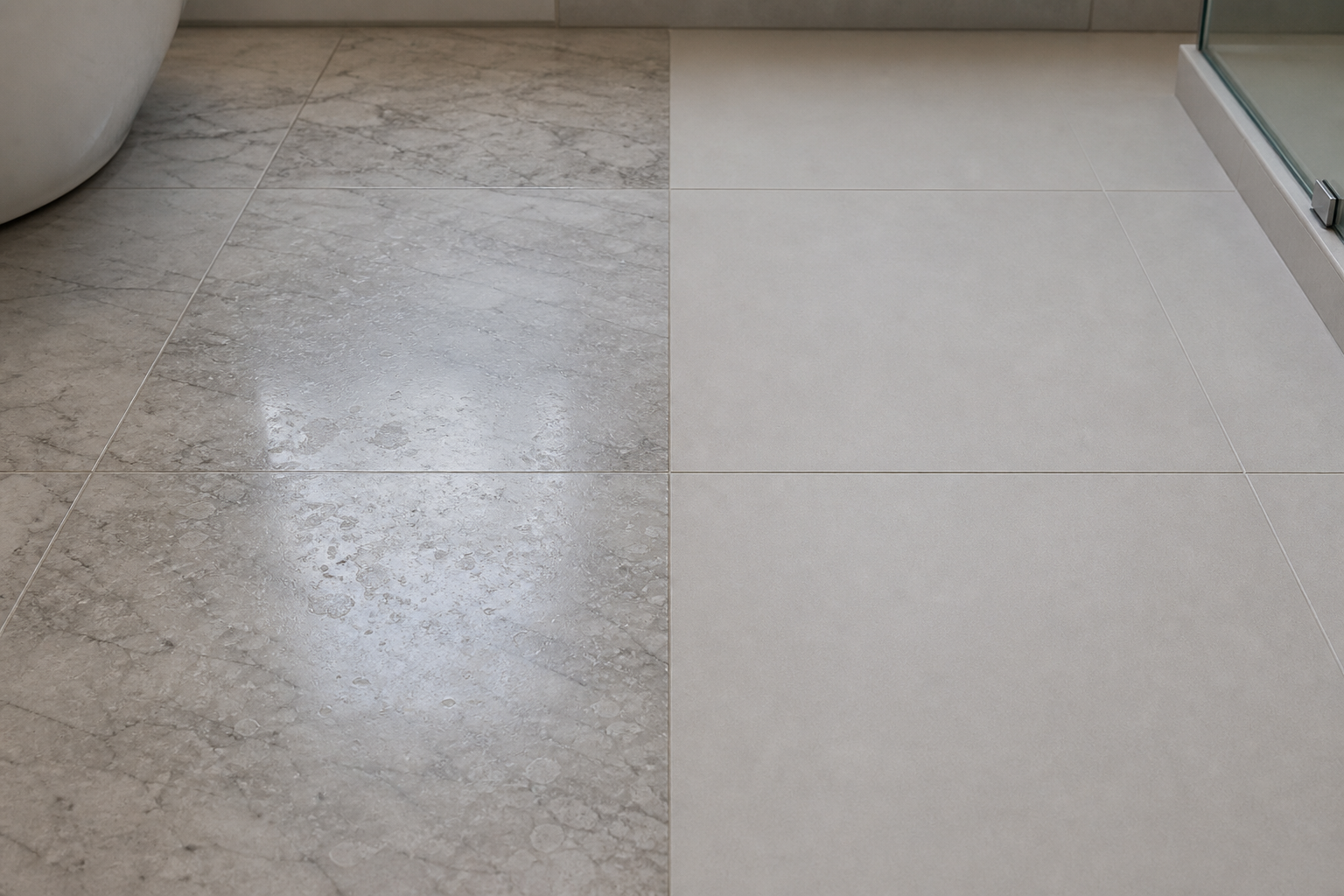
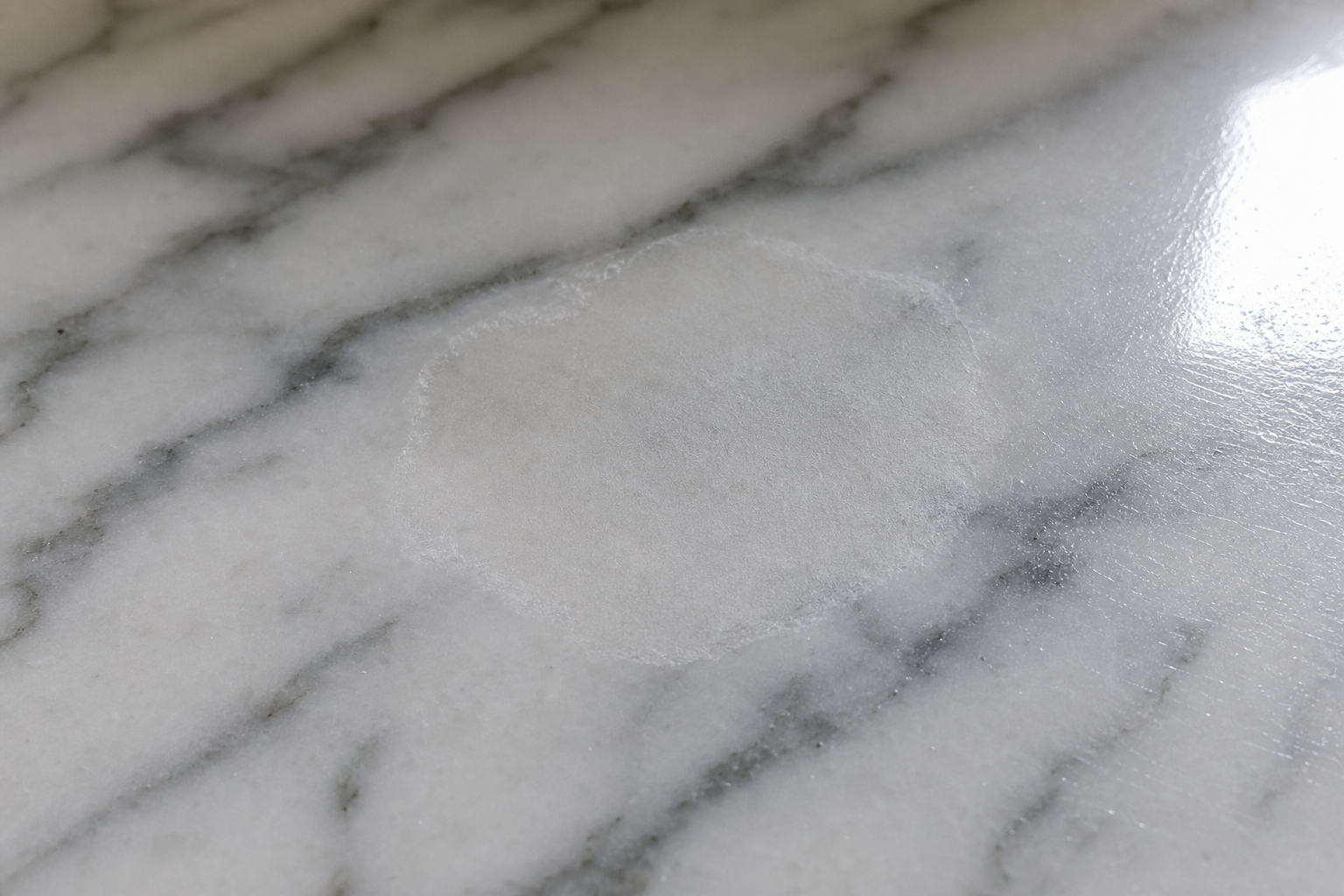
Marble, limestone, and travertine are calcite-based stones. Their primary mineral is calcium carbonate, a compound that reacts with acids at ordinary concentrations and room temperature. The reaction is not subtle. When an acid contacts a polished calcite surface, it dissolves the calcium carbonate at the surface, converting it to calcium salts that are carried away with the liquid. What remains is a zone where the polished surface has been chemically removed. The material beneath is the same stone, but the reflective polish is gone at that spot. In its place is a matte, slightly frosted zone that catches light differently from the surrounding polished surface.
The result is visible because polished stone is reflective. A polished marble counter reflects light uniformly across its surface. An etched zone reflects light diffusely from that spot. The difference is most obvious when viewed at a raking angle; under direct overhead light, mild etching can almost disappear. Under lighting that comes across the surface, even light etching is highly visible.
The acids responsible for etching in a bathroom are not industrial. Toothpaste typically has a pH between 5.5 and 7. Many hand soaps are formulated with citric acid or lactic acid as a component and have pH values in the 4 to 6 range. Shaving cream and gel products vary, but many are acidic. Perfume and cologne commonly contain alcohol and acidic fragrance compounds. Lemon juice has a pH of approximately 2 and will etch marble visibly within seconds. Most bathroom counter use does not involve lemon juice, but the same chemistry at lower concentration, repeated daily over months, produces the same result more gradually.
The stone does not need to be soaked. A drop of toothpaste foam that sits on a polished marble counter for a few minutes while someone brushes their teeth is acidic enough to produce a light etch mark. The mark is left after the foam is wiped away. This is not a defective stone. It is a stone behaving exactly as calcium carbonate behaves.
Why Sealers Cannot Stop Etching
A penetrating stone sealer works by filling the micro-pores of the stone surface with a material that resists water and oil penetration. This protects against staining. A liquid that cannot penetrate the stone cannot deposit colorants or contaminants in the stone body. Sealers do an excellent job of preventing stains from coffee, wine, oil, and similar liquids that would otherwise penetrate porous stone and leave permanent discoloration.
Etching is not staining. It is a surface dissolution, and it happens at the top surface of the stone rather than within the stone body. The acid that causes etching does not need to penetrate the stone at all. It reacts with the calcium carbonate at the very surface, the polished layer, and dissolves it. A sealer fills the pores beneath that surface. It does not cover the surface or change the chemistry of the calcium carbonate at the top.
In practical terms, this means that a perfectly sealed marble counter is just as susceptible to etching as an unsealed one. The sealer protects against staining. It does not protect against the acid-calcium carbonate reaction at the polish surface. These are two different mechanisms affecting two different zones of the stone, and a product designed to address one of them does nothing for the other.
This is the most common misunderstanding about marble maintenance, and it is reinforced by the fact that sealer products are often sold and described as stone protection without distinguishing between stain protection and etch protection. The distinction is not complicated, but it requires explaining the chemistry. Most retail material is not written to that level.
The Difference Between Polished and Honed Finishes
Honed marble is the same calcium carbonate stone that polished marble is, with the same reactivity to acid. An acid dropped on a honed marble surface still reacts with the calcium carbonate. The difference is in the visibility of the result.
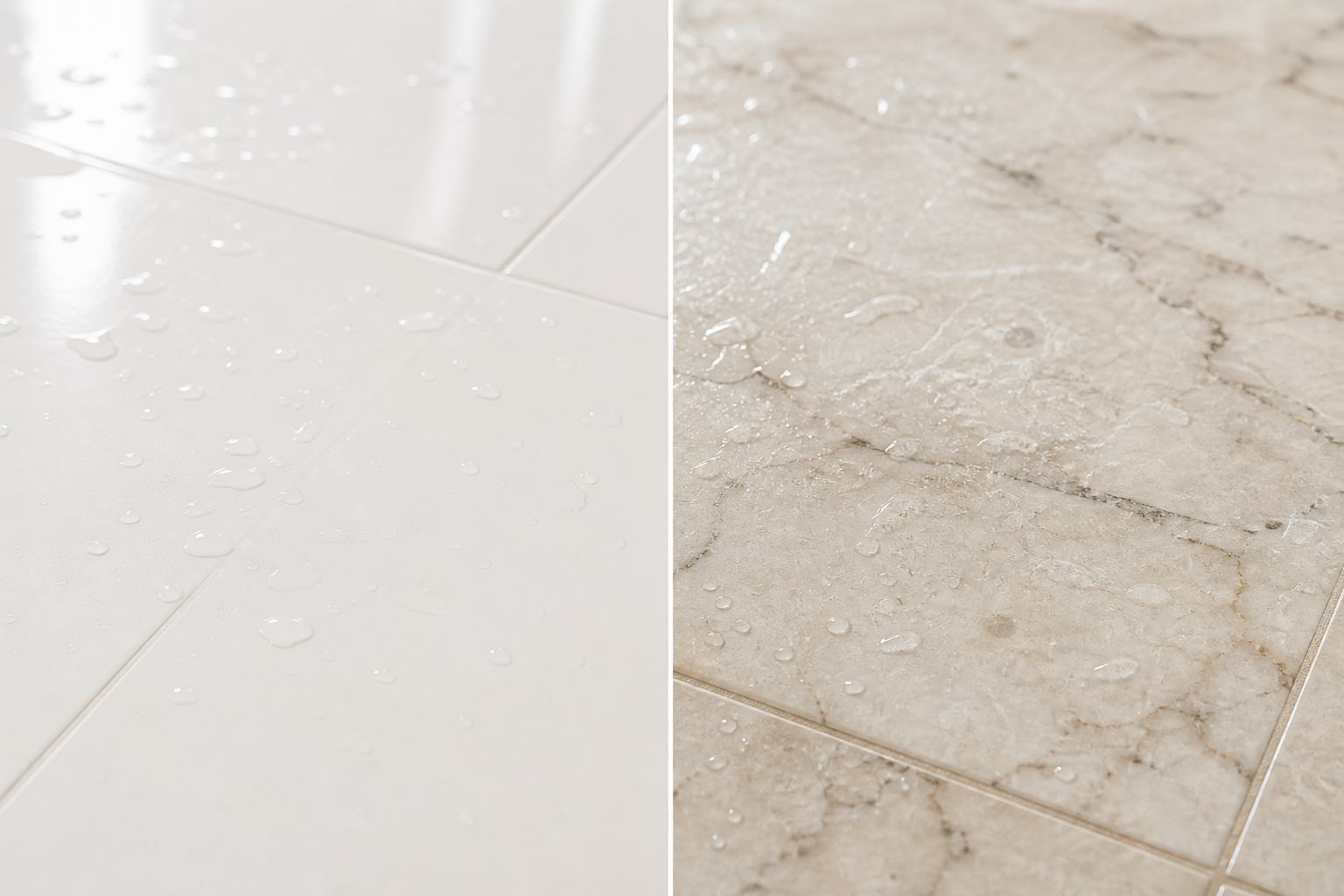
A polished surface is reflective. The polish is achieved by progressively finer abrasion until the surface reaches optical smoothness. A polished marble counter reflects light the way a mirror does: uniformly and predictably. When acid dissolves a zone of that surface, the resulting matte area is highly visible against the reflective field. The contrast between polished and etched is what makes etching so striking on polished marble.
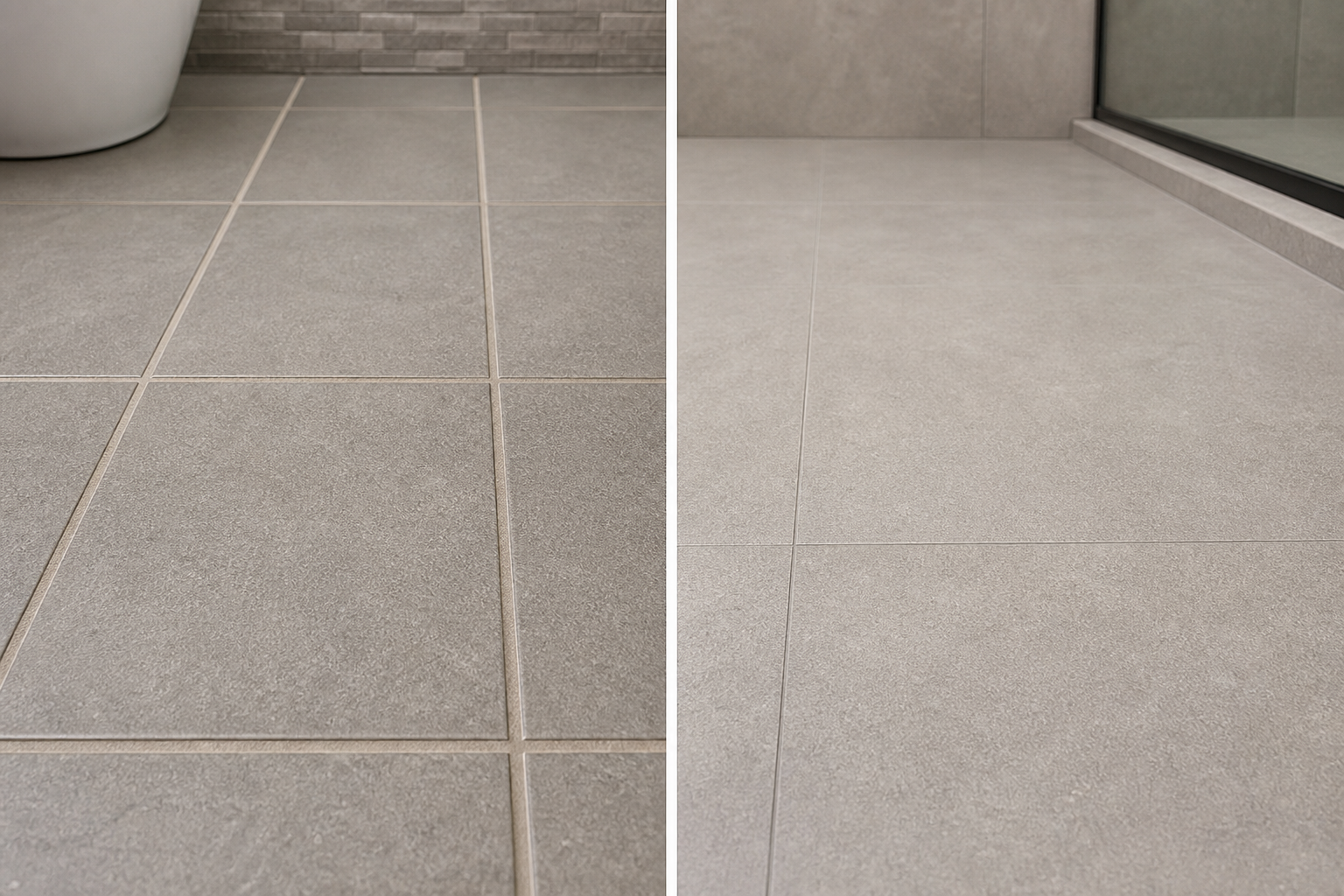
A honed surface is matte to start. Honing brings the stone to a smooth, flat finish without the final polishing stages that produce reflectivity. When acid reacts with a honed marble surface, the result is a slightly different matte texture in the affected zone. The contrast between honed and etched-honed is much lower than the contrast between polished and etched-polished. Under most lighting conditions, light etching on a honed marble surface is either invisible or appears as a slightly lighter zone that is easy to miss.
This is not a complete solution. Heavy or repeated etching on honed marble is still visible. And a honed finish has its own maintenance characteristics: it shows oils and fingerprints more readily than polished marble because the matte surface does not reflect light in a way that obscures them. But for a vanity counter that will see daily use with personal care products, the choice between polished and honed is significant, and the honed option forgives the etching chemistry substantially.
The Natural Stone Institute notes this distinction in its care and maintenance guidance, specifically recommending that homeowners who want marble in high-use bathroom applications consider honed finishes for reduced etch visibility, and that polished finishes be reserved for applications where daily acid contact can be managed or where aesthetic preference justifies the maintenance relationship.
Stones That Do Not Etch
Not all natural stone is calcite-based. Two categories of natural stone are commonly used in bathrooms and are essentially non-reactive to ordinary household acids: quartzite and granite.
Quartzite is a metamorphic stone composed primarily of quartz, a silicate mineral. Silicates do not react with acids at the concentrations present in bathroom personal care products. A quartzite counter can be exposed to the full range of bathroom surface chemistry without etching. Quartzite does have porosity and benefits from sealing to prevent staining, but the absence of acid reactivity means the etch mechanism does not apply.
Granite is an igneous rock composed primarily of quartz, feldspar, and mica. Feldspar is a silicate and quartz is a silicate; neither reacts with dilute acids. Granite counters in bathroom applications are effectively non-reactive to the chemistry that etches marble. Like quartzite, granite benefits from sealing for stain resistance but does not require management of acid contact.
The practical distinction matters for selection. A homeowner who wants natural stone movement and veining but is not prepared to manage etching has options. Quartzite, particularly varieties like Super White, Sea Pearl, and similar metamorphic stones with veining patterns, offers the visual character of marble without the acid reactivity. The confusion in the market is that many quartzite stones are sold by names that sound like marble and displayed alongside marble, and the visual similarity at a distance can make it difficult for a buyer to distinguish them without checking the mineralogy.
Engineered quartz is a fourth option: a man-made surface with a high quartz content bonded with polymer resin. Engineered quartz is acid-resistant, non-porous, does not require sealing, and does not etch. Its maintenance profile is the simplest of all the countertop categories. It does not have the natural variation of stone and has a different light character that some find less interesting. For applications where maintenance simplicity is the priority, it is worth including in the comparison.
The Repair Option and Its Limits
Light etching on polished marble can be improved by re-honing and re-polishing. This is the reverse of the finishing process: the stone is abraded to below the etch level and then polished back to a uniform reflective surface. The result is a restored surface that looks the way it did before the etching developed.
The limitation of this approach is that re-honing removes stone. The counter becomes fractionally thinner with each restoration. For a thick slab this is not a meaningful constraint. For a thin surface application or a laminated edge, repeated restoration may eventually affect the profile. More practically, professional stone restoration costs money and requires scheduling a contractor and removing everything from the counter surface. It is not a casual task.
The frequency of restoration depends on use patterns and tolerance for visible etching. A marble vanity top in regular use by a household that does not manage acid contact might develop visible etching within three to six months. A household that wipes the counter immediately after any product contact might go years without visible development. The range is wide, and the appropriate expectation depends on the specific household rather than on an average.
When a client wants marble in a bathroom vanity, we explain the etching mechanism before showing any material options. Most clients proceed with that knowledge. Some choose quartzite or a honed finish instead. Either way, the decision is informed.