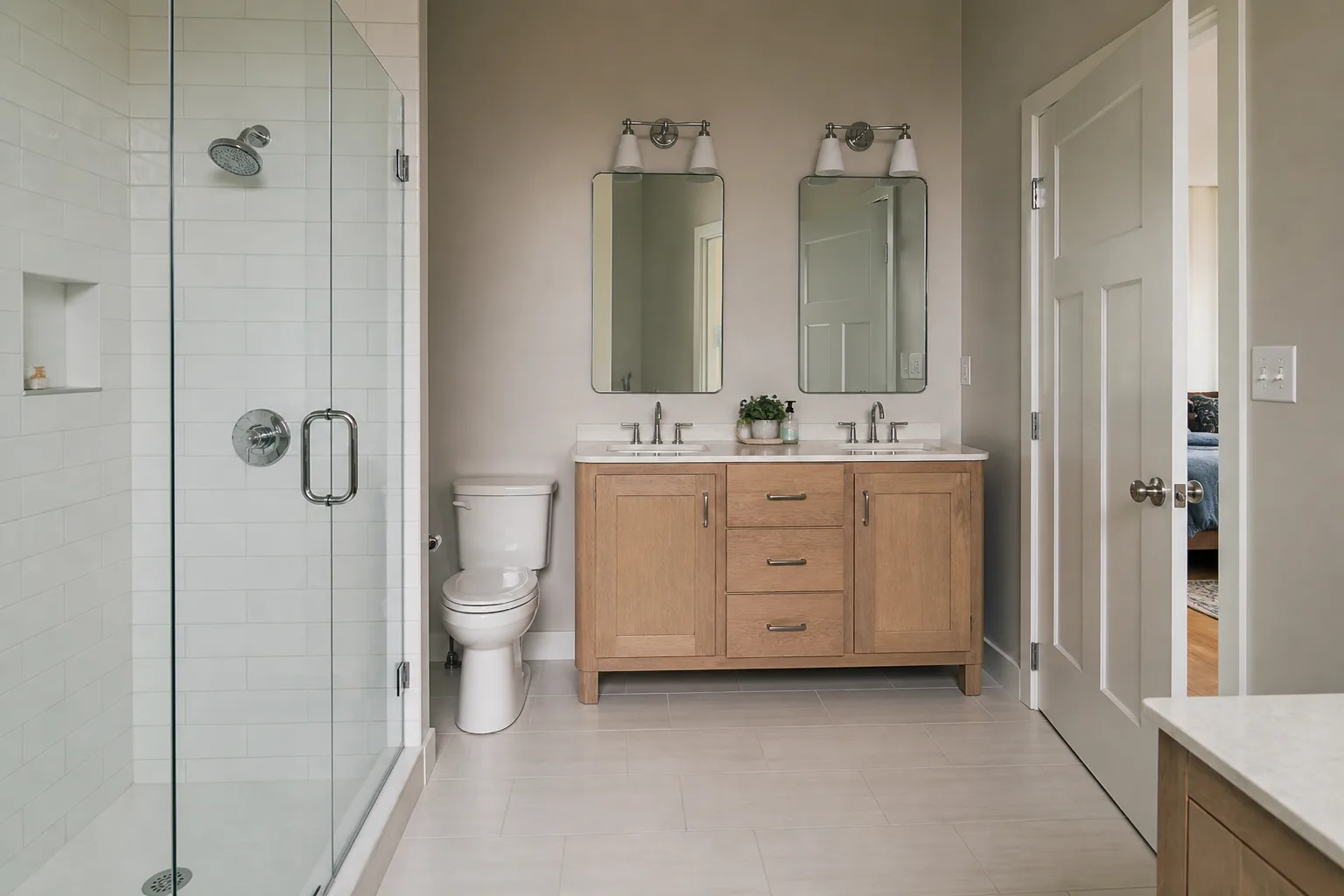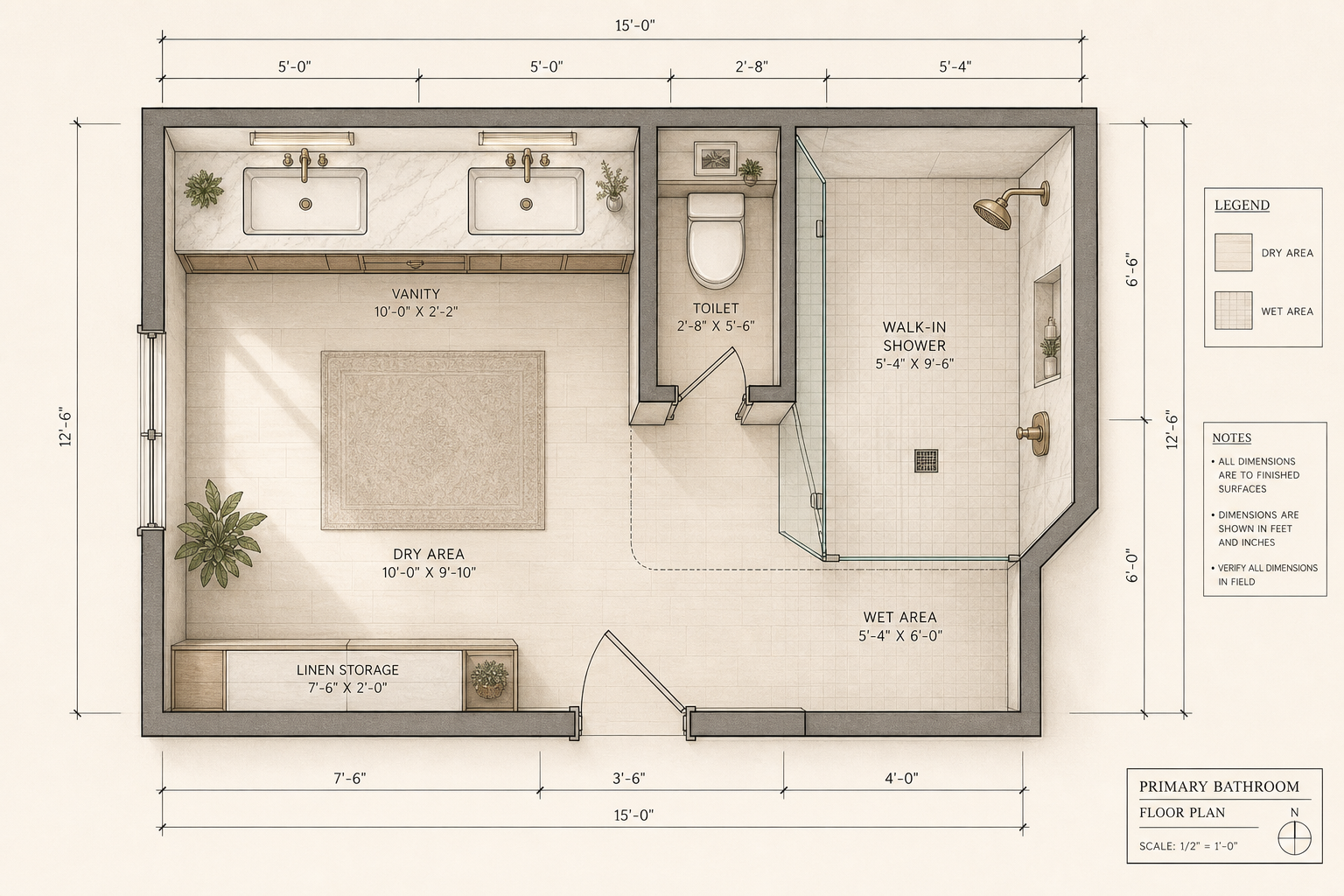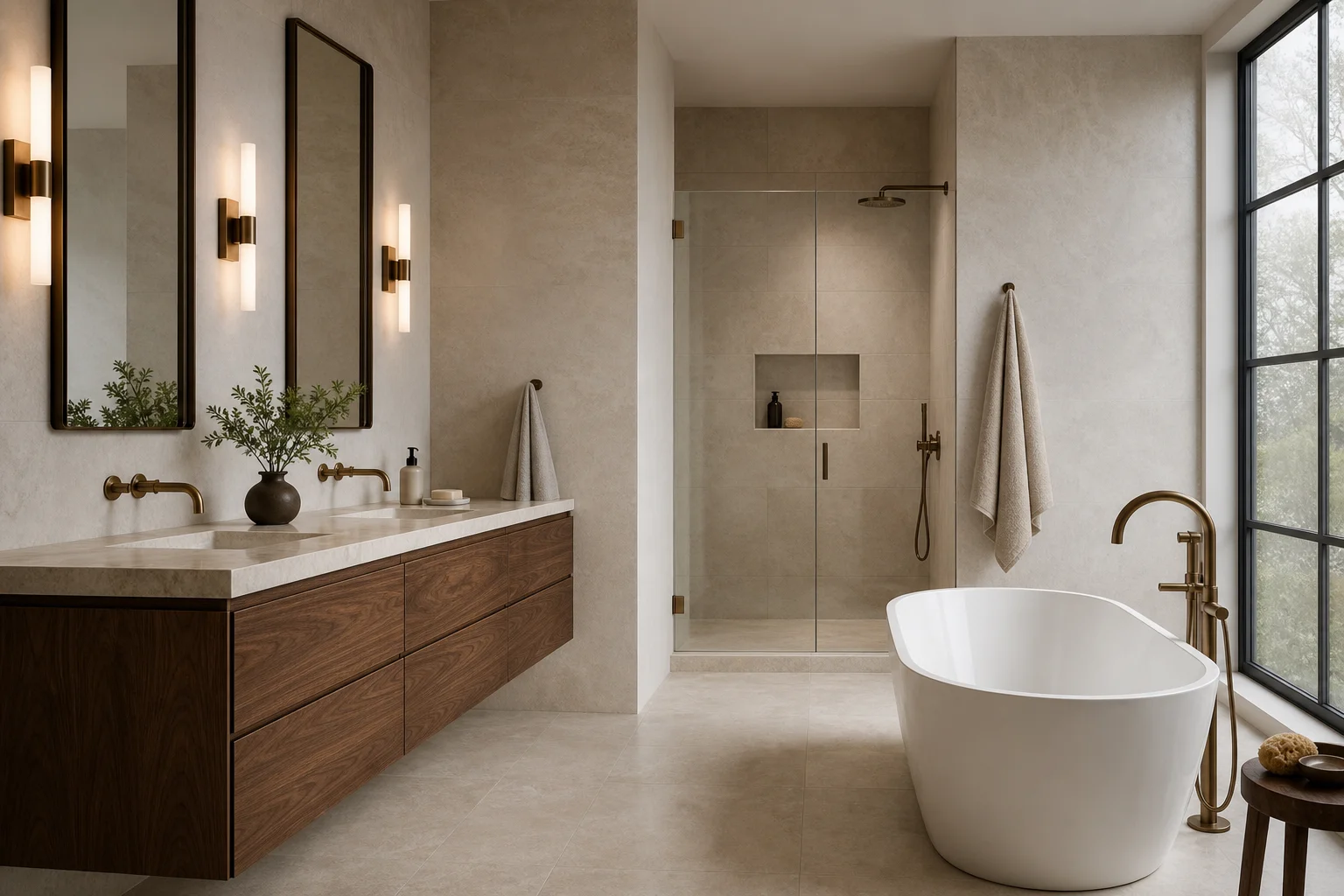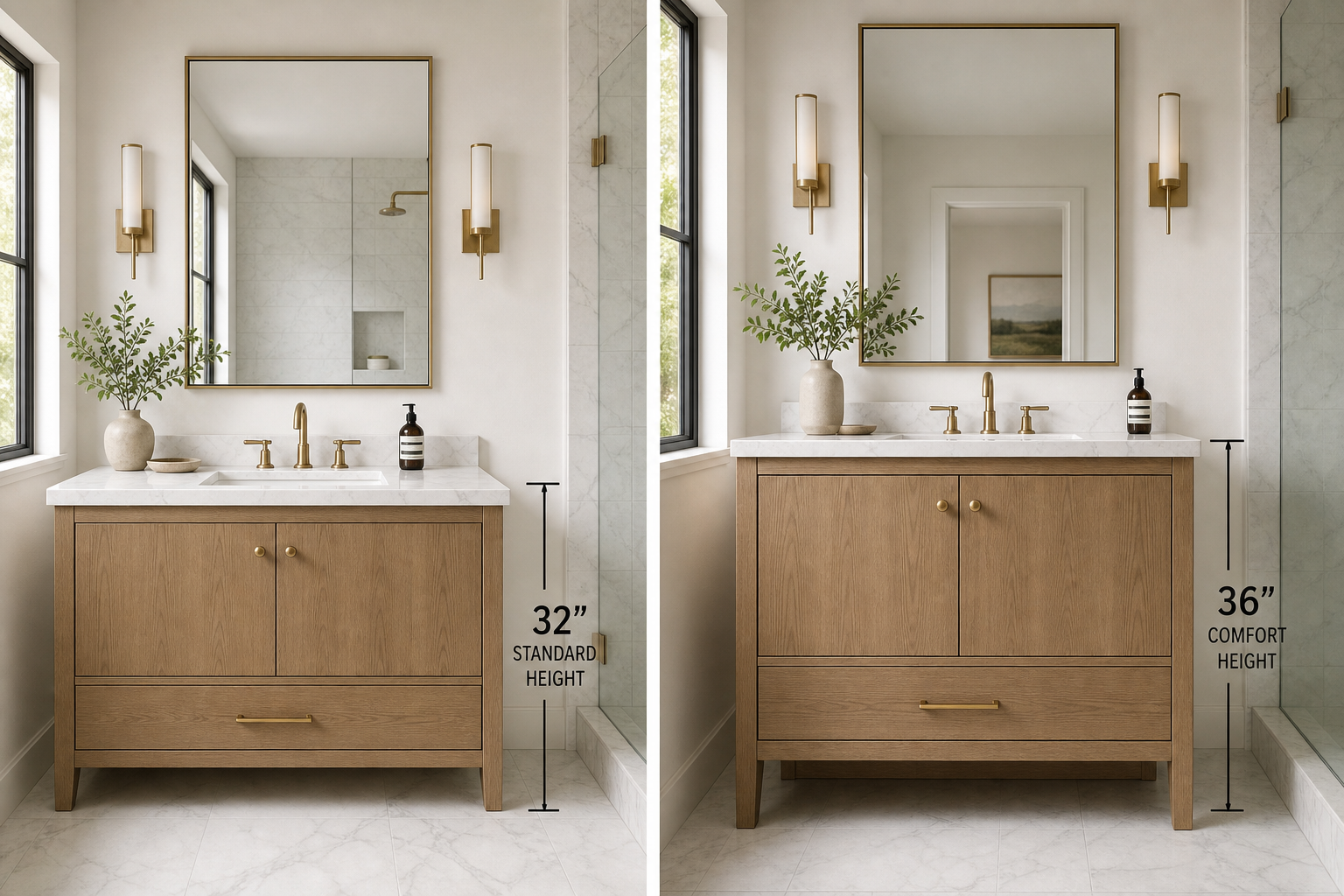
The standard 32-inch vanity height was set when the average American was shorter. For most adults today, particularly anyone over 5'8", it requires a forward hunch to wash hands or face that accumulates into real discomfort over years of daily use. A renovation is the only chance to fix it.
You notice it gradually. At first the sink feels a little low. You lean in slightly to rinse your face. Over months the lean becomes a habit. Your lower back tightens after morning routines. Your elbows wing out because the counter is too close to your knees when you stand close enough to use the faucet. You assume the discomfort is age or posture or stress. Often it is a counter height that was standardized for a different population, installed because that is what the cabinet catalog defaults to, and left unchanged because nobody thinks to measure the person against the fixture before ordering.
Where 32 Inches Came From
The 32-inch vanity height is not arbitrary, but it is old.
Bathroom vanities in mid-twentieth-century residential construction were sized for households where children and adults shared a single bath. A lower counter allowed shorter users to reach the faucet without a step stool. Cabinet manufacturers standardized around that dimension because it fit the majority of stock floor plans and kept inventory simple. The height became convention. Convention became code-adjacent recommendation. Recommendation became the default that showroom displays reinforce every day.
Kitchen counters moved in the opposite direction. The standard kitchen countertop height settled at 36 inches because kitchen work is performed standing for extended periods and because adults, not children, are the primary users. That height aligns more closely with elbow rest position for food preparation. Bathroom vanities remained at 32 inches because the bathroom was treated as a secondary space where ergonomics mattered less and where child accessibility still influenced the specification.
The National Kitchen and Bath Association now recommends a lavatory height range of 32 to 43 inches to fit the user. That range acknowledges what the fixed 32-inch standard never did: people vary. A household of adults over six feet tall has different requirements than a household with young children. A primary bathroom used mainly by one or two adults can be specified differently than a hall bath that serves every age in the family.
The NKBA guideline is not a mandate for 32 inches. It is permission to specify higher. Most stock vanity lines still default to the lower end of that range because that is what fits the most floor plans at the lowest cost.
What the Wrong Height Does to Your Body
Ergonomics in a bathroom is not luxury. It is repetition.
A person who washes their face twice daily performs that motion roughly 730 times per year. Each motion involves forward flexion at the hips and lumbar spine if the counter is too low. The flexion is small, perhaps two or three inches of additional bend compared to a properly placed surface. But the load is sustained for ten to twenty seconds per use, often with the arms extended and the head lowered. Physical therapists recognize this pattern in patients who report chronic lower back and neck tension with no obvious injury event. The injury is cumulative. The fixture is the constant.
Elbow position tells you quickly whether a vanity height is wrong. When the counter is too low, the user must abduct the elbows outward to reach the basin center. That winged-elbow posture strains the shoulders and encourages a rounded upper back. When the counter is too high, the user elevates the shoulders to reach the faucet, compressing the cervical spine. The correct height allows the forearms to approach horizontal with elbows near the body, wrists neutral, and minimal spinal flexion.
The NKBA access standard, referencing ANSI A117.1, recommends that the front of the lavatory sink be no more than 34 inches above the floor measured to the higher of the fixture or counter surface. That 34-inch ceiling for accessible design is often misread as the target height for everyone. It is a maximum for wheelchair approach clearance, not an ideal for standing users. Most comfortable standing heights for adults fall between 34 and 38 inches depending on user height, with 36 inches serving as the most common comfort-height specification in contemporary residential work.
Why 36 Inches Became the Quiet Standard
Comfort-height vanities at 36 inches match kitchen counter height for good reason.
The human body does not change dimensions between rooms. A person who stands at a 36-inch kitchen counter without strain will stand at the same height in a bathroom without strain. The 4-inch difference from a 32-inch vanity is small on a tape measure and large in daily use. It reduces forward lean. It brings the mirror relationship closer to eye level for taller users. It aligns the sink rim with the natural drop of the hands from the shoulders.
Trade literature now describes 36 inches as comfort height with increasing frequency. Manufacturers offer more stock lines at 36 inches than they did a decade ago, particularly in semi-custom and custom cabinet categories. The shift reflects demand from empty-nest homeowners and primary-bath renovations where child accessibility is no longer the governing constraint.
Vessel sinks complicate the calculation. A vessel that sits on top of the counter adds three to five inches of effective rim height. A 36-inch counter with a tall vessel may finish at 40 inches or higher, which can be correct for a tall user and incorrect for a shorter one. Undermount and integrated sinks keep the effective height closer to the cabinet specification. The vanity height conversation must include sink type, not just cabinet box dimension.
When 32 Inches Is Still the Right Answer
Comfort height is not universal. It is household-specific.
A bathroom shared by children who brush teeth without a step stool may genuinely need a lower counter. A secondary hall bath used by guests of all ages may benefit from a middle ground at 34 inches. A household with one tall adult and one shorter adult may split the difference with a 34-inch vanity in a shared space and a 36-inch or 38-inch vanity in a primary ensuite where one user dominates.
Wall-mounted vanities add adjustability that floor-mounted cabinets cannot offer. A wall-hung unit can be set at any height the carrier and plumbing allow, which makes per-user specification practical in a way that stock floor cabinets do not. The trade-off is cost and the requirement for solid blocking in the wall at the mounting height.
ADA-compliant and aging-in-place bathrooms introduce additional constraints. Grab bar locations, clear floor space, and forward reach ranges interact with vanity height in ways that a standard remodel may not consider. A 34-inch maximum for the lavatory front edge serves wheelchair users. A comfort-height 36-inch vanity in the same room may conflict with those requirements unless the layout separates accessible fixtures from standard fixtures.
The point is not that 36 inches wins every argument. The point is that 32 inches wins by default without an argument ever taking place.
What a Renovation Changes That Stock Replacements Cannot
Replacing a vanity cabinet with another stock cabinet at the same height reproduces the problem in a new finish.
A renovation that opens the wall, relocates plumbing, and resets the floor is the moment when vanity height becomes a variable again. Once the rough plumbing stub is set and the cabinet is ordered, the height is fixed for the life of that installation. Moving it later requires re-piping the supply and drain, patching wall finishes, and often replacing the mirror and lighting that were sized for the original position.
The measurement that matters is not the cabinet spec sheet. It is the distance from the finished floor to the rim of the sink at the point where the user stands. That measurement should be taken with the intended user standing in position, arms relaxed, and the proposed sink type mocked up if possible. Some designers use a cardboard template at the proposed height and ask the user to simulate washing their face. The test takes five minutes. The data it produces is more reliable than any catalog default.
Mirror height follows vanity height. A mirror centered for a 32-inch counter will sit too low relative to the face of a user at a 36-inch counter. Light fixtures flanking the mirror were positioned for a specific reflection geometry. Changing vanity height without adjusting mirror and lighting produces a room that is ergonomically improved at the sink and visually wrong at the glass.
Toe kick and cabinet construction add hidden height variables. A floor-mounted vanity with a four-inch toe kick and a one-and-a-half-inch counter thickness places the sink rim roughly five and a half inches above the nominal cabinet height. A furniture-style vanity with no toe kick and legs that raise the box changes the relationship between the spec sheet number and the user's body. Floating vanities can be set at any mounting height the wall carrier supports, which makes them the most flexible option for households where two users differ by six inches or more in height. The trade-off is that wall-mounted units require blocking, often cost more, and limit drawer depth compared to floor cabinets.
The opinion worth holding in one place: defaulting to 32 inches because the catalog does is not neutral. It is a choice that favors a shorter user profile than most primary bathrooms serve today. Specifying height against the people in the room is not a premium upgrade. It is the baseline for a bathroom that will be used ten years from now by the same bodies that use it on day one.
We ask the height of every adult who uses the bathroom before we specify vanity height. Our default for primary baths has moved to 36 inches unless the household requests otherwise.