Liquid water and water vapor are physically different things that move through building assemblies by different mechanisms and damage different materials. A shower membrane that stops liquid water does not necessarily stop water vapor. Understanding the distinction determines whether the wall behind the tile stays dry or accumulates moisture over years of daily showering.
Most homeowners who have renovated a bathroom have heard the word "waterproofing" used as if it covers everything. It does not. Waterproofing, in the sense most contractors mean it, describes a material's ability to stop liquid water from passing through under typical hydrostatic conditions. That is a real and important property. It is also only half of the moisture problem in a shower.
The other half is vapor. And vapor behaves by completely different physics.
What Water Vapor Actually Is
Liquid water is a collection of molecules bonded loosely to each other and constrained by gravity and pressure. It flows downhill, fills low spots, and obeys the visible world of plumbing and drainage.
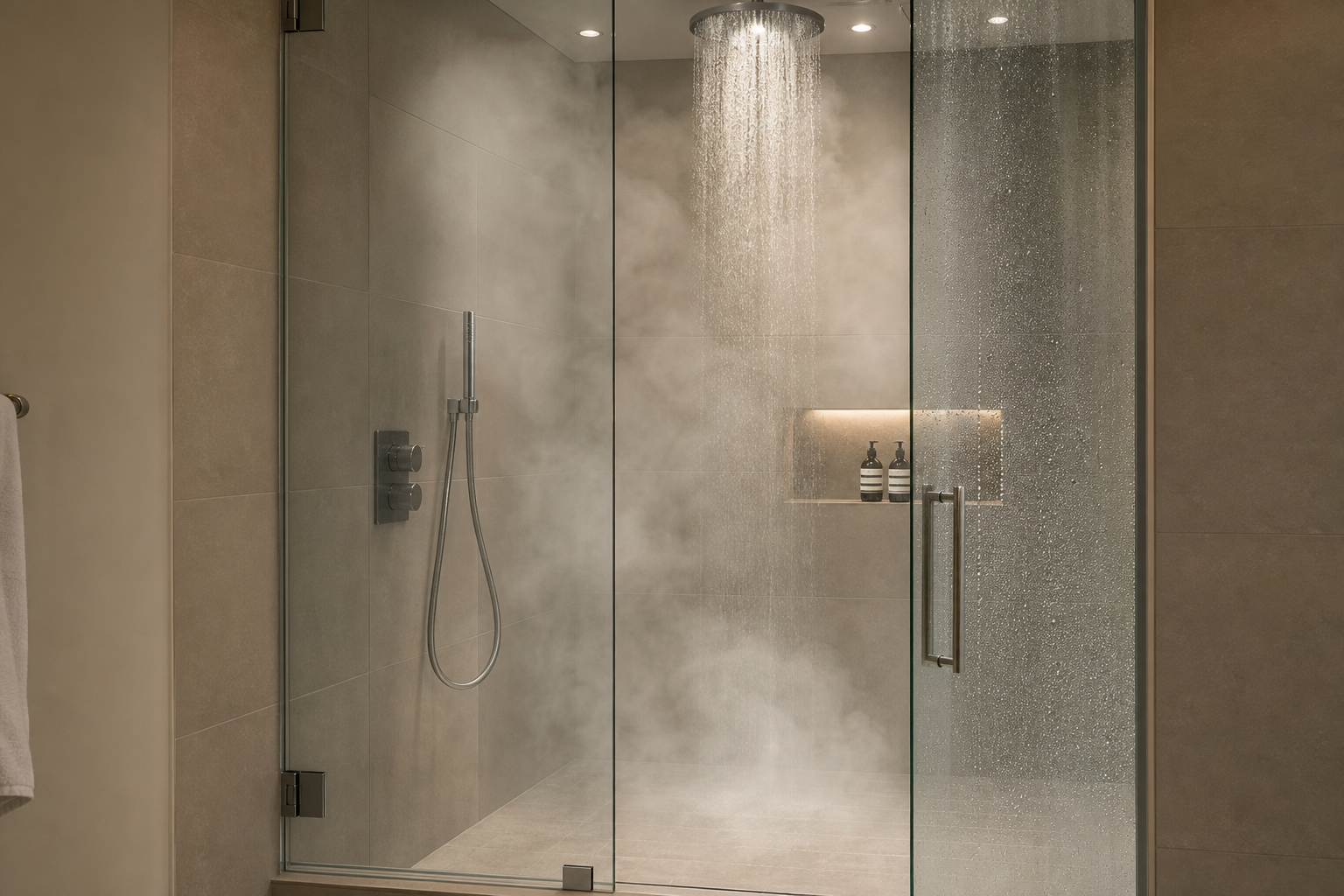
Water vapor is those same molecules in a gaseous state, dispersed individually through air. In a hot shower, water evaporates continuously from every warm wet surface into the surrounding air. As vapor concentration builds, the air inside the enclosure approaches saturation. At saturation, the air can hold no more water molecules in suspension, and any further evaporation produces condensation on whatever cool surfaces are available.
That saturation dynamic is the beginning of the problem. But the deeper problem is what happens before the air saturates, and after.
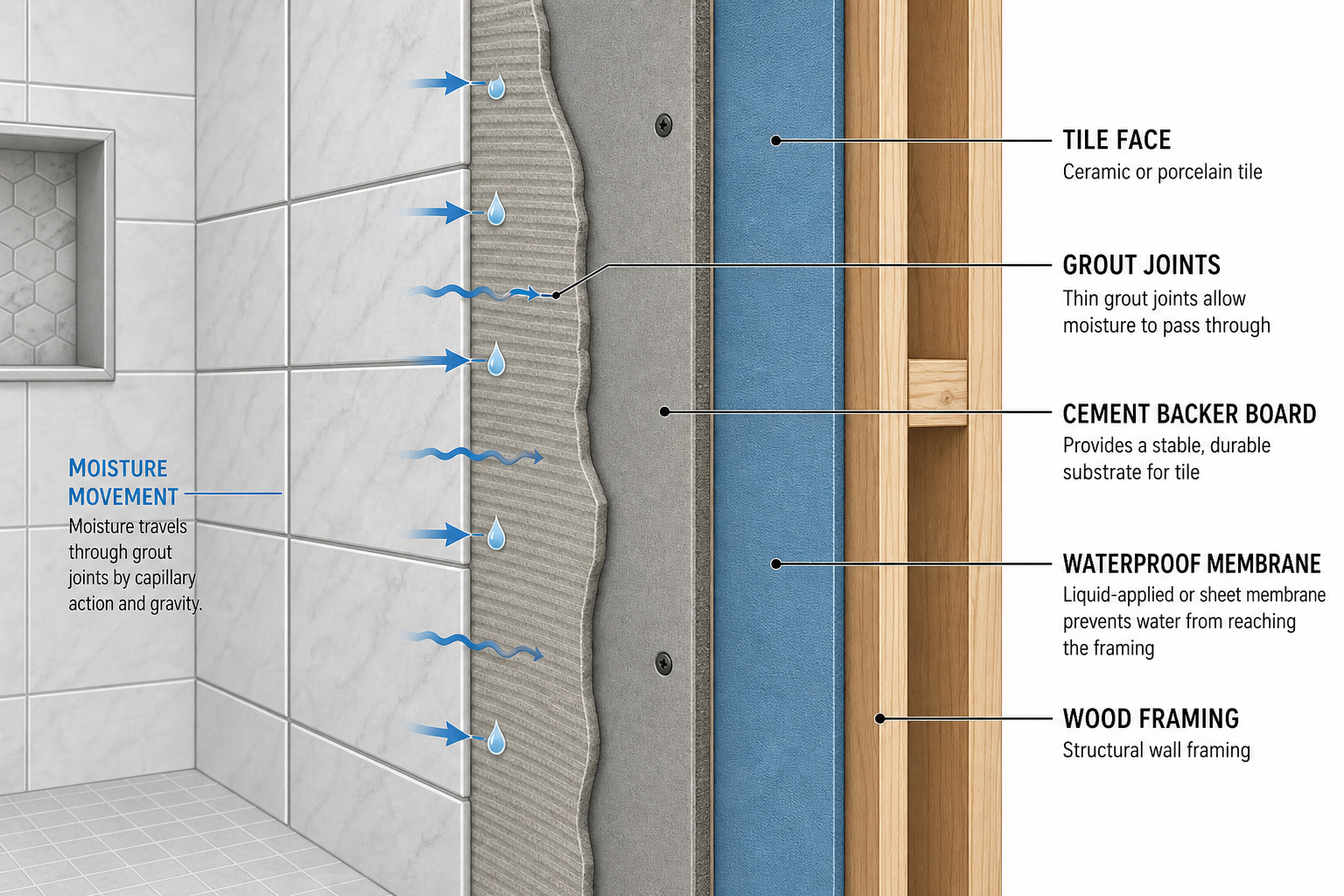
When warm, vapor-saturated air inside a shower enclosure contacts the cooler surfaces of a wall or ceiling assembly, vapor does not simply condense at the surface and run off. It moves. It follows a pressure gradient from the high-vapor-pressure zone inside the shower to the lower-vapor-pressure zone inside the wall cavity. The mechanism is diffusion: vapor molecules migrate individually through porous materials, passing through the bulk of a material rather than finding cracks or gaps. The tile does not stop this. The grout does not stop this. Even most waterproofing membranes do not stop this.
This movement is measured, tested, and described in building science using a unit called the perm. A material's perm rating (formally, its water vapor permeance) describes how readily water vapor passes through it under standardized test conditions. A perm rating of 1.0 means one grain of water vapor passes per hour per square foot per inch of mercury vapor pressure differential. Lower numbers mean better resistance to vapor transmission.
Why Permeance Is Not The Same As Waterproofing
A material can have a very low water vapor permeance rating and terrible resistance to liquid water, or vice versa. These are independent properties. They are tested by different methods and they reflect different physical phenomena.
The standard test for water vapor permeance is ASTM E96, which applies a measured vapor pressure differential across a sample and tracks weight change over time. A separate family of tests measures resistance to liquid water penetration under hydrostatic pressure. A material can pass the liquid-water tests with high marks and still have a perm rating that allows significant vapor transmission. Many commonly specified shower membranes occupy exactly this position.
The Tile Council of North America, in its technical document on membranes in steam showers, sets a clear threshold: membranes used in steam shower applications must have a water vapor permeance of 0.5 perms or less, tested per ASTM E96 Procedure E. That threshold was established because at vapor transmission rates above that level, a heavily used steam shower can deliver moisture to wall framing faster than the assembly can dry during off-hours. The moisture accumulates over months and years, invisibly, until it produces rot, mold, or structural damage.
The 0.5-perm threshold is specifically for steam showers because steam showers concentrate the vapor load. But the principle applies to any shower used frequently enough or long enough to produce sustained vapor pressure differentials across the wall assembly. A primary bath with two users taking daily twenty-minute hot showers produces a consistent vapor load that a membrane with a perm rating of 2.0 or 3.0 will not fully intercept.
This is not a fringe concern. It is the documented mechanism behind a significant fraction of shower failures that present with no visible waterproofing defect. The membrane was continuous. The tile was tight. The grout was intact. And moisture still found its way into the framing because the membrane stopped liquid water and not vapor.
How Vapor Accumulates Damage In A Wall Assembly
To understand why vapor accumulation matters, it helps to trace the moisture pathway in a typical shower wall that is protected against liquid water but not against vapor.
The interior face of the wall is tiled. Behind the tile is a bonding mortar. Behind the mortar is a waterproofing membrane installed over cement backer board or a foam substrate. The membrane reliably stops liquid water. But the membrane's perm rating is 2.5, which means it allows measurable vapor transmission.
During a shower, vapor pressure inside the enclosure rises significantly above the vapor pressure inside the wall cavity. Vapor diffuses through the membrane and enters the cavity. Inside the cavity, it encounters cooler surfaces: the back face of the backer board, the face of the wall framing, the cavity air. If any of those surfaces are at or below the dew point temperature, vapor condenses into liquid water on contact.
The dew point is the temperature at which a given air-vapor mixture will begin to condense. On a cool morning with a 40-degree wall cavity behind a hot shower, the interior surfaces of the cavity can easily be below the dew point of the vapor-laden air diffusing in from the shower side. Condensation forms on the back of the substrate, on the framing faces, and in the cavity insulation if any is present.
In a well-ventilated house with no insulation in the shower wall cavity, that condensation may dry completely during the hours between uses. In a house with insulation in the wall cavity, or in a primary bath used by multiple people in succession, drying may be incomplete. Over weeks and months, the moisture content of the framing rises. At a wood moisture content above approximately 19 percent, fungal decay organisms become active. The rot that eventually requires opening the wall and replacing framing is the end product of a process that began with vapor molecules diffusing through a membrane whose perm rating nobody checked.
The Role Of Ventilation In The Vapor Equation
A bathroom exhaust fan does not directly address vapor transmission through wall assemblies. What it does is reduce the vapor pressure differential that drives diffusion in the first place.
When an exhaust fan operates effectively during and after a shower, it removes vapor-laden air from the room and replaces it with drier supply air. This reduces the vapor concentration gradient between the shower interior and the wall assembly. A lower gradient means slower diffusion, a smaller vapor load entering the wall, and better odds that the assembly can dry completely between uses.
This is why fan specification and duct design matter for moisture control beyond just preventing mold on ceiling surfaces. The fan is part of the system. A membrane with a perm rating of 1.0 and a well-functioning exhaust fan creates a far more durable assembly than a membrane rated at 0.3 in a bathroom that never fully dries because the fan is undersized or poorly ducted.
But ventilation is not a substitute for vapor control at the membrane. In steam showers particularly, the vapor loads generated exceed what ventilation alone can address. Both controls are necessary, and they work at different points in the moisture pathway.
Dew Point Location In The Assembly And Why It Changes By Climate
One subtlety of vapor behavior in wall assemblies is that the dew point does not occur at a fixed location in the wall. It occurs wherever the temperature drops to the point where the vapor concentration in the diffusing air becomes saturated.
In a cold climate, where outdoor temperatures drop significantly below interior temperatures in winter, the temperature gradient across a shower wall can be steep. The dew point may occur within the insulated cavity, or even close to the exterior sheathing. In this configuration, vapor that diffuses all the way through the interior assembly can condense near the cold side of the wall in quantities that the exterior side of the assembly cannot dry.
In a mixed climate with moderate temperatures year-round, the dew point may fall at a more benign location, or the assembly may spend most of the year in conditions where the drying potential exceeds the vapor load from showering. The risk is lower but not zero, particularly in shoulder seasons when the wall assembly is cold but the outdoor drying potential is limited.
This climate sensitivity is one reason vapor control specification in bathrooms is not a single universal rule. The right perm rating for a shower membrane, and whether any supplemental vapor retarder is warranted in the wall assembly, depends on climate zone, assembly design, shower use patterns, and ventilation performance. It requires judgment, not just a code section.
The relevant standard for vapor retarder placement in wall assemblies is IRC Section R702.7, which specifies vapor retarder class requirements by climate zone. Class I retarders (0.1 perms or less) include materials like sheet polyethylene. Class II (0.1 to 1.0 perms) includes kraft-faced batts. Class III (1.0 to 10 perms) includes latex paint. The code defines minimum requirements for habitable space generally. Shower-specific conditions often warrant more conservative specifications, particularly in steam applications.
What A Vapor-Aware Specification Looks Like In Practice
A bathroom that takes vapor seriously has three things in place before any tile is selected.
First, the membrane behind the tile has a documented perm rating. Not just an implied one based on general product category, but a tested rating from the manufacturer's technical data sheet that can be referenced against the application. For a steam shower or a high-use primary bath, that rating should be at or below the TCNA threshold of 0.5 perms.
Second, the exhaust fan is appropriately sized, ducted with rigid or semi-rigid material to minimize static pressure loss, and controlled to continue operating for long enough after the shower ends to remove residual vapor from the room air. A humidity-sensing controller is not glamorous, but it removes the variable of whether household members remember to run the fan long enough.
Third, if the assembly includes insulation in the shower wall cavity, the designer has confirmed that the vapor control strategy is appropriate for the climate and use pattern. Some assemblies handle this by using an exterior-applied vapor-open material that allows the wall to dry to the outside. Others use a more vapor-closed membrane at the shower face. The logic of which strategy applies depends on the full assembly, not just the membrane in isolation.
These decisions are not complicated once the physics is understood. The difficulty is that they require the builder to understand the physics, which requires reading something beyond product marketing. Most residential construction does not include this step. Most shower failures that are attributed to waterproofing defects turn out, on investigation, to involve assemblies where liquid water was controlled and vapor was not.
When we specify waterproofing for steam showers or high-use primary baths, vapor permeance is part of the membrane specification, not an afterthought. We look at the perm rating of every material in the wall assembly, not just the membrane. The conversation about vapor control happens before the tile selection, and the documentation of what was specified stays in the project record.