The question is not how to find a contractor. You can find fifty in an afternoon. The question is how to evaluate a contractor when the thing you are buying is invisible until it is finished, when the most important work happens behind walls you will never open again, and when the difference between competent and mediocre will not reveal itself for years.
That is the actual problem. You are hiring someone to build a room you cannot fully inspect once they leave. The tile will look the same whether the waterproofing behind it was done correctly or not. The vanity will function the same whether the plumbing was run cleanly or improvised. The fan will sound the same whether it exhausts to the exterior or dumps into the attic. The consequences of those differences arrive in year three, or year seven, or when you try to sell the house and the inspector finds something.
So the real question is: how do you evaluate competence you cannot see?
The answer is not reviews. It is not referrals. It is not how nice the truck looks or how professional the estimate PDF appears. Those things correlate weakly with construction quality. The answer is a set of questions and observations that reveal how someone thinks about building, and whether they think about it the way your project needs them to.
Start With the Legal Minimum, Then Move Past It
Washington State requires every contractor performing work over $800 to be registered with the Department of Labor and Industries under RCW 18.27. Registration requires a surety bond ($30,000 for general contractors, $15,000 for specialty contractors as of 2024), general liability insurance, and workers' compensation coverage for any employees.
These are not quality indicators. They are legal minimums. An active registration means the contractor has posted a bond, carries insurance, and has not had their registration revoked. It does not mean they are good at bathrooms, that they understand waterproofing, or that they will communicate well during a six-week project.
But verifying registration is still the correct first step, because it eliminates the contractors who are not even playing by the minimum rules. Use the L&I Verify tool at secure.lni.wa.gov/verify. Confirm the registration is active, the bond is current, and there are no unresolved complaints or infractions. This takes three minutes and eliminates a meaningful percentage of the risk before you ever meet anyone in person.
What registration does not tell you: whether the contractor has specific experience with the type of bathroom you want to build, whether they use employees or subcontractors for critical work, whether they pull permits themselves, or whether they have ever built a shower that is still performing well after ten years. For those answers, you need a different kind of conversation.
What the First Meeting Should Actually Reveal
Most homeowners approach contractor meetings backward. They describe the room they want, ask "how much?" and "when can you start?" and then pick based on price, timeline, and gut feeling.
That sequence gets the right answer about ten percent of the time. Here is why.
Price is a function of scope. If two contractors are pricing different scopes of work, comparing their numbers tells you nothing. One bid may include full waterproofing membrane, engineered vent routing, and a month of trade coordination. Another may include tile over drywall, existing vent path reused, and a two-week timeline that assumes nothing goes wrong. Both say "bathroom remodel." They are not the same room.
Timeline is a function of honesty. A contractor who quotes six weeks and delivers in eight was honest. A contractor who quotes three weeks and delivers in eight was not. You cannot evaluate timeline accuracy before the project, but you can evaluate whether the timeline comes with reasoning or whether it arrives as a confident number with no explanation behind it.
The first meeting should answer a different set of questions entirely:
Does this person ask me questions I did not expect? A contractor who only asks about finishes and budget is thinking like a project manager. A contractor who asks about your morning routine, how many people use the bathroom simultaneously, whether the floor feels soft anywhere, how old the plumbing is, and whether you have noticed any moisture or smell issues... that person is thinking like a builder. They are gathering information about the system, not just the surfaces.
Can this person explain their process in sequence? Ask: "Walk me through what happens between signing the contract and the day I take my first shower in the new room." A competent bathroom contractor can describe the sequence of trades, the decision points, the inspection milestones, and the dependencies that determine whether one trade can begin before another finishes. If the answer is vague or generic, the planning will be too.
Does this person have opinions about things I did not ask about? You want a contractor who says, without prompting, "I would want to open that wall to check the vent path before we price this" or "the floor feels solid but I would want to verify the subfloor condition at demo before we commit to tile layout." Unprompted observations signal active thinking. A contractor who agrees with everything you suggest is either not listening or not experienced enough to notice what you are missing.
The Questions That Separate Competent From Average
Once you have established that someone is registered, insured, experienced, and communicative, the next layer is technical judgment. These are questions most homeowners do not think to ask. The answers are diagnostic.
"What waterproofing system do you use in showers, and why?" A competent bathroom contractor will name a specific system (Schluter-Kerdi, Laticrete Hydro Ban, ARDEX 8+9, RedGard over cement board, or equivalent) and explain why they chose it. They should be able to describe where the membrane goes, how it integrates with the drain, and how corners and penetrations are handled. If the answer is "we use waterproof cement board" or "we seal the grout," that is not a waterproofing strategy. That is a misunderstanding of how water behaves in a shower.
"Who does your tile work, and how long have they worked with you?" In many remodeling companies, tile is subcontracted. That is not inherently a problem. The problem arises when the tile sub changes from project to project, when the general contractor has limited oversight of tile installation quality, or when the tile sub has never worked with the specific waterproofing system being specified. Continuity between the waterproofing installer and the tile installer matters. Errors at that handoff are common and expensive.
"How do you handle the exhaust ventilation path?" This question reveals whether the contractor thinks about the room as a system or as a collection of surfaces. A thoughtful answer includes checking the existing duct path, verifying it terminates outdoors, evaluating duct length and material, and sizing the fan to the room volume. A concerning answer is "we put in a new fan" with no mention of where the air goes.
"Do you flood-test the shower before tile?" This is a yes-or-no question, and the correct answer is yes. A flood test (filling the shower pan with water and leaving it for 24 hours to verify no leakage) is the only way to confirm the waterproofing works before it is permanently concealed. Not every system requires a traditional flood test (bonded membranes are sometimes verified differently), but the contractor should have a clear verification method and be able to explain it.
"What is your change-order process?" Changes during construction are normal. The question is whether changes are documented, priced, and approved in writing before additional work begins. The National Association of the Remodeling Industry recommends that all scope changes be documented as written amendments to the original contract, with cost and timeline impact clearly stated and signed by both parties. A contractor whose change-order process is "we will figure it out" is a contractor whose final invoice will surprise you.
Ask us the waterproofing question and we will name the system, describe where the membrane sits in the assembly, explain how corners and drain connections are handled, and tell you when the flood test is scheduled. Ask us about change orders and we will hand you a copy of the form we use. These are not impressive answers; they are the minimum a homeowner should be able to get from any contractor they are considering for a six-figure project, and the answers should come without hesitation.
References: What to Actually Ask Previous Clients
Every contractor can produce three references. The value is not in getting the names. It is in what you ask when you call.
Skip "were you satisfied?" Everyone says yes. Instead, ask:
"Was anything about the project different from what you expected when you signed the contract?" This reveals scope surprises, timeline surprises, cost surprises, and communication gaps. The answer is never "no." The question is whether the differences were managed well or poorly.
"Did anything go wrong during the project, and how was it handled?" Every project has problems. Material arrives damaged. A subfloor turns out to be rotten. A fixture is backordered. The measure of a contractor is not the absence of problems. It is how problems are communicated, documented, and resolved. A reference who says "yes, we found rot in the subfloor, they showed me, we discussed options, they gave me a written change order, and the timeline adjusted by a week" is describing a good contractor.
"Is there anything you would do differently if you were starting the project over?" This question often produces the most useful information. "I wish I had asked more questions about the vent path" or "I would have insisted on seeing the waterproofing before tile" tells you something about what was not communicated clearly enough.
"How long ago was the project completed, and have you noticed any issues since?" A reference from three months ago tells you the project went smoothly. A reference from three years ago tells you the project lasted.
The Contract: What Belongs in It
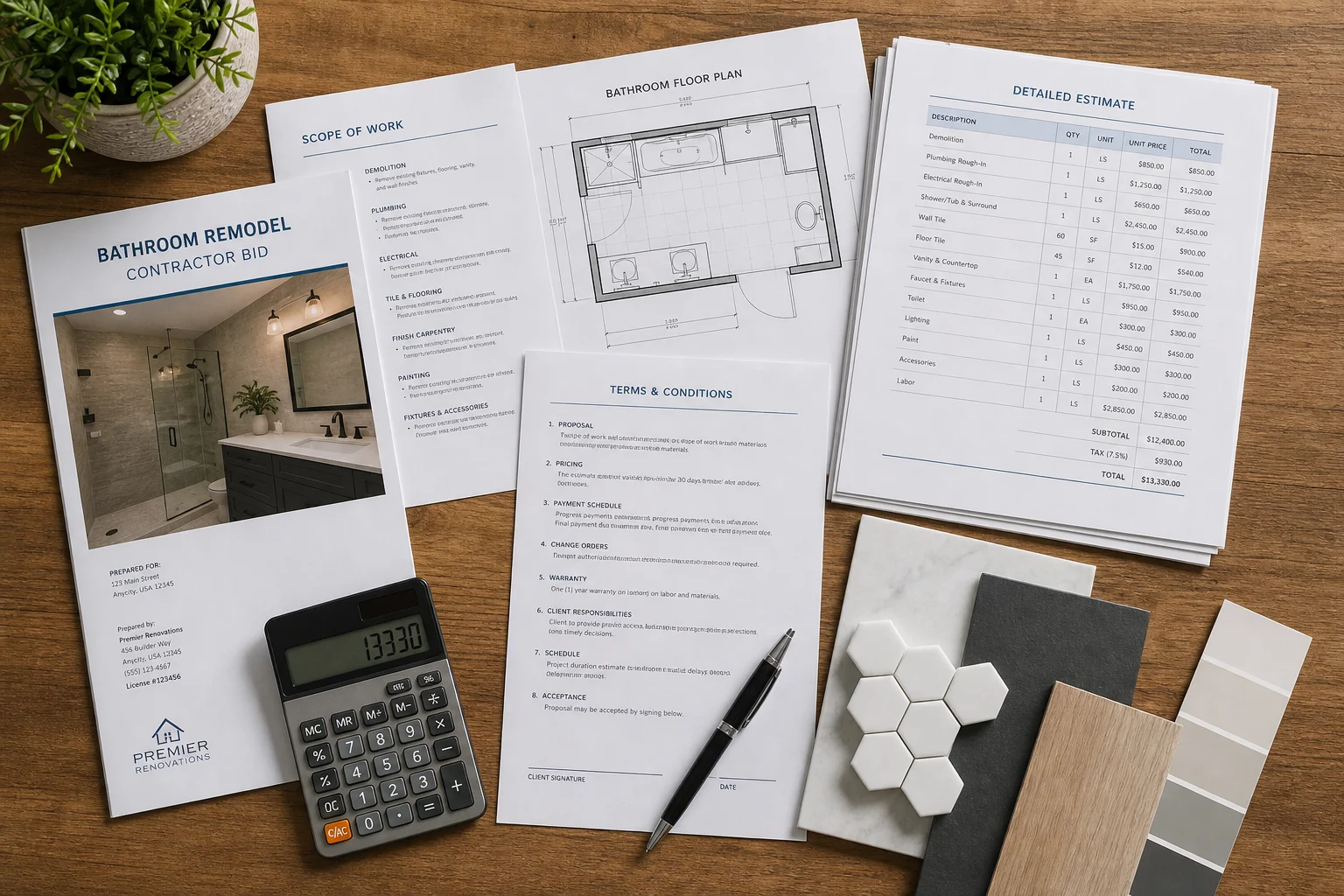
Washington State law requires a written contract for residential projects over $1,000. But "written contract" can mean a one-page estimate with a signature line or a detailed document that actually protects both parties. You want the second kind.
At minimum, a bathroom remodeling contract should include:
- The contractor's registration number (required by WA law)
- A complete scope of work describing what is included and what is excluded
- Material specifications (not just "tile" but which tile, which grout, which waterproofing system)
- A payment schedule tied to milestones (not calendar dates)
- Who is responsible for pulling permits and attending inspections
- A defined change-order process
- Start date and estimated completion date with terms for delays
- Warranty terms for labor and materials
- A statement of insurance requirements
The payment schedule matters more than most homeowners realize. A schedule tied to milestones (deposit, demo complete, rough plumbing inspected, waterproofing verified, tile complete, fixture install complete, final walkthrough) means you are paying for completed work. A schedule tied to calendar dates means you are paying regardless of progress. The NARI Contractor Checklist recommends that no more than 25 to 30 percent be paid upfront, with subsequent payments tied to completed milestones.
What You Are Really Hiring
The deeper truth about choosing a contractor is that you are not hiring someone to install tile. You are hiring someone to make two hundred decisions you will never see, in a room you will use every day, using methods you cannot verify once the walls are closed.
That means the hiring decision is fundamentally about trust. And trust is built not by charm, not by marketing, not by a polished estimate packet. It is built by demonstrated thinking. A contractor who can explain why they do things, who asks questions before quoting, who names the risks before you ask about them, and who has a process for documenting changes... that is a contractor who is thinking about your room the way you want them to.
The room will be finished eventually regardless of who you hire. The question is whether it will still be finished in ten years, or whether it will be the room you quietly start apologizing for again.