The primary bathroom is used simultaneously, every morning, by two people. This is true in most households, and almost no primary bathrooms are actually designed for it. The layout assumes sequential use. The vanity has one sink. The lighting illuminates one face. The mirror reflects one person. The clearances allow one body. The result is a room where one person waits for the other, every morning, in the most time-constrained window of the day.
This is not an observation about square footage. A large primary bathroom can be just as dysfunctional for two simultaneous users as a small one, if the layout was designed as a single-user space. The question is not how much room the room has; it is whether the room was actually laid out to support what the household does in it.
The Vanity Is Where the Conflict Lives
Most morning routine friction concentrates at the vanity. Two people need the mirror and the sink at overlapping times. With a single sink and a mirror centered above it, the second person has no functional position. They either wait or they occupy a position that does not work: standing behind the person at the mirror, leaning in from the side, or performing tasks out of sequence to yield the space.
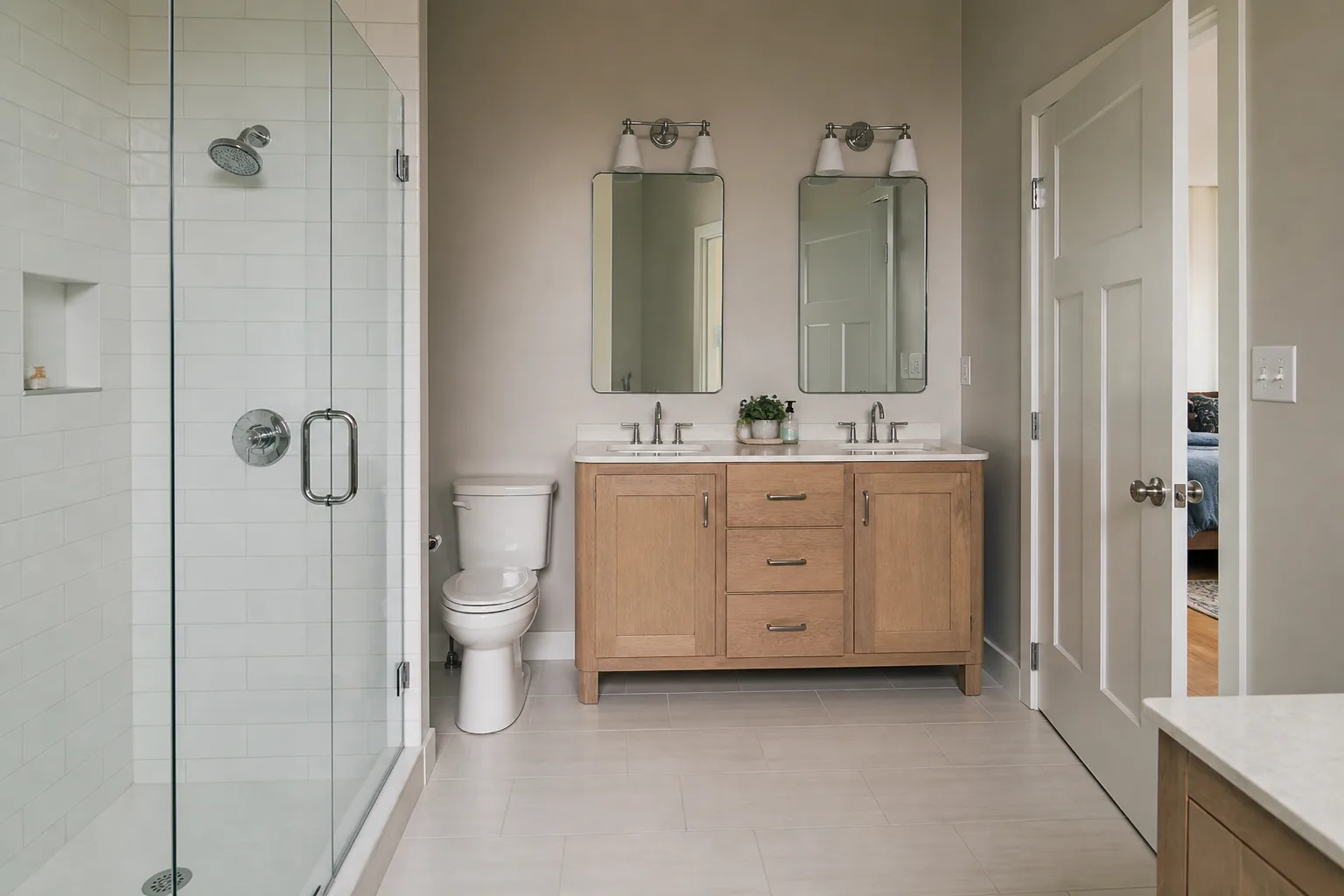
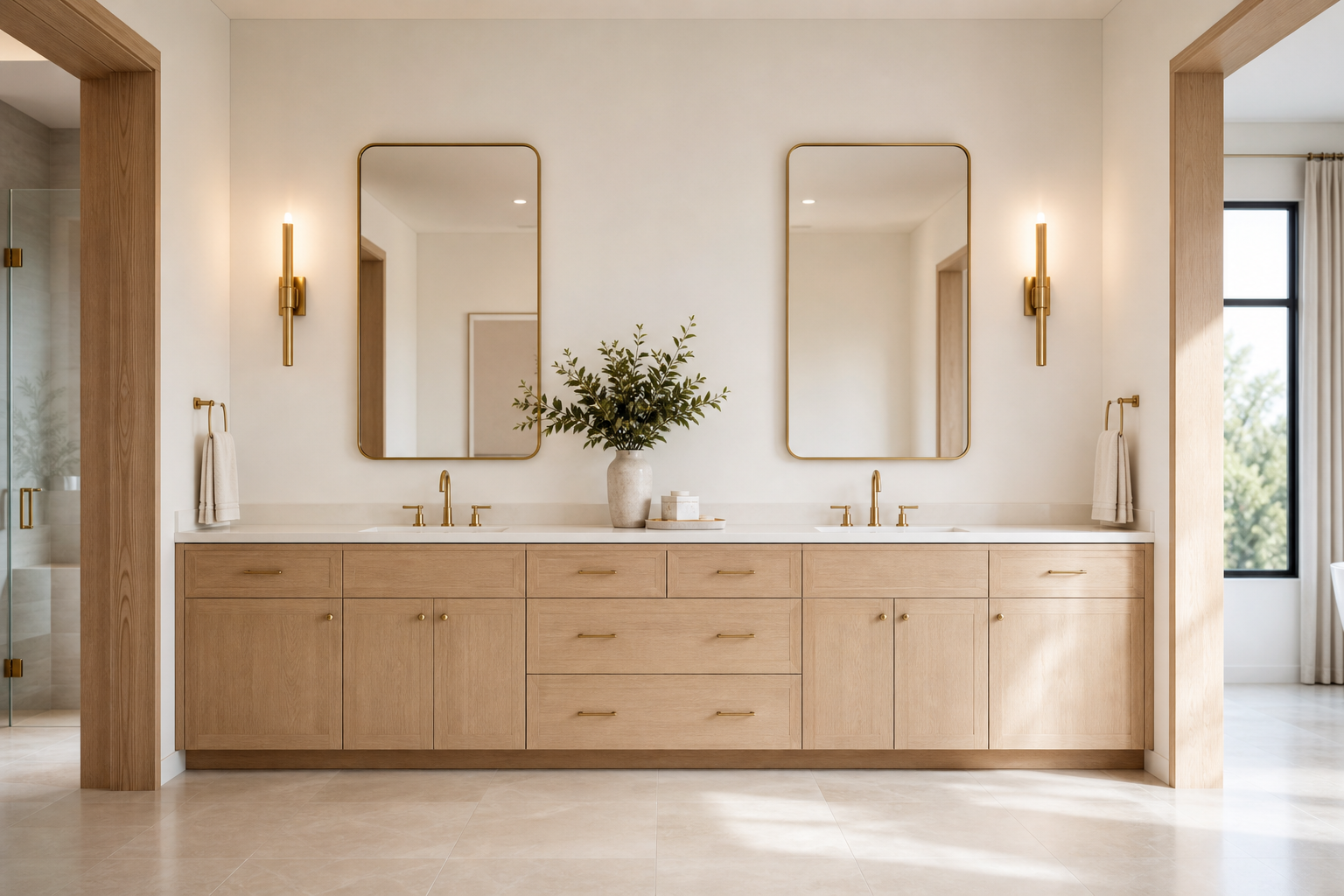
A double vanity solves this at the layout level. Two sinks, two mirror zones, two positions at the counter. The two people can now perform their morning routines in parallel rather than in series, and the amount of actual friction depends on how well the double vanity is dimensioned.
The NKBA recommends a minimum of 36 inches center-to-center between double lavatories. At 30 inches, which is code-legal, two adults using adjacent sinks will have elbow interference. At 36 inches, they do not. Most primary bath double vanities are best served at 60 to 72 inches total width, which provides 36-inch sink spacing, adequate countertop landing space on each side, and enough drawer volume in the center for two people's daily supplies without constant reorganization.
A 60-inch double vanity is the practical minimum for comfortable simultaneous use. A 72-inch vanity is better. The difference in wall space required is one foot; the difference in daily experience is larger than that sounds.
Storage Is a Parallel-Use Problem
Double vanity countertops become shared countertops within a few weeks if there is no clear allocation of storage. Both people's things end up on both surfaces, and each cleaning cycle involves moving things that belong in a drawer that does not have enough space.
The design response is not more storage, necessarily; it is organized storage with clear zones. Plumbing eats cabinet volume in a double vanity; two drain assemblies and two sets of supply lines reduce the available interior significantly compared to a single-sink cabinet. The design needs to account for this explicitly. Drawers on each side of the center, organized around each person's actual set of objects, work better than shelves behind doors that become a shared pile.
Individual medicine cabinets or mirrored storage above each sink, rather than one shared cabinet, extends the zone logic to daily-use items. Each person's half of the wall serves each person's routine.
The Shower and Tub Zone: Simultaneous Is Different from Sequential
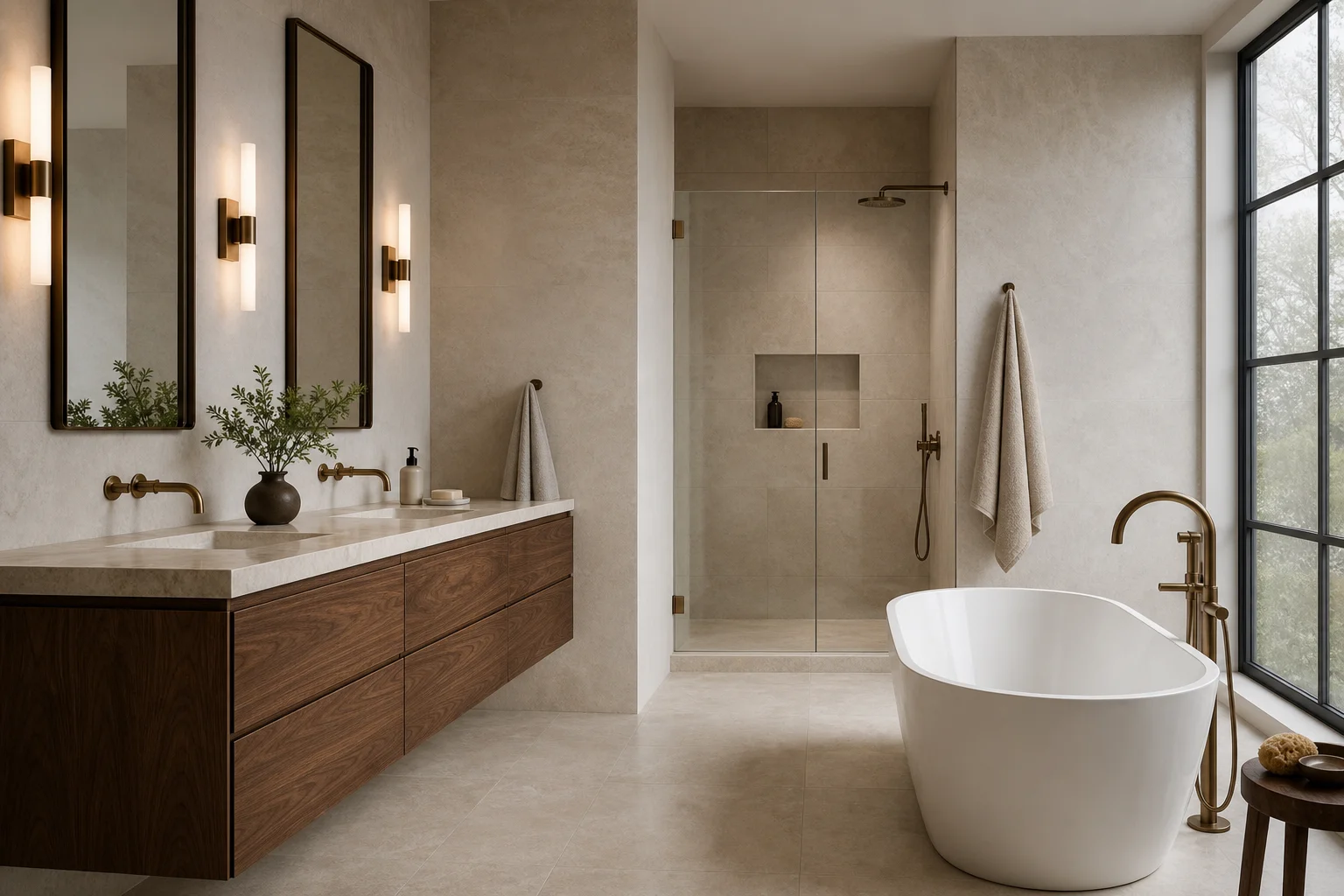
A shared bathroom with a shower and a tub can, with the right layout, allow one person to shower while the other bathes. This requires wet zone separation that keeps shower steam from reaching the mirror zone, and it requires enough clearance that both activities are not competing for the same floor space.
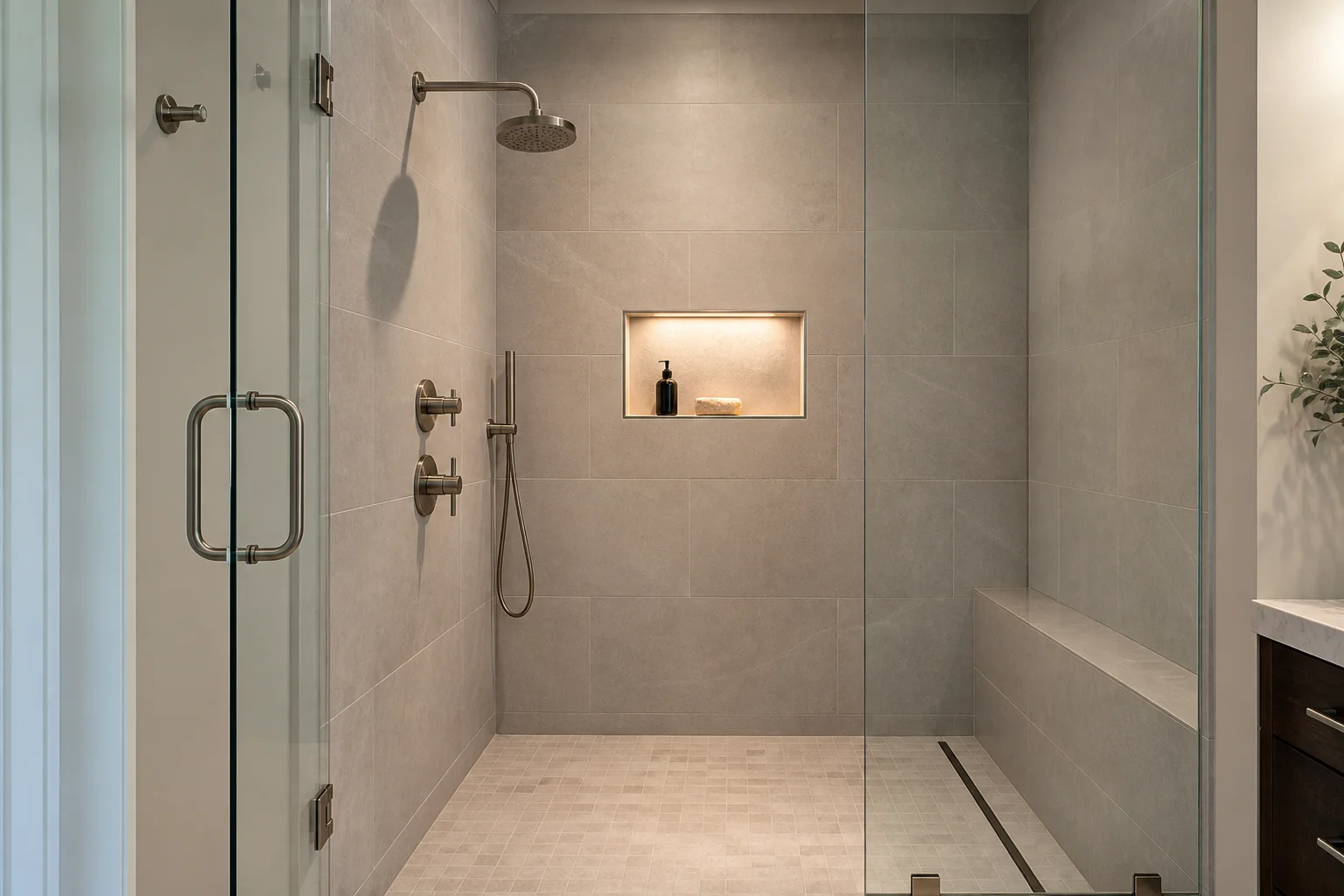
In a smaller primary bath where true simultaneous wet-zone use is not possible, the question becomes whether the layout minimizes the wait. A shower that one person can prepare (turn on, let warm) while the other is still at the vanity, without cross-traffic through the vanity zone, shortens the sequential time. Door placement, glass panel configuration, and shower entry direction all affect whether the zones support each other or compete.
The more common problem is a primary bath where the toilet and the shower are both on the circulation path between the door and the vanity, so any use of either blocks the whole room. The layout has effectively made every activity sequential by putting the transition space through occupied zones.
Private Zone Planning
Some primary bathrooms are large enough to include a toilet compartment: a separate room-within-the-room for the toilet that allows complete privacy while the rest of the bathroom is in use. This is the gold standard for two-person use, because it fully decouples one person's routine from the other's. The toilet compartment requires a minimum of 30 by 60 inches of floor area with a door that swings outward or is a pocket door.
Where a full compartment is not possible, even partial acoustic and visual separation between the toilet and the rest of the bathroom improves the shared-use experience considerably. A partial wall, a frosted glass panel, or a toilet position that faces away from the vanity rather than toward it makes a qualitative difference that does not require architectural change.
Lighting for Two Different Heights and Two Different Tasks
A vanity mirror lit for one person's height is lit for that height. Side-mounted sconces at 60 to 65 inches serve the median height well but not both members of a household with significant height variation. Two separate mirror zones with independently adjustable or separately mounted fixtures let each person have task lighting calibrated to their face position.
Two lighting circuits rather than one also allow the bathroom to operate in different modes for different phases of a shared morning: one person's bright-grooming mode running while the other does a lower-stimulus task does not require both people to be in the same state.
What the Layout Drawing Should Show
A primary bathroom layout designed for two people should show, explicitly: two sink positions with center-to-center dimensions marked; two mirror zones; at least 30 inches of clear space in front of the vanity; circulation paths that allow movement from the door to the shower without passing through the vanity zone; whether the toilet has visual separation from the vanity; and where each person's storage is allocated.
A layout that shows a room with two sinks and no attention to how the two-person circulation works has captured the visual feature of a double vanity without designing for the use case it is supposed to serve.
We ask about household routines before drawing a single layout line for a primary bath. Who showers first? Who takes longer at the mirror? Do both people use the tub or just one? The answers change where the sinks go, how the zones are allocated, and whether a partial partition around the toilet is worth the square footage. The drawing follows the routine, not the other way around.