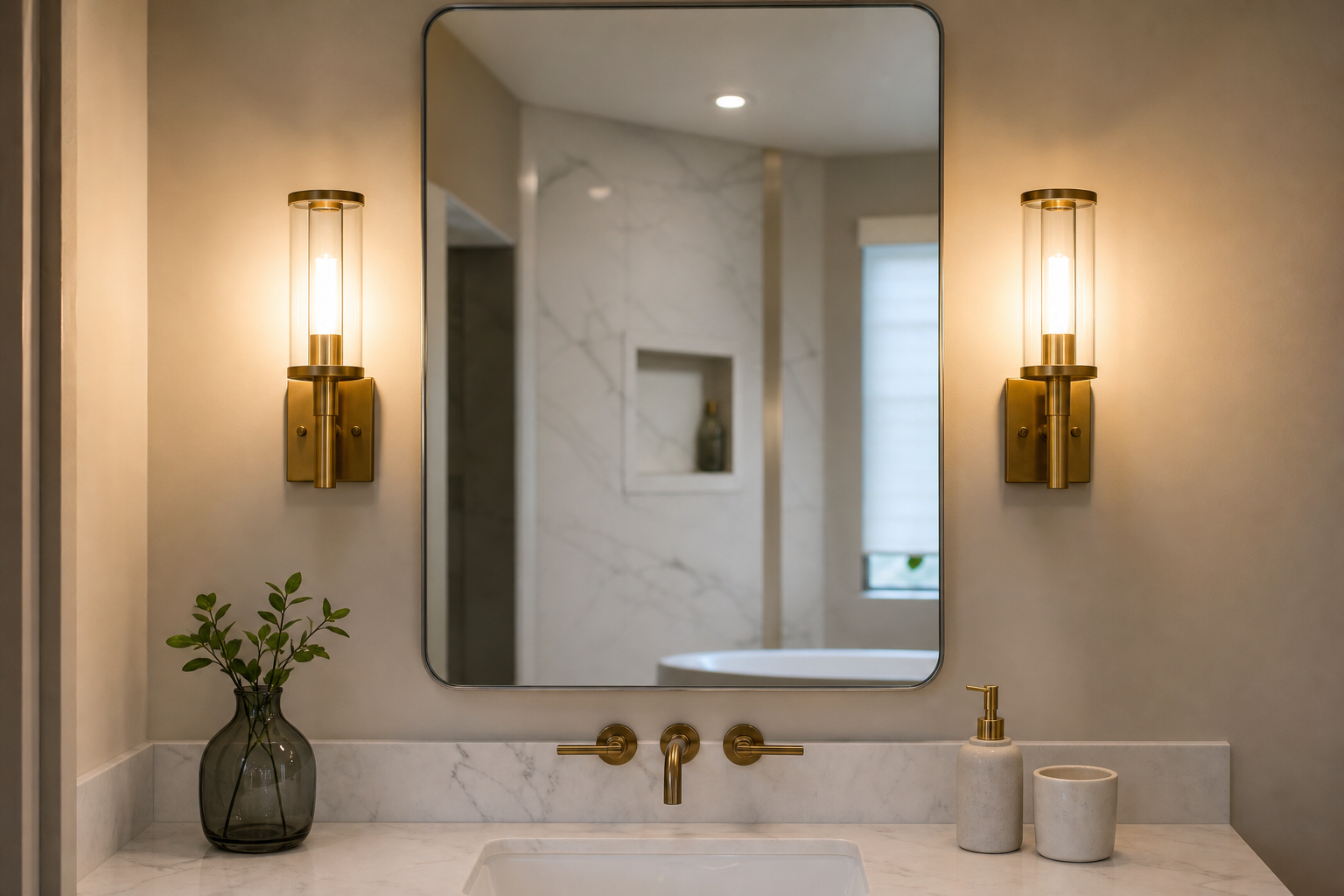
You can spend $40,000 on tile and end up with a room that makes you look unwell every morning. Swap the lighting for $800 worth of fixtures in the right positions at the right color temperature, and the same tile looks expensive. The lighting is not a supporting character in a bathroom. It is doing more work than anything else in the room, and most bathrooms get it completely wrong.
The reason is understandable. Lighting is invisible until it fails. Tile is visible the moment the floor is laid. Fixtures photograph well in showrooms and poorly in real conditions. And the guidance homeowners usually receive amounts to "warmer is cozier," which is true for a living room and misleading in a room built around a mirror.
This article is about the mechanics: what light actually does in a bathroom, where the common approach breaks down, and the three variables that determine whether your lighting flatters or flattens the room.
Why Overhead Lighting Is the Wrong Starting Point
Most bathrooms are lit from a single ceiling fixture above the mirror. This arrangement produces one of the least flattering lighting conditions possible for a human face.
The geometry is simple. Light arriving from above casts downward shadows. Shadows fall under the brow ridge, pooling in the eye sockets. They collect under the nose and underneath the jaw. The face, illuminated only from above, reads as hollowed and harsh. This is the lighting model of a horror film, and it is standard in most American bathrooms.
The problem is not the ceiling fixture itself. Ambient light from the ceiling has a role in a bathroom. The problem is using it as the only source, or the primary source, for a task that requires seeing a face accurately. Grooming, makeup, skincare, and shaving all require even frontal illumination without shadows. Overhead light cannot provide that regardless of how bright it is.
The lighting solution that actually works for a vanity mirror is cross-illumination: fixtures on both sides of the mirror at approximately face height, 60 to 65 inches from the floor to the center of the fixture. Light arriving from both sides simultaneously fills the eye socket shadows from left and right, eliminates the under-nose shadow by illuminating it laterally, and reaches the jaw and chin from angles overhead light cannot. The result is a face lit the way a makeup artist would light it, because that is exactly the geometry makeup artists use.
When side mounting is not possible due to the bathroom's layout, a single horizontal bar above the mirror is the next best option. But it should span at least 75 percent of the mirror width so the light reaches the sides of the face, and it should be high-CRI (more on that below) to compensate for the geometry penalty.
Color Temperature: The Number Nobody Checks
Every light source has a color temperature measured in Kelvin. Low numbers are warm; high numbers are cool. A candle is around 1,800K. A clear sky at noon is around 6,500K. Most household lighting sits somewhere between 2,700K and 4,000K.
In a bathroom, color temperature controls two things: how comfortable the room feels to be in, and how accurately you can see color. These two goals pull in opposite directions.
Very warm light (2,700K) creates a pleasant, amber atmosphere. It also masks color information. Under 2,700K light, redness looks less red, blemishes flatten out, and skin tone reads as uniformly warm regardless of what is actually there. This sounds like a benefit. It is not. You may apply makeup under 2,700K light that looks balanced in the mirror and garish in daylight. You may not notice that your skin looks different until you are under a different light source.
Very cool light (4,000K and above) provides accurate color contrast. It also renders skin tones harshly, makes the room feel clinical, and is genuinely uncomfortable for a space where you spend time looking at yourself. Bathrooms lit at 4,000K or higher tend to feel like a hospital regardless of how beautiful the tile is.
The practical target for most bathrooms is 3,000K at the vanity. Warm enough to be comfortable; neutral enough to render colors with reasonable accuracy. If the primary user applies makeup seriously, 3,000K to 3,200K is a reasonable range. The specific number matters less than consistency: mixing color temperatures in the same visual field, a 2,700K sconce next to a 4,000K ceiling fixture, is immediately jarring and makes both sources look wrong.
CRI: The Specification Most Homeowners Skip
Color temperature tells you where on the warm-to-cool spectrum a light falls. Color Rendering Index (CRI) tells you something different: how accurately the light source reveals color compared to natural reference light.
The CRI scale runs from 0 to 100. A score of 100 means the light source renders all colors identically to the reference (natural daylight or an incandescent blackbody reference, depending on color temperature). A score of 80 means colors are rendered adequately but with some distortion; reds may appear muddy, greens may flatten, and skin tones may look grayish or dull. A score of 90 or above means color rendering is close enough to the reference that most people cannot distinguish it from natural light.
For bathroom vanity lighting, 90 CRI is the minimum worth specifying. Below that threshold, skin tones cannot be trusted in the mirror. A person can apply makeup under 80 CRI light that looks balanced in the bathroom and noticeably off in a different environment. The problem is invisible to the person looking in the mirror, which makes it worse than a visible problem.
There is a nuance worth knowing. The standard CRI score averages eight pastel color samples. It deliberately omits saturated reds, which are harder for some LED sources to reproduce accurately. A fixture can score 90 CRI on the standard scale while performing poorly on saturated red rendering. Since healthy skin tone relies on red undertones, a vanity fixture with high standard CRI but weak red performance will still make skin look ashy or flat.
The metric that captures red rendering is R9, listed separately on product data sheets from quality manufacturers. A good vanity fixture should have a standard CRI of 90 or above and an R9 value of 50 or above. These fixtures exist at reasonable price points. They simply require knowing to ask for them.
Layers: Why One Right Answer Is Still Wrong
Even a perfectly positioned, correctly specified vanity fixture will produce a flat room if it is the only source. Bathrooms benefit from at least three light layers operating independently.
Task lighting is the vanity layer: side-mounted sconces or a horizontal bar above the mirror, high-CRI, 3,000K, dimmable, aimed at the face. This is the workhorse layer.
Ambient lighting is the ceiling layer: provides overall room illumination so the vanity task light does not float in darkness. A recessed fixture centered in the room, or a flush mount for lower ceilings, at the same color temperature as the task layer so the two sources read as coherent.
Accent or mood lighting is optional but transforms how the room feels at different times of day. A dimmer on the ambient layer, or a separate low-level fixture near the floor or tub zone, allows the bathroom to shift from a grooming environment in the morning to a lower-stimulus space in the evening. This matters more than most people expect; bright overhead light in the hour before sleep disrupts circadian signals in ways the body notices even if the mind does not make the connection.
Each layer should be on an independent switch or dimmer. A single switch that controls all three layers simultaneously is a design decision that optimizes for simplicity at the expense of every other use case. The bathroom has at least four distinct use modes: bright grooming, general use, low-light evening use, and nighttime navigation. A single switch handles one of them.
Lighting specification is part of our design package before the electrician rough-in is scheduled. We show fixture positions, switch zones, and color temperature on the design drawing so the electrician is routing to a layout decision rather than guessing. A lighting plan developed after walls close is a compromise; the one we want to work from is drawn before demo, when every option is still available.
The Connection to Everything Else
Bathroom lighting has a secondary effect that is easy to overlook: it changes how every other material in the room appears.
Tile selected under a showroom's 4,000K daylight fluorescents will look noticeably different under the 2,700K warm light of the average installed bathroom. Stone with warm veining will read completely differently at 3,000K than at 4,000K. Grout color shifts under different sources. A polished finish catches light differently than a matte one, and the effect depends on where the light source sits relative to the surface.
This means that material selections made without knowing the final lighting specification are partially guesses. The most rigorous approach is to decide the color temperature of the installed lighting first, then review material samples under that temperature. In practice, most selections happen in the opposite order: tile is chosen at the showroom, then lighting is chosen later. The result is a room where the materials look subtly different than expected, and the homeowner cannot quite explain why.
Fixing this sequence is not complicated. It requires knowing that lighting color temperature is a specification with visual consequences, not just a comfort preference. Once that is understood, it becomes natural to treat it as the context in which all other material decisions are made, rather than an afterthought.
A bathroom that is lit well makes every other correct decision more visible. It makes the tile look the way you chose it. It makes the stone look the way it looked in the sample. It makes you look the way you want to look. That is a significant amount of work for a fixture that costs less than most plumbing trim packages.