"Water-resistant" and "waterproof" describe fundamentally different physical properties, and the tile industry sells the former while most homeowners assume they are buying the latter. The distinction determines whether the room lasts five years or fifty.
Walk through a tile showroom and the language blurs on purpose. A porcelain tile labeled water-resistant. A cement backer board marketed for wet areas. A grout sealer that promises protection. A sheet membrane described as a waterproofing system. Each product occupies a different position in the assembly stack, yet the marketing vocabulary treats them as interchangeable shields against moisture. They are not. Water-resistant materials slow water down or tolerate brief contact without immediate failure. Waterproof materials, when installed as a continuous system, stop liquid water from reaching what lies behind them. In a shower, confusing the two is not a semantic error. It is a construction error that may not announce itself until the framing is soft.
Understanding the difference requires looking past product labels to what each material actually does when water arrives daily, hot, and under pressure.
What Water-Resistant Actually Means
Water resistance is a rate question, not a stop question. A water-resistant material can get wet, absorb some moisture, and eventually dry without falling apart. That is a useful property. Cement board will not disintegrate like paper-faced drywall when it gets damp. Porcelain tile will not crumble when splashed. Grout will hold its shape after repeated wetting. None of those behaviors makes the material waterproof.
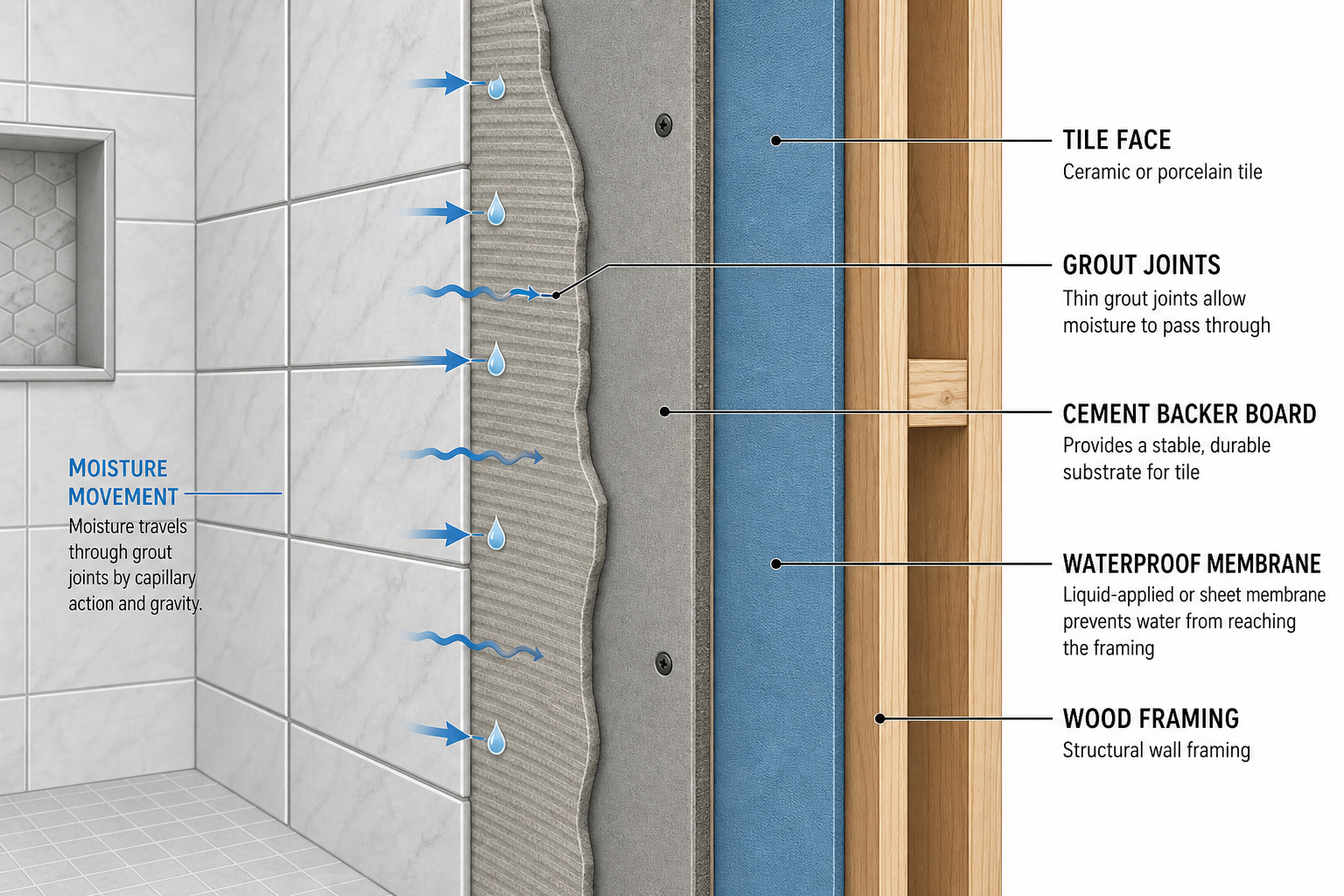
The National Tile Authority, in its shower installation guidance, states the distinction plainly: cement board compliant with ASTM C1325 is water-resistant but not waterproof. It will not disintegrate when wet, but it absorbs water and transmits it to framing behind it without a separate waterproofing membrane. The board is doing exactly what it was designed to do. It provides a rigid, dimensionally stable substrate for tile. It was never intended to be the last line of defense against moisture migration into the wall cavity.
Porcelain and ceramic tile occupy a similar category at the surface. The glazed face of a tile sheds bulk water effectively. The body of the tile, the mortar bed beneath it, and the grout between units are all porous to varying degrees. Industry testing under ANSI A118.6 documents cement-based grout absorbing water at rates between approximately five and sixteen percent by weight depending on formulation. That absorption is not a defect. It is the physics of a cementitious matrix with a network of capillaries formed during cure. Water enters. Water moves laterally. Water continues inward until something stops it or the assembly dries faster than it wets.
Water-resistant, then, describes tolerance. The material can coexist with moisture without immediate structural failure. It does not describe containment.
What Waterproof Actually Means
Waterproof, in the context of a tiled shower, has a specific technical definition tied to tested performance, not marketing adjectives.
ANSI A118.10 is the American National Standard for load-bearing, bonded waterproof membranes used beneath thin-set ceramic tile and dimension stone. Membranes certified to this standard must pass rigorous testing: long-term water immersion shear strength, seam strength, breaking strength, fungus resistance, and hydrostatic pressure resistance. The 110-day water immersion test alone signals that waterproofness here is measured in months of sustained exposure, not in the ability to survive a spill on a countertop.
A membrane meeting A118.10 is designed to be bonded directly to a substrate, covered with tile-setting mortar, and expected to remain intact while water moves through the tile layer above it. The membrane intercepts that water and directs it toward a drain connection. It is load-bearing because tile and mortar sit on top of it. It is bonded because adhesion failure at the membrane-substrate interface would create a void where water collects. It is waterproof because it has demonstrated, under standardized laboratory conditions, the ability to resist water penetration under pressure.
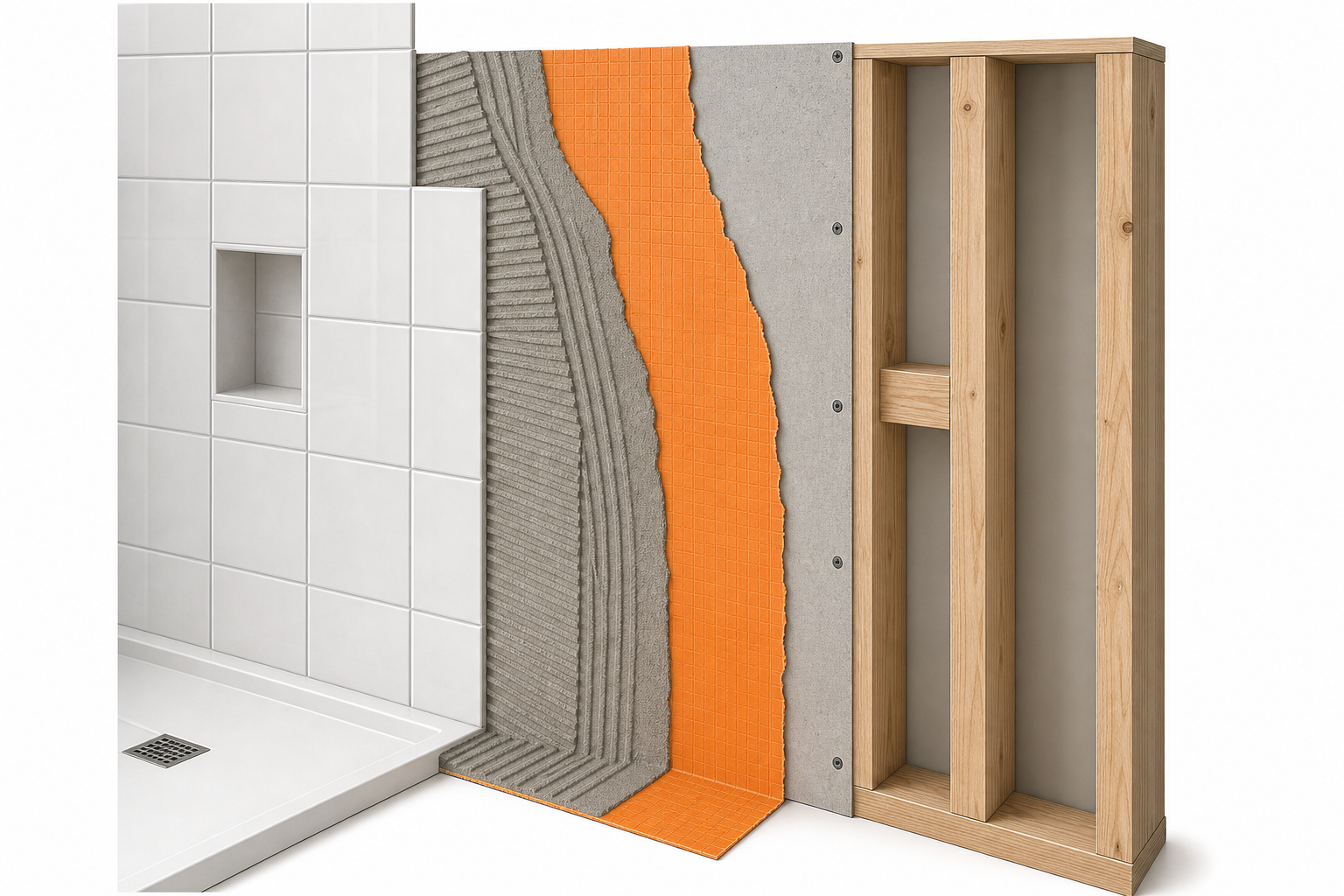
This is a different category of product from a water-resistant backer board or a penetrating grout sealer. The membrane is the designated barrier. Everything above it in the assembly is allowed to get wet by design.
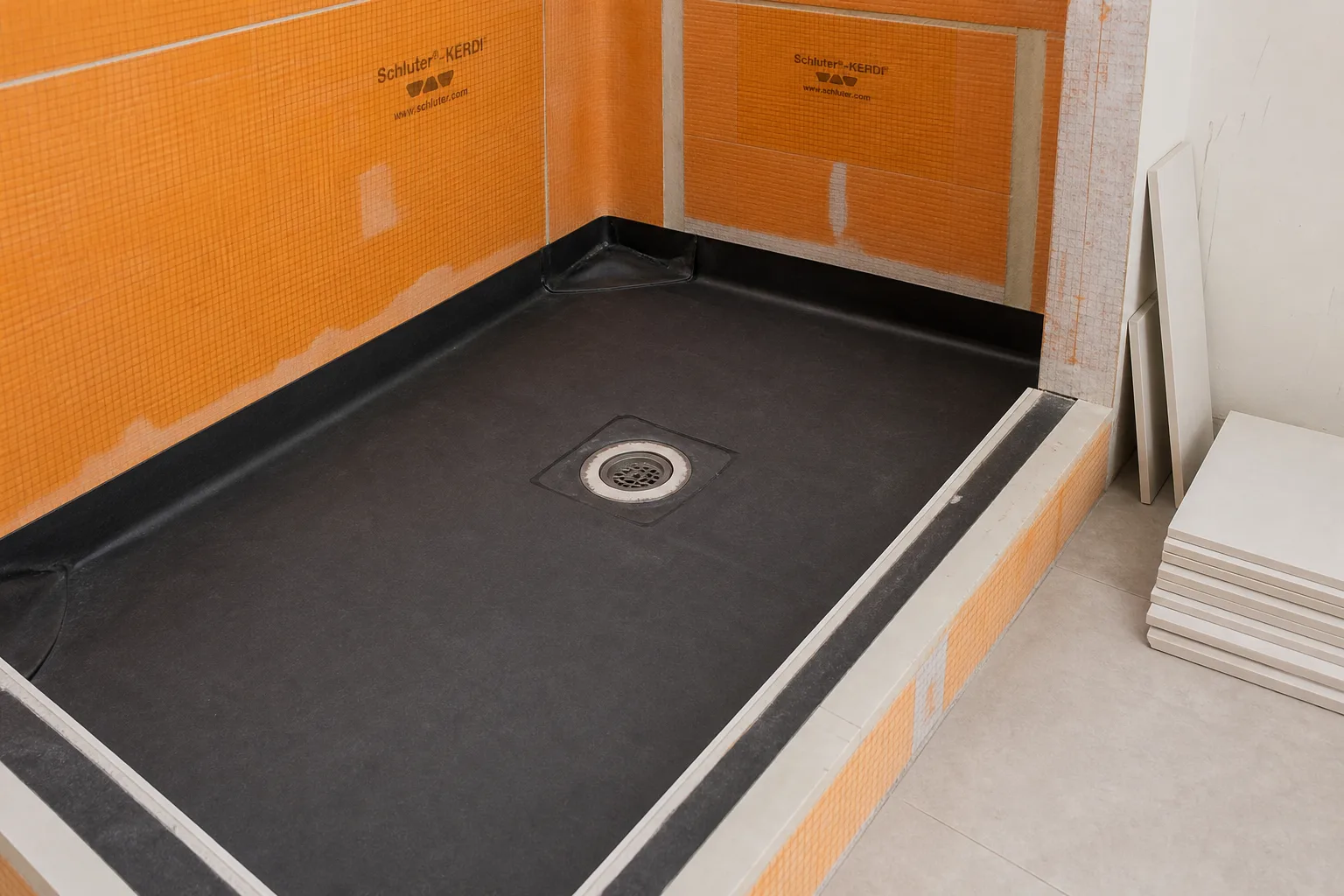
The Tile Council of North America publishes installation methods, such as B415 and B422, that specify how these membranes integrate with cement board substrates, two-stage drains, and floor slopes. The methods exist because a certified membrane installed incorrectly is not a waterproof assembly. Continuity at inside corners, proper lapping at floor-to-wall transitions, and sealed fastener penetrations are part of the waterproof definition. A sheet of A118.10 material with a screw through an untreated hole is water-resistant at best around that penetration.
Where the Industry Sells One Thing and Homeowners Hear Another
The confusion is structural, not accidental.
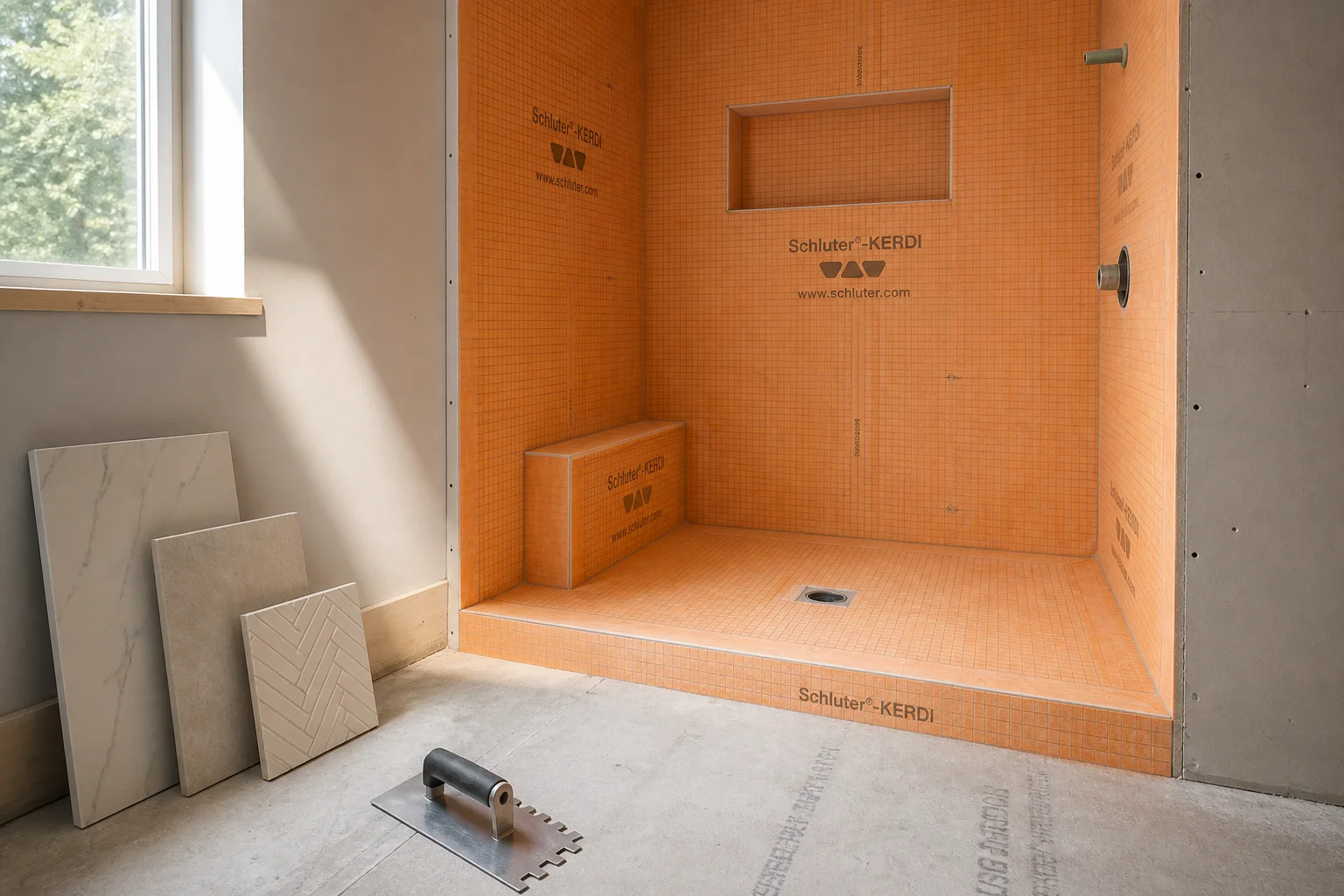
Tile showrooms lead with surfaces. The sample board shows stone or porcelain. The conversation centers on color, format, and pattern. Waterproofing membranes do not photograph well. They are sheets of orange or blue material applied to backer board before any finish is visible. Liquid-applied membranes cure to a uniform coating that looks, to an untrained eye, like primer. The most consequential layer in the shower is the one with the least consumer-facing marketing budget.
Meanwhile, products in adjacent categories borrow language from the waterproof tier without earning it. Cement board packaging emphasizes wet-area suitability. Consumers reasonably infer that suitability means waterproof. It does not. Grout sealers promise protection against stains and moisture. Consumers reasonably infer that sealed grout eliminates water entry. It does not. Custom Building Products, in its technical white paper on shower waterproofing, states directly that even treated grout joints will not eliminate water intrusion completely. Sealers degrade. Reapplication schedules are rarely followed. The capillary network in cement grout remains.
Even within the membrane category, not all products meet A118.10. Crack isolation membranes, uncoupling mats, and vapor retarders serve different functions with different permeance ratings. A membrane that performs adequately against liquid water may still permit vapor transmission at rates that deliver sustained moisture loads to framing over years of daily hot showers. The TCNA steam shower guidelines require membranes in steam applications to achieve water vapor permeance of 0.5 perms or less, tested per ASTM E96 Procedure E. A standard shower is not a steam room, but the principle applies: stopping liquid water and stopping water vapor are related but not identical problems.
The industry sells water-resistant components at every visible layer and waterproof components at a hidden layer that many bids treat as optional. Homeowners assume the visible layers are doing the waterproofing because that is what the language suggests. Contractors who know better may not correct the assumption because correcting it adds cost to a competitive bid.
Why the Distinction Determines Cost
Waterproof systems cost more at every stage: material, labor, inspection, and coordination.
Material cost first. An ANSI A118.10 sheet membrane from a major manufacturer costs more per square foot than cement board alone. Liquid-applied systems require specified wet-film thickness, often verified with a gauge, and fabric reinforcement at corners and changes of plane. Factory-made sheet and peel-and-stick membranes carry higher unit costs but reduce the risk of insufficient coverage that trowel-applied products can hide until saturation occurs weeks or months later. Integrated foam panel systems that combine substrate and waterproof coating in one unit add cost relative to standard cement board but eliminate a separate application step.
Labor cost second. Applying a bonded membrane correctly takes time the tile setter cannot spend setting tile. Inside corners need prefabricated bands or folded fabric. Floor-to-wall transitions need continuous lapping, not butted seams. Fastener heads need treatment. The drain body needs a clamping flange or bonded connection compatible with the membrane system. Each step is invisible after tile goes up, which means each step competes with visible finish work for the installer's attention on a fixed schedule.
Inspection cost third, though it is rarely line-itemed. Flood testing a traditional pan liner before the mortar bed goes down has been standard practice for decades. Bonded membrane systems rely on visual verification of continuity before tile covers the evidence. A contractor who skips verification saves hours and wins bids. A contractor who performs verification adds cost that does not appear in the finished room.
Coordination cost fourth. The waterproofing system, drain model, and tile assembly must be specified as a compatible set. Mixing a membrane from one manufacturer with a drain designed for another system's clamping ring creates failure points that no amount of caulk at the surface will fix. Schluter Systems, in its published guide on common waterproofing mistakes, identifies fastener penetrations through pan liners and incompatible system mixing as among the most consistent documented failure modes in the field.
The price difference between a shower built with a named A118.10 system installed continuously and a shower built with cement board, sealed grout, and hope is real. It may represent ten to twenty percent of the tile scope on a mid-range bathroom. Spread across a whole remodel, it can feel like a line item worth cutting when every other selection is competing for budget. The cut saves money on the day the room is finished. It spends money the day someone opens the wall and finds framing that has been wet for years while the tile still looked perfect.
What Failure Looks Like When the Wrong Category Was Specified
Failure does not always arrive as water on the bathroom floor.
The more common trajectory is slow accumulation. Water moves through grout via capillary action. It passes through a water-resistant backer board that was never sealed with a membrane. It reaches the wood framing, which is also water-resistant in the sense that it can get wet occasionally and dry. But daily shower use in a household with multiple occupants delivers more moisture than occasional drying can remove. The framing stays above fiber saturation point long enough for fungal growth. The sheathing swells at the base of the wall. The first visible sign may be a stain on the ceiling below, a musty smell that returns after cleaning, or tile that sounds hollow when tapped because the bond layer has degraded from cyclic wetting.
The International Institute of Building Enclosure Consultants has documented that tiled shower walls behave comparably to clad exterior walls in their moisture dynamics. The finish looks sealed. The assembly behind the finish is managing water, vapor, and drying capacity as a system. When the waterproof layer is absent or discontinuous, the system fails at the substrate, not at the surface.
Opening a failed shower confirms the pattern repeatedly. The tile and grout look fine. The membrane, if one was installed, has a gap at a corner, a missed penetration, or an incompatible drain connection. The cement board is damp and crumbly at the base course. The framing is stained and soft. The repair requires removing the tile, replacing the substrate, addressing structural damage, and rebuilding the assembly correctly. The cost of that repair dwarfs the savings from skipping proper waterproofing on the original install.
This is why the five-year bathroom and the fifty-year bathroom diverge before tile is chosen. The five-year bathroom treats waterproofing as a premium upgrade. The fifty-year bathroom treats it as the definition of a shower.
How to Tell What You Are Actually Buying
The question is not whether your contractor uses quality tile. The question is whether they can name the waterproof layer, cite its standard, and show you where it connects to the drain before tile covers it.
Ask for the membrane manufacturer and product line. Ask whether it is ANSI A118.10 certified. Ask how inside corners, the curb, and the drain flange are detailed. Ask whether the system will be visually inspected or flood tested before tile installation begins. A contractor who answers in product names and standard numbers is describing a system. A contractor who answers with grout brand and sealer type is describing a finish.
Read bid documents carefully for what is excluded. "Tile-ready shower" can mean a foam pan with an integrated waterproof surface. It can also mean cement board on a framed curb with no membrane line item. "Waterproof backer" can mean a board rated for wet-area exposure. It can also mean a board with an integrated A118.10 coating that still requires treated joints and penetrations. The words sound similar. The assemblies are not.
If you are comparing bids, compare membrane systems, not just square footage of tile. Two bids with identical tile selections and different waterproofing specifications are bids for different rooms. One lasts five years. One lasts fifty. The tile will look the same on day one.
Every shower we build has a named waterproofing system with a specific perm rating, and we can tell a client exactly what the membrane is before demo begins. That specification is written into the scope before tile samples arrive, not added after the budget conversation turns toward cuts.