The splurge-vs-save decision in a bathroom renovation is not about which item is worth the premium. It is about which layer of the room you are making a decision in. That distinction changes the entire logic of the conversation.
Most homeowners approach this as a product-level question: is the expensive tile worth it, is the designer faucet worth it, is the custom vanity worth it. The question sounds reasonable. But it frames the problem incorrectly, because it treats the shower waterproofing and the shower tile as equivalent types of decisions. They are not. One is a finish product. One is infrastructure. Infrastructure decisions have completely different failure economics than product decisions.
The framework that actually works is this: divide the room into two layers. The hidden layer is everything assembled before the walls close and the finish materials set -- the waterproofing membrane, the substrate, the drain connection, the exhaust ventilation, the rough electrical, the subfloor preparation. The visible layer is everything you see once the room is complete -- the tile, the fixtures, the vanity, the hardware, the mirror. In the hidden layer, there is almost no safe place to save, because the consequences of failure are structural, expensive to reverse, and often invisible for years. In the visible layer, there is almost always a genuine equivalent at a lower price, because the premium above the mid-range is mostly design, brand, and finish variation rather than meaningful performance difference.
The Hidden Layer: Where Savings Almost Always Cost More
Waterproofing is the clearest example. The shower is the only room in a home designed to have water sprayed directly at its walls for decades, and the tile and grout are not the waterproofing. They are a finish layer. The actual waterproofing happens behind the tile, and it either works completely or it does not work at all.
The critical technical point is that waterproofing systems are not interchangeable. A traditional three-piece clamping drain is designed for a water-in, water-out system: the membrane sits below the mortar bed, water migrates through grout and mortar to reach the liner, and weep holes at the drain base evacuate that moisture. A bonding flange drain is designed for a surface-applied system: the waterproofing membrane bonds directly to the drain flange, and the goal is to stop water from entering the mortar bed entirely. As Schluter Systems and the TCNA Handbook specify, each system works when installed correctly and consistently within its own logic. What creates failures is mixing them.
The most common hidden-layer mistake is installing a topical waterproofing membrane over a mortar bed paired with a clamping drain designed for a liner-below system. The topical membrane has no adequate bonding surface at the drain, traps moisture between layers, and creates what tile contractors describe as a moisture sandwich. The weep holes cannot do their job because the topical waterproofing blocks the drainage path. The problem does not announce itself. The shower functions normally for months or years. The damage accumulates in the subfloor and framing and, when it becomes visible, the repair requires demolishing a finished room.
The cost differential between a continuous, correctly installed membrane system and a cheaper partial application is typically between $800 and $2,000 on a full shower remodel. Mold remediation and subfloor repair, when a cheaper approach fails, starts at $5,000 and frequently runs above $15,000. That is not a savings calculation. It is a risk calculation with highly asymmetric outcomes.
Exhaust ventilation is the second place where saving costs more. The function of an exhaust fan is to move a specific volume of air out of the bathroom through a duct that terminates outside the building envelope. Home Ventilating Institute guidelines call for at least one cubic foot per minute per square foot of bathroom area, with a minimum of 50 CFM for small bathrooms. But the rated CFM of a fan assumes minimal duct length and no friction losses. A fan installed at the ceiling with ten feet of flexible duct running through an unconditioned attic before reaching an exterior cap is performing at 60 to 70 percent of its nameplate rating. Specifying the minimum-rated fan in that installation is specifying an undersized fan.
An undersized exhaust fan cannot achieve adequate air exchange. Humidity accumulates. Condensation forms on cold surfaces including framing and insulation inside the wall cavity. Over time, that moisture creates the same mold and rot conditions as failed waterproofing, but distributed across the entire ceiling and upper wall framing rather than concentrated at the shower. The difference between a correctly sized fan and a marginal one is frequently $80 to $150 in materials. The cost of treating the mold that grows because of inadequate ventilation is not.
Subfloor preparation is the third hidden-layer decision where the savings do not hold up under scrutiny. In a bathroom remodel, standard practice is to verify subfloor condition at demolition, before setting any substrate. The subfloor may have rot from a previous slow leak, delamination from moisture exposure, or soft spots from inadequate support. Proceeding directly to substrate installation over an unverified subfloor is common on lower-priced bids. It is also how tile installations end up with flex, cracked grout, and eventually cracked tile -- because the floor movement the substrate is absorbing comes from deflection in an inadequate base, not from anything the tile installation did wrong.
The Visible Layer: Where Genuine Equivalents Exist
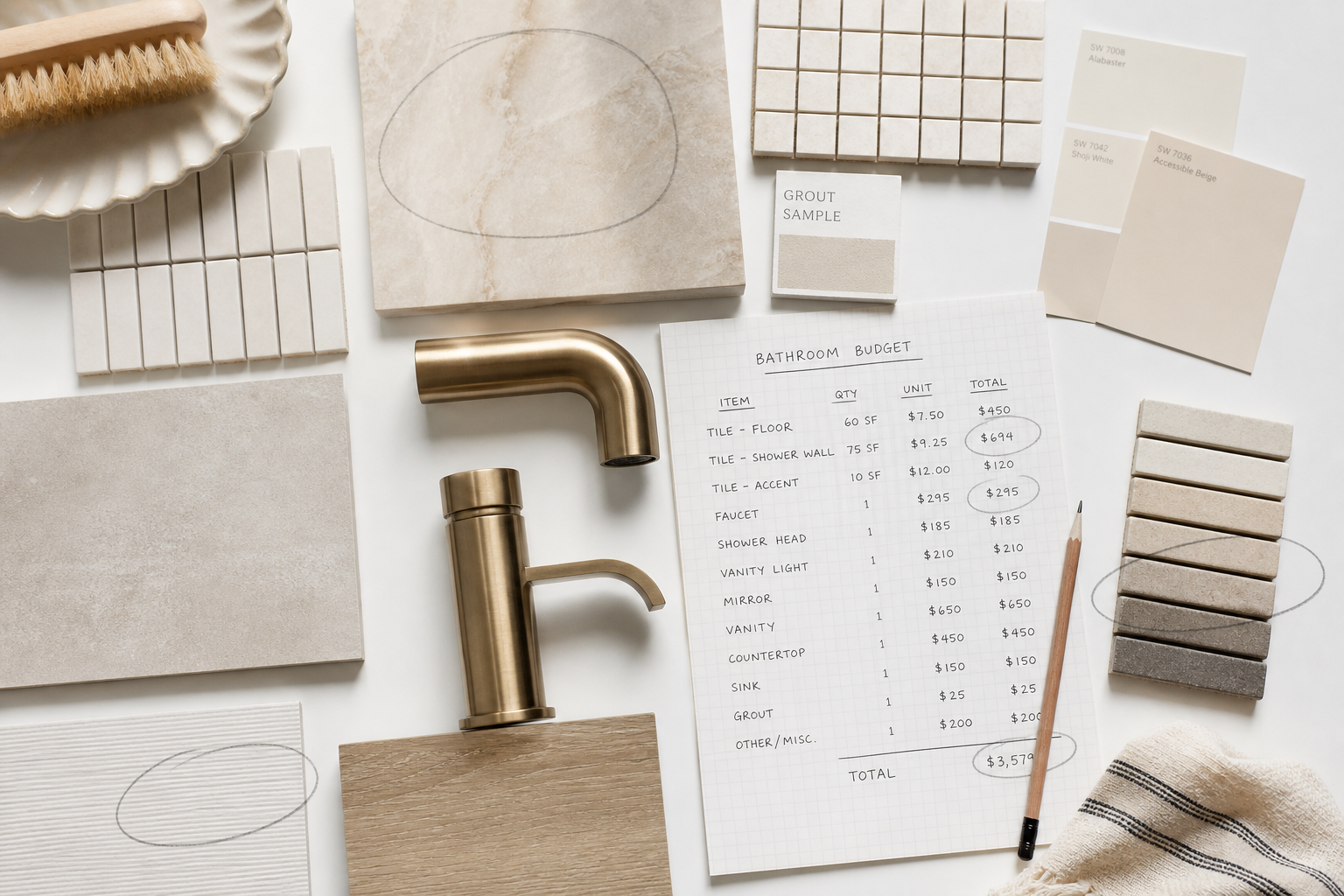
The visible layer operates differently. Here, a meaningful price premium often delivers brand, design, or finish variation rather than a performance difference. The job of the person making budget decisions is to distinguish between those two types of premium.
Porcelain tile versus natural stone is the clearest example. In a wet application, specifically a shower, porcelain with a water absorption rate below 0.5 percent per ANSI A137.1 standards outperforms most natural stone choices on the metric that matters most in that environment: moisture resistance. Marble has a water absorption rate of 0.2 to 0.6 percent. Travertine runs from 1.0 to 5.0 percent. Limestone can reach 12 percent. The absorption rate matters because water that enters the stone carries dissolved minerals and soap residue that etch the surface, require periodic professional honing, and demand resealing every six to twelve months. A stone shower that is properly maintained costs $200 to $500 per professional sealing application, plus the ongoing maintenance overhead of pH-neutral cleaners, monitoring for etch marks, and a major restoration at year ten to fifteen that can run $1,500 to $3,000.
Porcelain requires none of that. It requires the same mild cleaner and the same wipe-down as any other smooth surface. For a primary shower used daily, that difference in maintenance obligation is not trivial, and it compounds over the life of the room.
The premium for natural stone in a shower is real. The performance advantage, in a wet application, mostly favors the lower-cost option. That is the inverse of what the price signal implies, and it is worth naming directly. If the design goal is a stone-look surface, a high-quality porcelain tile printed with natural stone texture and veining is manufactured specifically to provide that outcome at a fraction of the cost and with superior wet-area performance.
Mid-range versus premium faucets is the second visible-layer case where the equivalence is nearly complete. A faucet's functional lifespan is determined primarily by one component: the valve. A ceramic disc valve uses two precision-ground ceramic discs rotating against each other to control flow, and is rated for 500,000 or more on/off cycles. Under normal residential use, that translates to roughly 15 to 20 years of operation before the first service need. A compression valve using a rubber washer against a seat shows visible wear and begins dripping within three to ten years. A ball valve sits between those ranges.
The specific valve in a faucet is a specification, not a price bracket. A $180 faucet from a major manufacturer can carry a ceramic disc valve. A $1,400 faucet from a designer brand may carry the same ceramic disc valve with different design execution and a premium finish. Both valves will perform identically for the life of the faucet, because the valve mechanism is the same. The difference between those price points is almost entirely finish, proportion, and brand. Whether that difference is worth paying depends on what the design outcome is worth to you. It is not a performance question.
Painted MDF vanities in secondary bathrooms occupy a similar position. A painted MDF vanity from a reputable manufacturer, installed in a secondary bath that does not face direct water exposure and sees moderate use, will perform indistinguishably from custom millwork at twice the price for most of its service life. Custom millwork allows for specific dimensions, drawer configurations, and wood species. In a room where standard dimensions work and the design ambition is moderate, those benefits are real but they are design benefits, not durability benefits. The MDF vanity will not fail sooner. It will just look like a standard bathroom vanity rather than a custom one.
Where the Visible Layer Actually Does Have Performance Implications
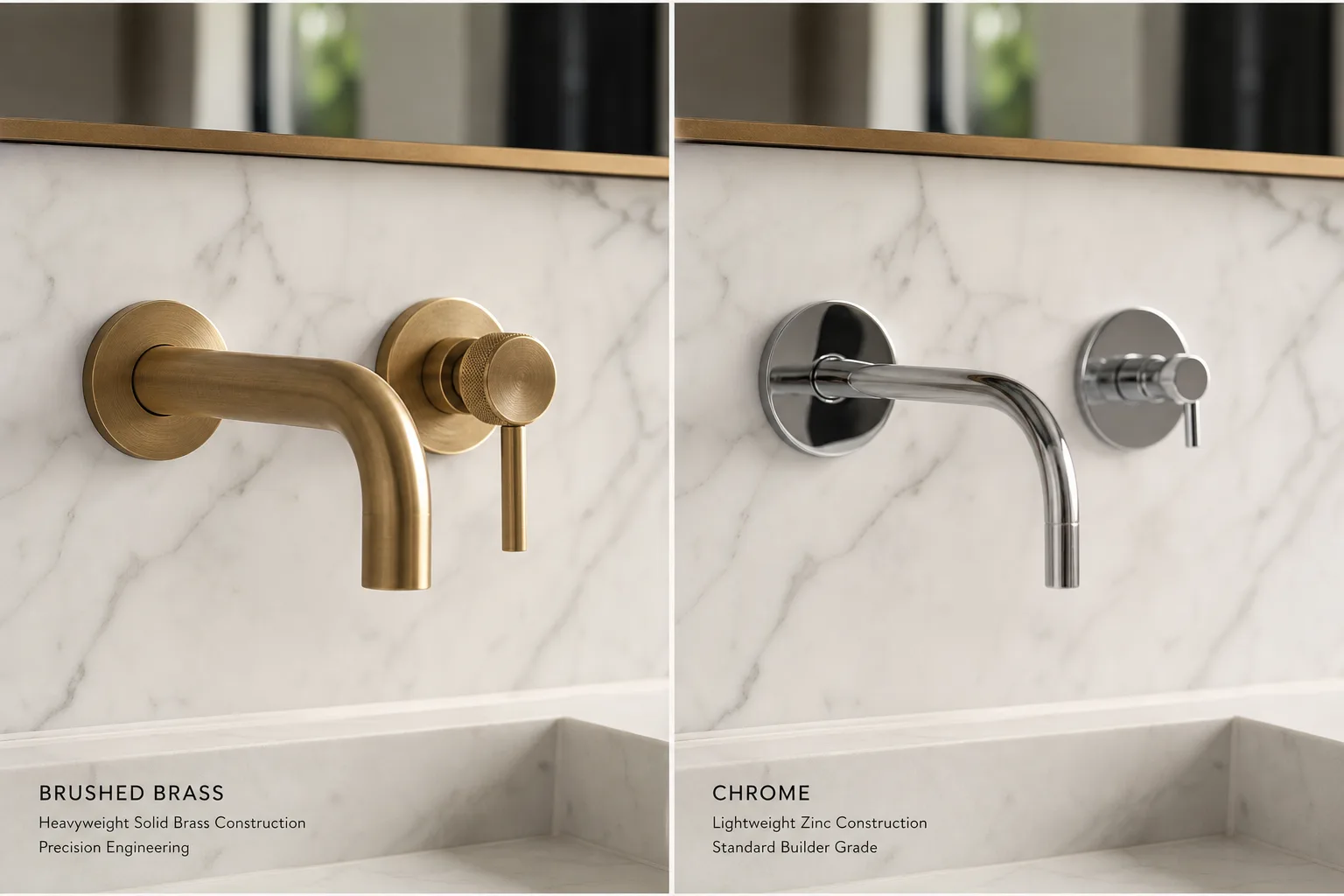
The visible layer is not uniformly safe to value-engineer. There is a specific category within it where choices have genuine long-term performance consequences: the surface finish on metal fixtures.
Bathroom fixture finishes are produced primarily through two processes. Electroplating deposits a thin metal coating onto the fixture body through a chemical process. The coating is typically 5 to 10 microns thick. Physical vapor deposition, known as PVD, applies a coating in a vacuum chamber at the molecular level. The coating is typically 1 to 3 microns thick but is significantly harder, with surface hardness ratings of HV1800 to HV2500 compared to standard electroplating.
In salt spray testing per ASTM B117, PVD finishes hold up at 1,000 to 1,200 hours of exposure versus 300 to 500 hours for electroplated finishes. In practical terms, electroplated finishes on fixtures used daily in a humid bathroom begin showing degradation -- pitting, peeling, color shift -- within three to seven years. PVD finishes maintain their appearance for eight to fifteen years or more under the same conditions. Warranty coverage tracks this difference: premium PVD finishes typically carry 5 to 10 year finish coverage; electroplated finishes typically carry 1 to 3 years.
The price difference between an electroplated and a PVD fixture in the same product line from the same manufacturer is typically 20 to 40 percent. That premium is a performance premium, not a brand premium. It is one of the cases in the visible layer where the higher cost buys a meaningfully different outcome over the life of the room. A set of three fixtures, saved $150 by specifying electroplated over PVD, will likely need replacement in year four or five. The same set in PVD has a realistic service life of three to four times longer.
The rule of thumb that resolves these cases: if the item is in the visible layer but you touch it every day and it faces constant humidity and water contact, the finish specification matters. PVD is worth the premium over electroplating in those conditions. If the item is primarily decorative and sees limited contact, the finish specification is mostly an aesthetic question.
The Decision Rule
The framework resolves to a single principle: splurge on anything structural that you cannot reach after the room is assembled, and save on anything you can replace in an afternoon.
The waterproofing membrane, once tiled over, cannot be inspected or repaired without demolishing the shower. The subfloor, once the substrate and tile are set, cannot be accessed without full demolition. The exhaust duct path, once the ceiling is finished, cannot be rerouted without opening the ceiling. These are permanent decisions. The cost of a mistake is not the cost of the item. It is the cost of the item plus the cost of demolishing and rebuilding everything that sits on top of it.
The tile, by contrast, can be removed with a chisel and a day of work. The faucet can be swapped in forty-five minutes. The vanity can be replaced in a day. The mirror and hardware take an hour. None of these are trivial purchases, but they are reversible. The hidden layer is not reversible. That asymmetry is the entire framework, and applying it consistently is the difference between a budget that holds up for twenty years and a budget that looks fine on paper but does not survive the room.
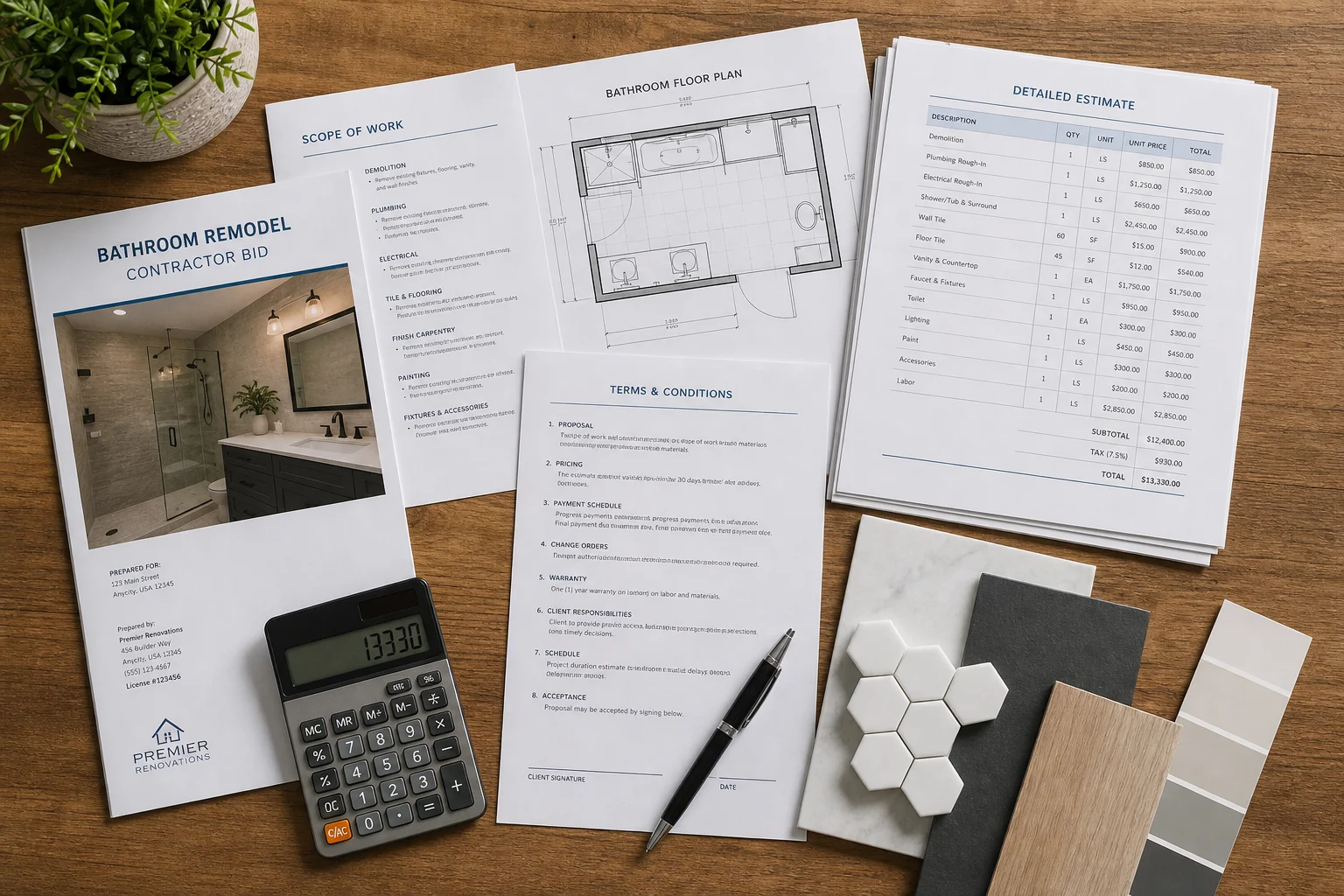
When we help clients work through budget decisions on bathroom projects, the framework is always the same: hidden work first, visible work second. We do not value-engineer the waterproofing membrane or the subfloor preparation. We do help clients find the same visual outcome at a lower material cost -- and we are direct about which substitutions are genuine equivalents and which are not.