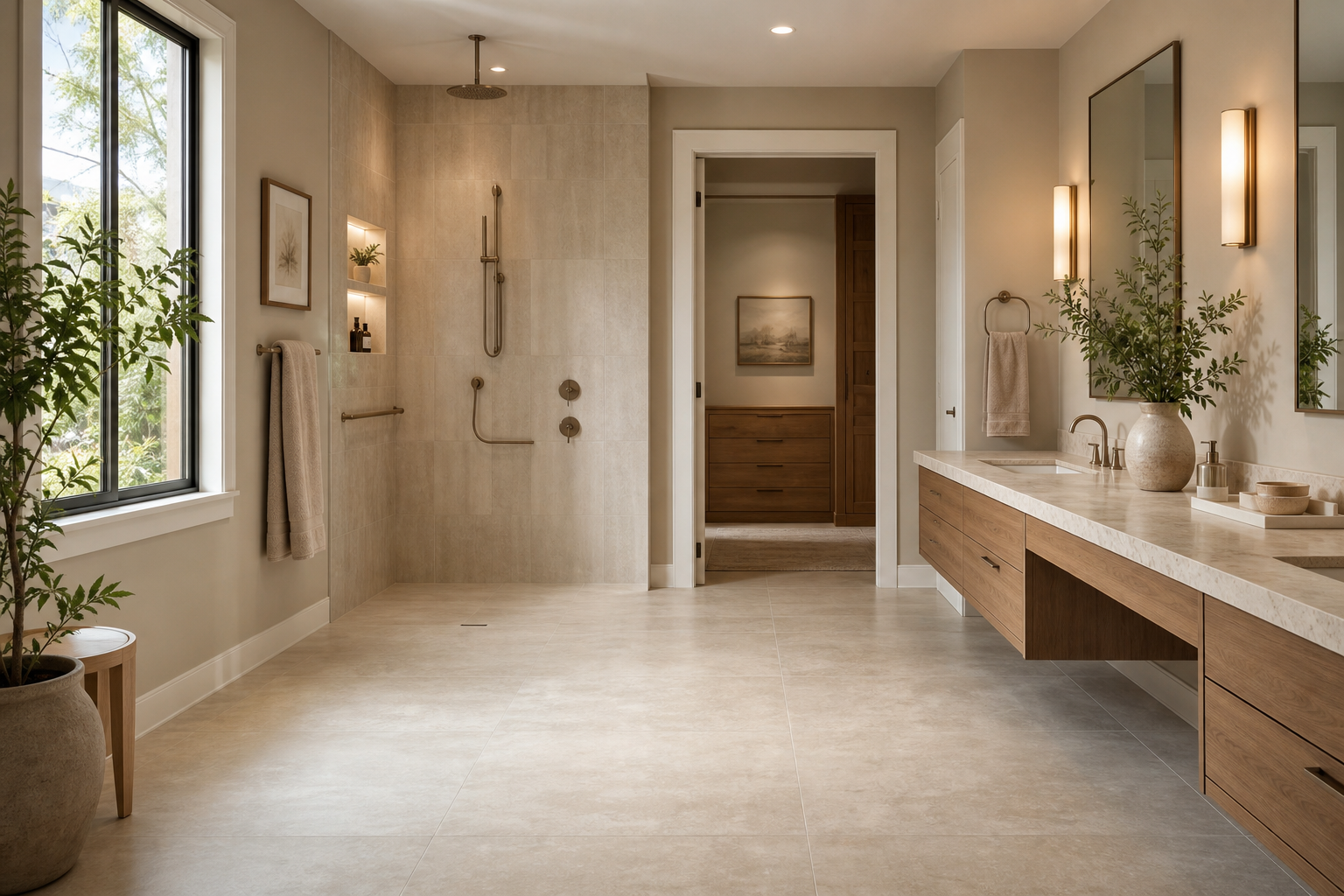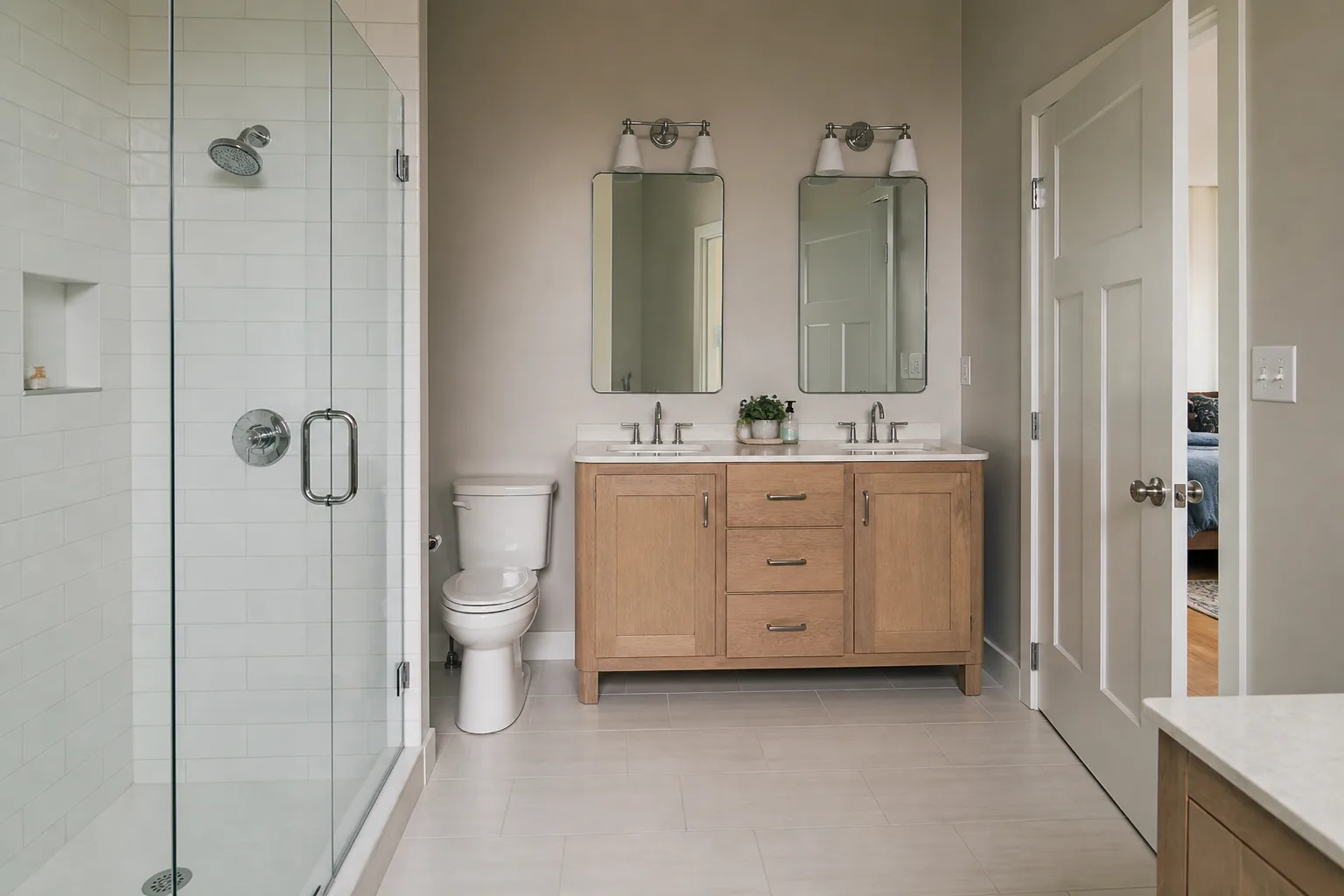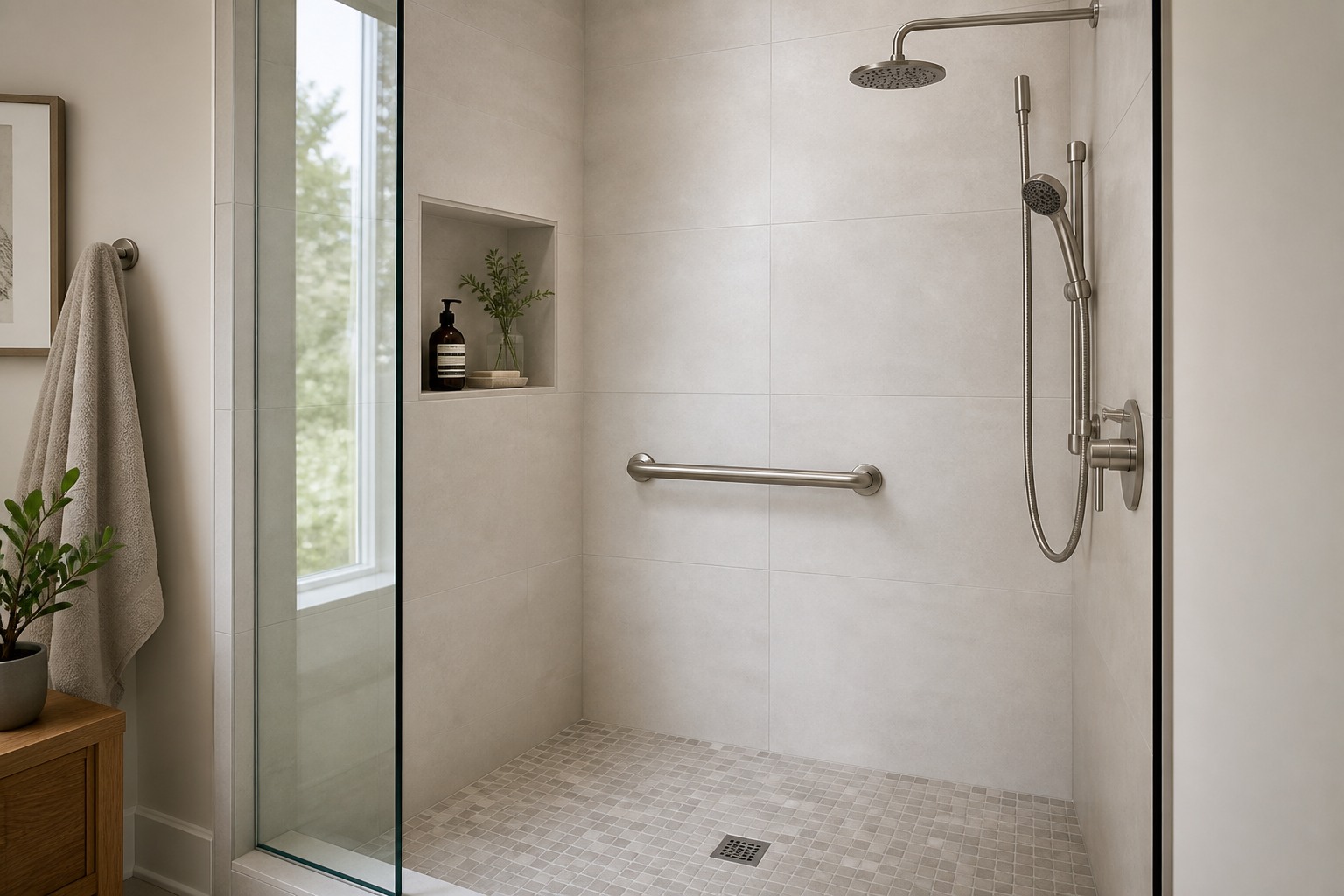
The question of where grab bars should go belongs in the renovation planning conversation, not in the decade when someone falls. Blocking, the structural reinforcement that makes a secure grab bar installation possible anywhere in a tiled wall, costs a few board-feet of lumber and fifteen minutes of labor during rough framing. Installing a grab bar into that blocking a year later, or twenty years later, is a thirty-minute job that costs the price of the hardware. Retrofitting a grab bar into studs or wall anchors in finished tile is a permanent compromise. The decision about whether to block gets made before the walls close. After that, it is mostly made for you.
This is not an argument about aging. It is an argument about sequencing.
What Blocking Actually Is
Blocking is a horizontal piece of dimensional lumber installed between wall studs at a specific location so that a fastener driven through a finished wall has something solid to grab. In bathroom applications, the blocking for grab bars is typically 2x8 or 2x10 lumber installed flat between studs at the height ranges where bars are most likely to be needed: behind the toilet, along the entry wall of a shower, at the transition from a shower seat to the wall, and along the back wall of a tub surround.
The blocking itself costs almost nothing. A single eight-foot 2x10 cut into blocking segments represents a few dollars of lumber. The labor to install it, during rough framing, is a line item that disappears into the larger rough work. The blocking does not affect anything about the visible room. It does not change the tile, the substrate, the fixture placement, or the design. It is structurally invisible once the walls close.
What blocking provides is load capacity. A grab bar installed into blocking at the correct depth can support static loads well in excess of two hundred and fifty pounds without movement. The same bar installed with toggle bolts into drywall or backerboard might feel stable when first installed and fail under the asymmetric dynamic loads that occur when someone grabs it for balance on a wet floor. The physics of a fall are not the physics of standing still and pulling on a bar. Hollow wall anchors are designed for art. They are not designed for the one moment that actually matters.
The NKBA Bath Planning Guidelines recommend a continuous blocking zone rather than blocking at a single height in shower applications. A horizontal blocking field from roughly thirty-three to fifty-one inches above the floor in a shower, and from fifteen to forty-eight inches in a toilet alcove, accommodates the full range of bar heights that serve different users doing different tasks. A single blocking zone at a fixed height serves one scenario. A blocking field serves all of them.
Where Grab Bars Actually Go
The geometry of grab bar placement is well established in the research literature and codified in the ADA Standards for Accessible Design, though most residential bathrooms are not technically required to meet those standards. The ADA requirements exist because they represent decades of research on human posture, balance, and recovery movement. They are not arbitrary.
In a shower with a bench, the critical bar location is the wall adjacent to the seat. A person lowering onto or rising from a bench applies lateral and vertical force simultaneously, often with wet feet and reduced grip. A bar at thirty-three to thirty-six inches high on the seat wall, and a second bar on the adjacent control wall at approximately thirty-eight to forty-two inches, supports the full arc of that transfer. In a walk-in shower without a seat, a bar along the entry wall at about thirty-six inches high provides a control point when entering and exiting over a threshold or curb, which is the moment of highest fall risk in a shower.
At a toilet, the side wall bar is mounted at thirty-three to thirty-six inches above the floor on the near wall. For a toilet positioned away from a side wall, a swing-down bar mounted to a reinforced backing plate accomplishes the same function. In a larger bathroom with a freestanding tub, a bar along the floor-adjacent edge of the tub deck provides a step-in point for a fixture that otherwise asks you to swing a leg over a high rim on one foot.
None of these locations require architectural improvisation. They are specific, predictable, and serve a documented purpose. Blocking placed during rough-in is placed in exactly those locations, at no additional complexity, because the wall is open and the lumber is cheap.
The Retrofit Problem
A bathroom built without blocking does not mean grab bars cannot be installed later. It means they cannot be installed well.
The first retrofit option is to locate existing studs and install bars that align with stud spacing. Studs are typically spaced sixteen or twenty-four inches on center. This constraint forces bar placement based on where the framing is, not where the bar performs best. If the layout is fortunate, the studs fall in approximately the right position. More often they do not, and the bar ends up at a compromised height or anchored primarily into one stud with a toggle bolt on the other end, which is an installation that a careful contractor will feel uncomfortable signing their name to.
The second option is hollow wall anchors rated for grab bar loads. Several toggle and snap anchor systems carry impressive load ratings in laboratory conditions tested against flat-panel substrate in good condition. Real-world installations are in tile and composite backerboard of varying ages, with substrate that may have absorbed moisture over years of use. The failure mode of a grab bar under dynamic load on wet tile, installed into aged wall systems with toggle anchors, is not a subject that has been studied extensively in peer-reviewed literature. The practical record among experienced bathroom contractors is not encouraging.
The third option is opening the wall. This actually produces a reliable installation because it introduces real blocking. It also means cutting finished tile, patching or replacing substrate, sourcing matching tile (which may no longer be manufactured in the same shade, size, or texture), and spending several hundred dollars in labor for what could have been a thirty-minute job in rough framing. In a bathroom that was recently remodeled, it means destroying work that is still relatively new.
The pattern in residential renovation is that grab bars get installed reactively, after a fall or near-fall, in bathrooms that were built without blocking. The installations are compromised or expensive, and the conversation that did not happen during the renovation is the reason why.
The Fear of Looking Clinical
The most common reason homeowners resist planning for grab bars is aesthetic. The mental image is a stainless-steel tube bolted to a white tile wall, the kind found in an airport restroom or a hospital corridor. That association is understandable, and the resistance to it in the context of a carefully designed home renovation is reasonable. Nobody builds a bathroom to look clinical.
The bar hardware market has moved considerably from institutional aesthetics. Nearly every decorative plumbing manufacturer now produces grab bars in the same finish families sold for faucets, towel bars, and toilet paper holders. Brushed nickel grab bars exist. Matte black grab bars exist. Unlacquered brass, polished chrome, satin brass, oil-rubbed bronze: the finish options track the decorative hardware market. The bars are available in a range of profiles, diameters, and lengths. A thirty-six-inch bar in brushed nickel, mounted at the same height as the coordinating towel bar, does not read as institutional. It reads as hardware.
Integrated blocking removes the only constraint that makes placement feel compromised. When blocking exists in the right location, the bar can be placed where it looks correct and performs well. When blocking does not exist, the bar is placed wherever the studs land and the appearance is secondary to the structural reality. The design conversation becomes a structural conversation, and the result tends to look like one.
There is also the option of installing bars at the time of renovation and having them serve double duty. A well-placed grab bar in a shower functions simultaneously as a handle. It can serve as the point of contact when entering, when adjusting the valve temperature, when reaching for a shelf. The load-bearing capacity that makes it reliable in a fall scenario also makes it survive actual daily use, which most residential towel bars and shower handles do not. The bar does not need to announce its purpose. A bar on the shower wall that reads as architectural hardware is a bar. Its structural competence is not visible.
The Lightbulb: A Free Option
Most renovation decisions involve trade-offs. More tile means more cost. A bigger shower means a smaller footprint somewhere else. Better fixtures mean more of the budget allocated to plumbing. The list of variables that compete with each other is long, and the exercise of renovation planning is mostly an exercise in managing those competitions.
Blocking for future grab bars is unusual because it does not compete with anything. It does not affect the visible design. It does not consume material budget. It does not constrain any other decision. It adds one option to the future that did not exist before, at a cost that disappears into the labor of rough framing.
The households with the most straightforward grab bar experiences are the ones who blocked for them during a renovation and installed them on their own timeline, without urgency, choosing finish and placement to match the room. The households with the hardest experiences are the ones making the decision after a fall, in a finished bathroom that was not built for it, facing a compromise installation or an expensive retrofit in tile that cannot be matched.
The only difference between those two outcomes is a decision made before the walls closed.
We include blocking for future grab bars in every primary bathroom we build, regardless of the client's current age. We note the blocking locations in the project documentation so the client can find them in ten or twenty years. The bars go in when they are wanted, not when they become necessary.