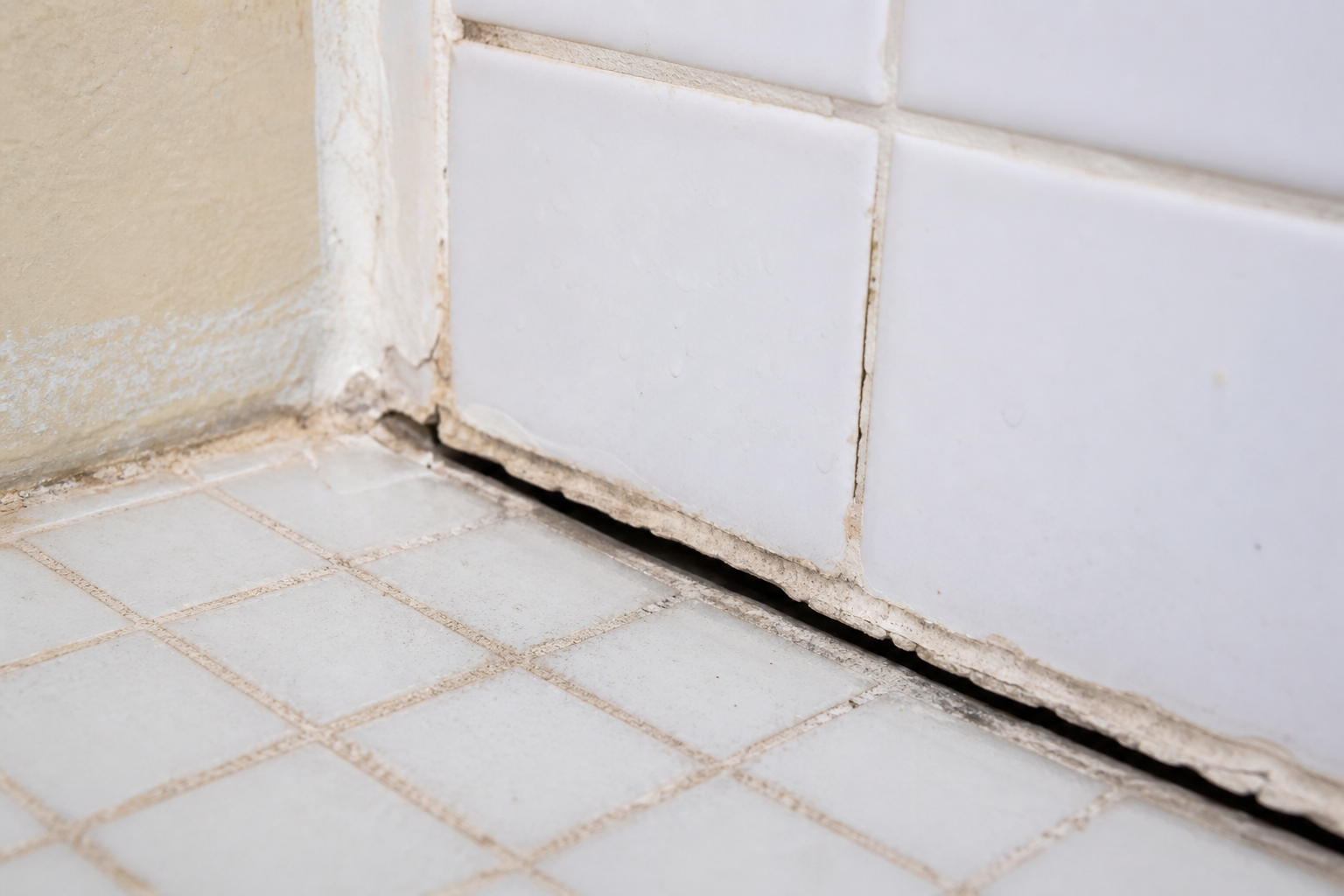
By the time you notice a soft spot in the floor near your shower, or a stain on the ceiling below it, the shower has probably been leaking for one to three years. The tile still looks fine. The grout may look fine. The shower functions normally. Water drains when you use it, the walls feel solid, nothing appears wrong from inside the room. What is not visible is the slow accumulation of moisture in the subfloor, the framing, the insulation, and sometimes the ceiling of the room below. The damage does not announce itself until it reaches surfaces you can see, and that announcement is usually years behind the failure.
This gap between when a shower pan fails and when a homeowner finds out is not a fluke. It is built into the physics of how these systems fail. Understanding the mechanism is the single most useful thing a homeowner can know before making decisions about shower construction, because once tile is set, the system is essentially permanent.
How a Shower Pan Is Supposed to Work
A shower floor is not waterproof because of the tile. Tile and grout are porous, and water passes through them with every use. The waterproofing layer is beneath the tile, not at the tile surface.
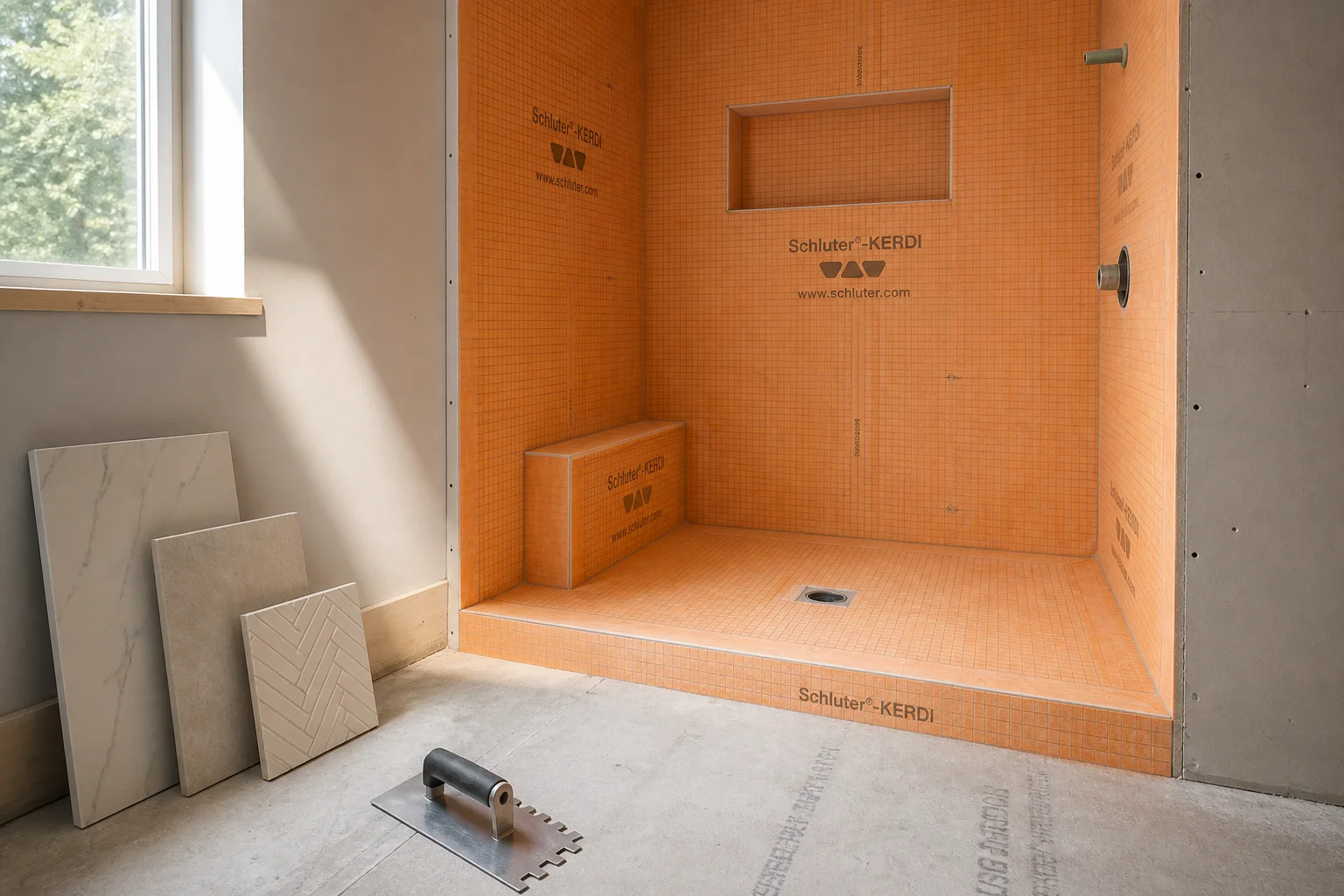
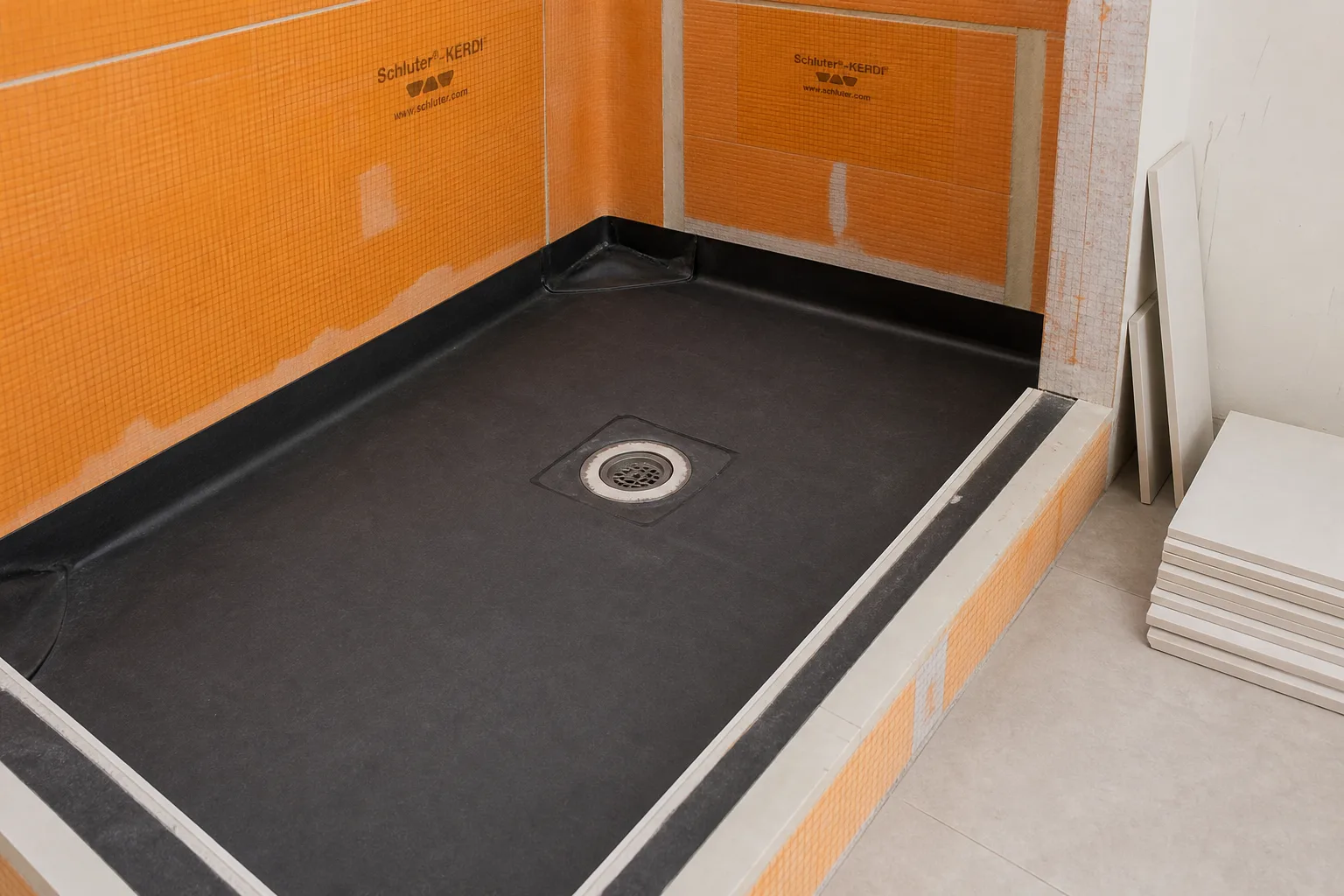
In a traditional shower pan assembly, a sheet liner (typically PVC or CPE, sometimes rubber) is installed below the mortar bed that the tile sits on. The liner extends up the shower walls several inches and is integrated with the drain assembly through a clamping ring that sandwiches the liner between the drain body and the drain ring. Water that passes through the tile and mortar reaches the liner, runs down the slope toward the drain, and exits through the clamped connection.
The system depends on three things being correct: the liner must be continuous with no punctures; the pre-slope below the liner must direct water toward the drain so it does not pool in the mortar bed; and the drain clamping ring must create a watertight connection so water cannot escape between the liner and the drain body.
When all three are correct, the system can perform for twenty to thirty years or more. When any of them is wrong, the leak begins at installation.
Where the Failure Happens
The drain connection is the most common failure point. Moisture intrusion investigators consistently identify an improper or missing clamping ring as the leading predictor of shower pan failure. Without the clamping ring, the liner is simply pressed against the drain body and held in place by the mortar bed above it. Over time, the mortar bed shifts slightly, the silicone or caulk that was used as a substitute degrades, and water begins escaping between the liner and the drain. This does not happen immediately; it happens gradually as the materials move and age, typically within three to seven years of installation.
By that point, water has been reaching the subfloor with every shower use. In a bathroom used once or twice daily, that is hundreds of water events before any visible symptom appears. The wood absorbs moisture. The moisture promotes biological growth. The biological growth begins consuming the structural material. The deterioration is not visible from the finished side of the room because it is occurring between the liner and the structure below it.
The pre-slope is the second common failure point. The liner must sit on a sloped surface that directs water toward the drain, so water that passes through the mortar bed has a path to the drain. If the pre-slope is flat or missing, water pools in the mortar bed between the liner and the tile. The mortar stays wet indefinitely. This does not produce a leak to the exterior the way a drain-connection failure does; it produces a chronically saturated assembly that promotes the same biological decay from within. The floor develops a soft or springy quality years later, and the grout at the bottom tile course cracks repeatedly because the assembly beneath it is unstable.
Punctures during installation are the third failure mode. PVC liners are relatively easy to puncture with a trowel, a knee, a fastener driven too low on the curb, or a tool set down without attention. These punctures may be small; a half-inch hole in the liner creates a path for every drop of water that reaches that location for the life of the shower. They are typically not visible after the mortar bed is applied, and they cannot be inspected after tile is set.
Why the Damage Stays Hidden
Water that escapes a shower pan does not announce itself immediately because it must travel. It soaks into the subfloor sheathing. It migrates laterally through joist bays before finding a path downward. In a two-story home, the water may travel several feet horizontally before it emerges as a stain on the ceiling below; the stain may not appear directly below the shower, and the source is not obvious.
In a single-story home on a slab, the water has nowhere to go but into the slab and through the perimeter of the assembly. Mold growth in the wall framing of the shower may be the first signal, appearing as a persistent smell that does not resolve despite cleaning. The smell is coming from inside the wall, not from the visible surface.
The other reason damage stays hidden is that the visual surface continues to function. The tile above the failing liner does not crack or move unless the structural damage beneath it becomes severe. The grout may deteriorate faster than expected at the base course, and the homeowner may regrout it without recognizing that the pattern of failure is structural rather than cosmetic. The shower looks fine. The shower functions. The damage accumulates behind it.
How This Changes the Conversation About Shower Construction
A shower pan failure that goes undetected for three years produces a repair that typically involves demolishing the shower, replacing the subfloor, sistering the damaged joists, remediating any mold, and rebuilding the entire assembly from scratch. The cost scales with how long the leak ran and how extensively the damage spread. It is one of the most expensive repairs in residential construction and one of the most preventable.
The prevention is not complicated. The flood test, filling the shower pan with water and holding it for 24 hours before tile is set, is the only way to verify the liner is continuous and the drain connection is watertight before the assembly is permanently concealed. This test cannot be performed after tile. Every professional tile installation guide and the IRC 2024 both recognize it as the verification step that determines whether the system was correctly built. A contractor who does not perform a flood test before tile is installed cannot know whether the waterproofing they installed works.
The other prevention is asking about the drain clamping ring explicitly. It is an inexpensive component; it adds a few minutes to the installation; and its absence or improper installation is the leading cause of the most expensive bathroom repair most homeowners will ever face. Asking whether the drain assembly includes a clamping ring, and whether the liner is clamped rather than silicone-sealed to the drain body, is a reasonable and appropriate question before a shower pan is built.
If the answer is uncertain, that uncertainty is important information about the contractor's familiarity with the assembly they are installing.
We flood-test every shower pan before tile is scheduled, and the result is documented in the project file. Not as a formality; as the only verification method that actually works before the assembly is hidden. If a shower pan fails the test, we open the drain connection before tile is discussed. We have caught missed clamps and liner punctures this way. The cost of opening a drain connection before tile is a few hours. The cost of the same problem found after the room is finished is a complete demolition and rebuild.