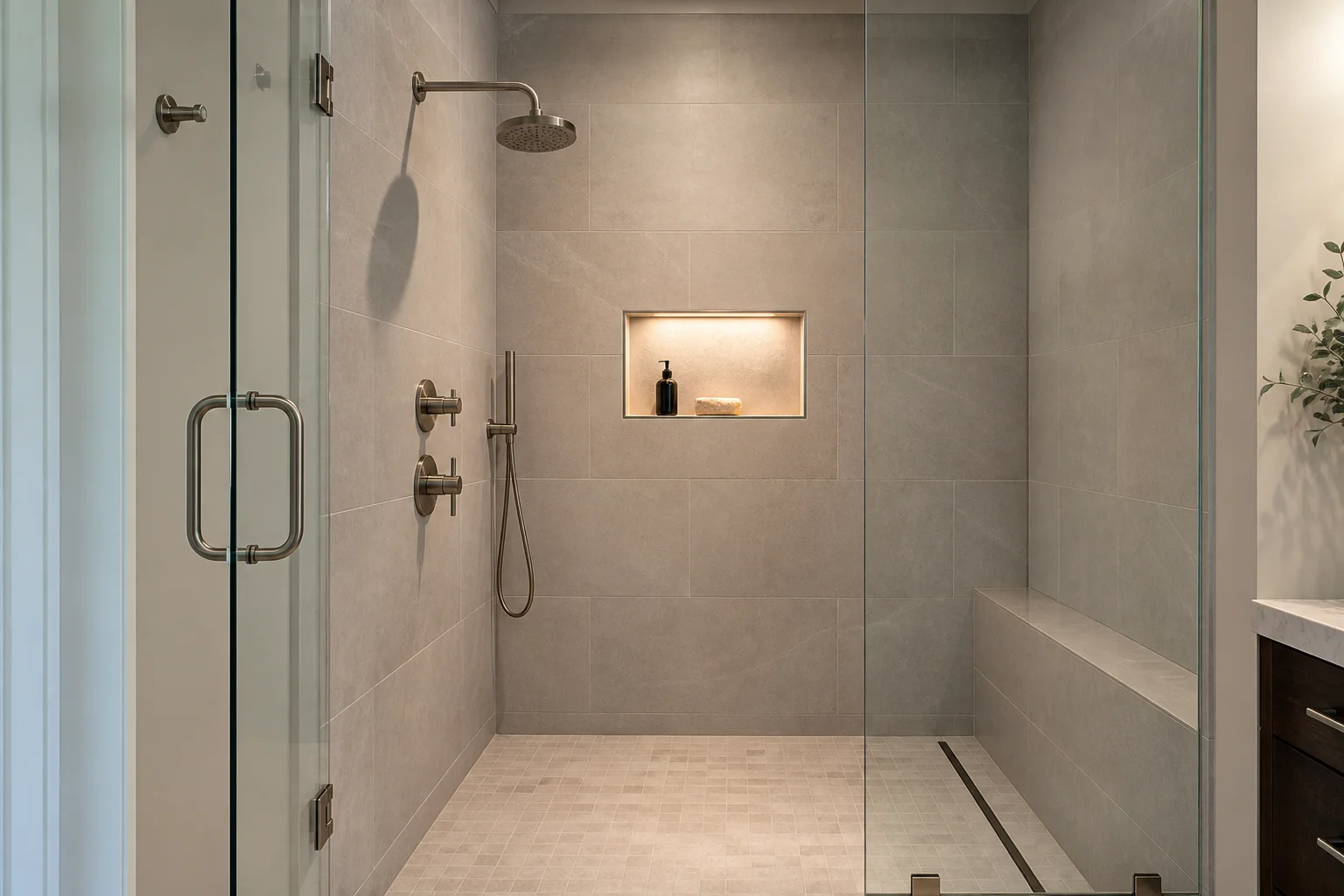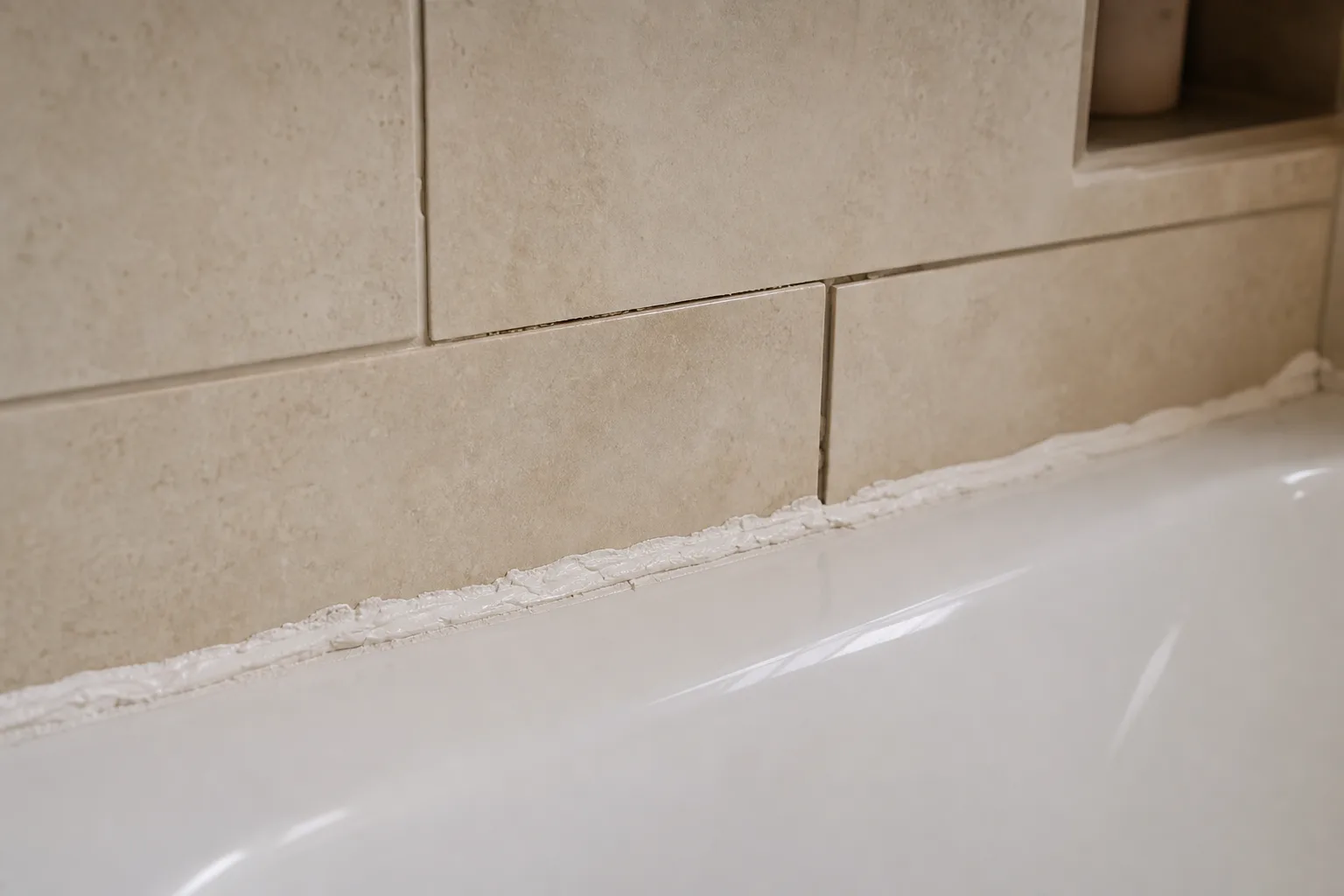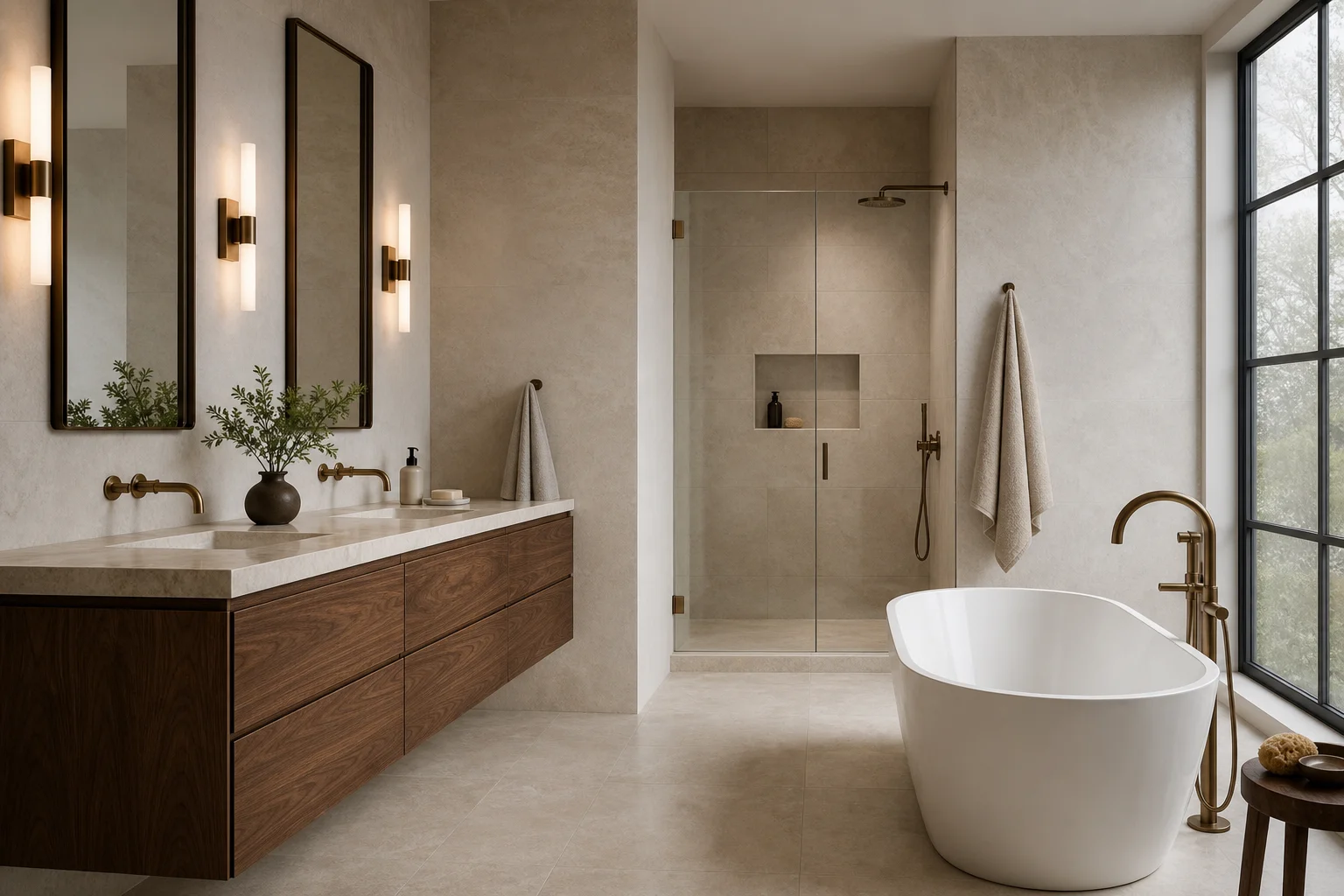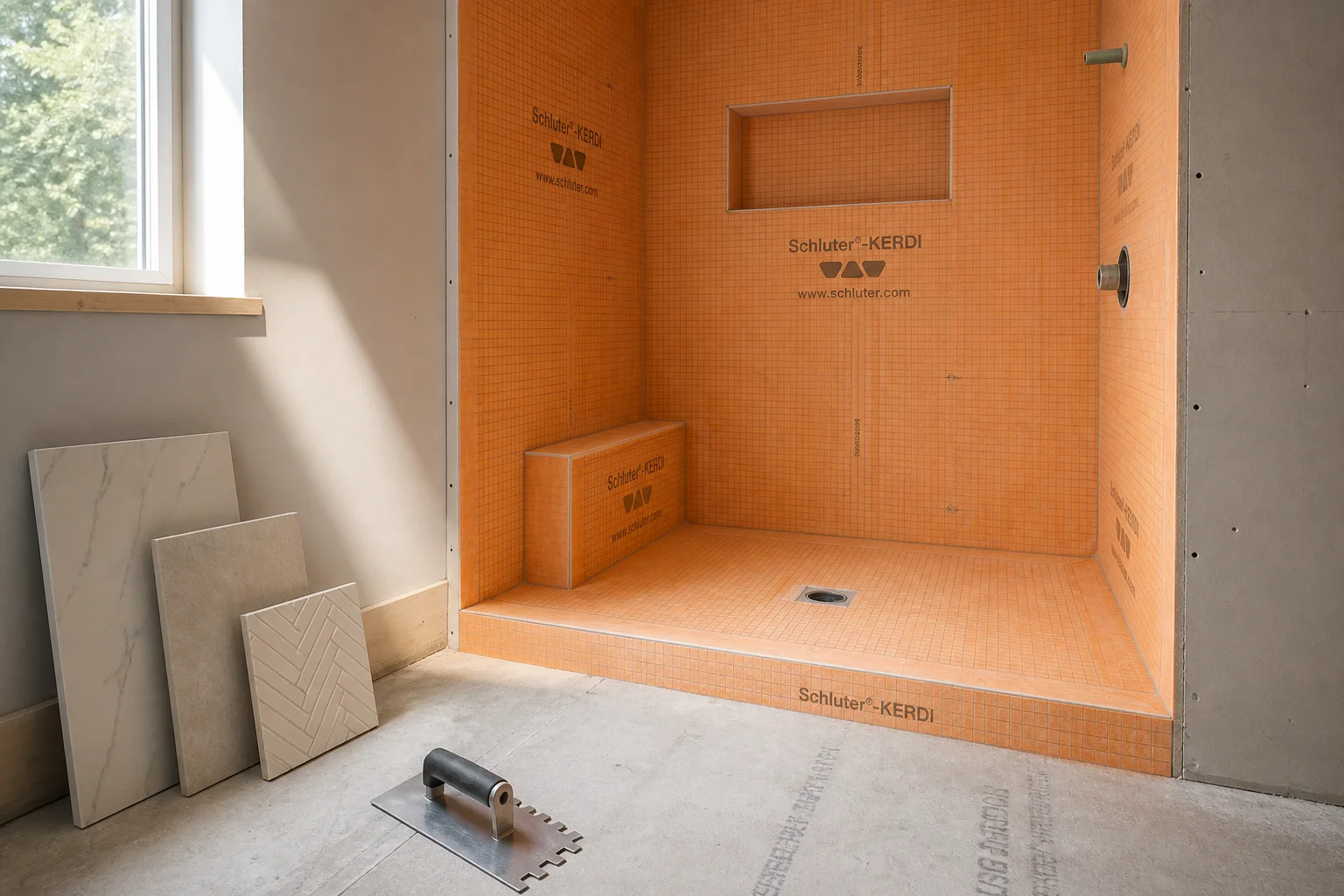
Most people judge a new shower by the tile. That is understandable. Tile is the part you see every morning. It carries the color, the pattern, the mood, the photograph you show a friend.
But tile is not the shower.
The shower is the assembly behind the tile: the slope, the drain, the substrate, the corners, the penetrations, the transitions, and the waterproofing layer that decides whether water stays where it belongs. A shower can look finished and still be badly built. A shower can look ordinary and be built with care. The difference is usually hidden before the homeowner ever sees the room again.
That is why waterproofing systems like Schluter-Kerdi matter. Not because one orange membrane is magic, and not because every good shower must use the same brand. They matter because they force the right question: where is the waterproof layer, and how does water get from the wall to the drain without touching the house?
If a contractor cannot answer that question clearly, the tile selection is not the first problem.
Tile Is Durable, But It Is Not Waterproof
Ceramic and porcelain tile are often described as water-resistant, and many tiles are highly resistant to water. The trouble is the shower is not made of tile alone. It is made of grout joints, corners, edges, pipe penetrations, niches, benches, fasteners, and plane changes. Those are the places where water gets curious.
Grout can absorb moisture. Natural stone can absorb moisture. Cement board can tolerate moisture, but it is not a complete waterproofing strategy by itself. Water does not need a dramatic leak to cause trouble. It can move slowly through capillary action, collect behind tile, saturate a bench, or find the one unsealed corner of a niche. The failure often announces itself years later, when the repair is no longer a tile repair. It is framing, subfloor, drywall, trim, and sometimes mold remediation.
This is the strange emotional problem of bathroom remodeling: the part that protects the investment is the part most homeowners never get to inspect once the room is finished.
So the better way to think about a shower is not "what tile do I like?" It is "what waterproofing assembly am I buying, and how will it be verified before it disappears?"
What Kerdi Is Trying To Solve
Schluter-Kerdi is a sheet-applied waterproofing membrane used behind tile. In a typical Kerdi shower, the membrane is bonded to the wall substrate and tied into the shower floor, corners, seams, drain flange, and penetrations as one continuous waterproof layer.
That continuity is the point.
Older shower methods often relied on a waterproof pan liner below a mortar bed, with cementitious materials above it. Those systems can work when detailed correctly. The problem is they are easy to misunderstand. A traditional shower pan needs correct pre-slope, weep-hole protection, proper liner height, careful corner treatment, and a mortar bed that can drain. When shortcuts happen, water can sit inside the assembly. It may not leak immediately, but it can become a damp system rather than a drying system.
Surface-applied membranes shift the waterproof layer closer to the tile. Water still reaches the tile and grout, but it meets a membrane near the surface rather than soaking into deeper layers. That can shorten the wetting path and make the shower easier to reason about.
The homeowner version is simple: the closer the waterproofing layer is to the water, the fewer hidden materials have to get wet before the system does its job.
That is not marketing. That is geometry.
The Drain Is Part Of The Argument
A waterproof membrane is only as good as its connection to the drain. Many shower failures happen where the field waterproofing meets the drain assembly, because that is where water is supposed to leave the room.
In a Kerdi assembly, the membrane bonds to a compatible bonding-flange drain. That detail matters because it creates a continuous path: wall membrane to floor membrane to drain flange. The waterproofing is not merely painted or stapled near the drain and trusted to behave. It is integrated into the drain design.
This is one reason comparing shower bids can be so confusing. One bid may include a complete surface-bonded waterproofing system with compatible drain components. Another may say "waterproof shower" but rely on a patchwork of methods, products, and assumptions. On paper, both say shower. In the wall, they are different rooms.
The right question is not "do you waterproof?" Almost everyone will say yes. The better questions are:
- What waterproofing system will be used?
- Where is the waterproof layer in the wall and floor assembly?
- How are seams, corners, niches, benches, and valve penetrations handled?
- Is the drain designed to integrate with that membrane?
- Will the shower be flood tested before tile?
Those questions are not adversarial. They are how a serious homeowner invites a serious answer.
Niches, Benches, And Corners Are Where The Story Gets Honest
Flat shower walls are the easy part. The real test is anything that interrupts the plane.
A niche creates inside corners, shelf slopes, membrane overlaps, and a back wall that must not collect water. A bench adds horizontal surface inside a wet area. A pony wall creates a top surface and an outside corner. A curbless transition asks the floor outside the shower to participate in water management. A handheld shower introduces more water direction and more penetrations.
This is why a shower should be designed and built as an assembly, not as a collection of pretty features. The more features you add, the more the waterproofing logic has to be drawn before the tile is chosen.
An elegant shower niche is not elegant because it lines up with the tile pattern. It is elegant because the shelf slopes slightly, the membrane is continuous, the corners are reinforced, the valve wall has been thought through, and the bottles fit without turning the whole recess into a puddle shelf.
That is the kind of detail that does not show up in inspiration photos. It shows up ten years later as the absence of a problem.
We specify the waterproofing system and drain assembly by name before a tile conversation begins on any project. Every shower we build is flood-tested before the tile crew mobilizes; the scheduled test is in the project documentation before demo starts, and the homeowner sees the result. If the pan holds, we proceed. If it does not, we open the drain connection and find out why before anything is covered.
What A Homeowner Should Ask To See
You do not need to become a tile setter to protect yourself. You do need to know what evidence looks like.
Ask for the named system before work begins. Ask whether the crew is following the manufacturer's instructions. Ask whether product mixing is acceptable within that system. Ask how the contractor handles fastener penetrations, curb tops, glass attachments, and outside corners. Ask whether the shower will be flood tested, and when.
A good contractor will not be offended by these questions. They may even be relieved. A homeowner who cares about the hidden assembly is a better partner than a homeowner who only notices tile shade variation after installation.
The point is not to micromanage. The point is to learn whether the person building the room can explain the room.
That is the minimum standard for trust.
The Taste Lesson Hidden Inside Waterproofing
There is a design lesson here too. A bathroom that lasts is usually quieter than a bathroom that merely impresses. The reason is not moral superiority. It is because durable work requires sequence. The membrane has to be continuous before the tile can be expressive. The slope has to be correct before the glass can look clean. The drain has to be chosen before the floor pattern is finalized.
Taste, in a bathroom, is not only about color. It is about respecting order.
When the order is wrong, the room becomes a stage set. It may look good for a while, but the house eventually tells the truth. When the order is right, even simple tile can feel expensive because the room has confidence. Nothing looks improvised. Nothing looks forced. The details seem calm because the decisions underneath them were made in the right sequence.
That is why the membrane matters. It is not the glamorous part of the shower. It is the argument that makes every visible choice more believable.