Nobody renovates a bathroom because the tile cracked. They renovate because the floor feels soft near the shower, or the grout will not stay white no matter what they try, or there is a smell they cannot find, or the ceiling below started staining and the conversation changed from "should we update the bathroom?" to "we have to open this wall."
Bathrooms do not fail dramatically. They fail in a sequence, and the sequence is predictable. The first failure is always minor. The second is annoying. By the third, you are no longer maintaining a room. You are managing damage.
Understanding that sequence is the difference between catching a problem at forty dollars and catching it at forty thousand. It is also the difference between building a new bathroom that repeats the pattern and building one that resists it.
The Sequence Is Always the Same
Every bathroom, regardless of age or quality, follows the same degradation path. The order does not change because the materials do not change their behavior. Water is patient, gravity is constant, and organic materials respond to sustained moisture the same way they did a century ago.
Here is the sequence, simplified:
1. Caulk fails. 2. Grout deteriorates. 3. Ventilation underperforms. 4. Water reaches the substrate. 5. Substrate decays. 6. Structure is compromised.
Steps one through three are maintenance items. They cost almost nothing to address. Steps four through six are construction problems. They cost everything to address. The entire game is preventing the first three from becoming the last three.
Caulk: The First Thing to Go
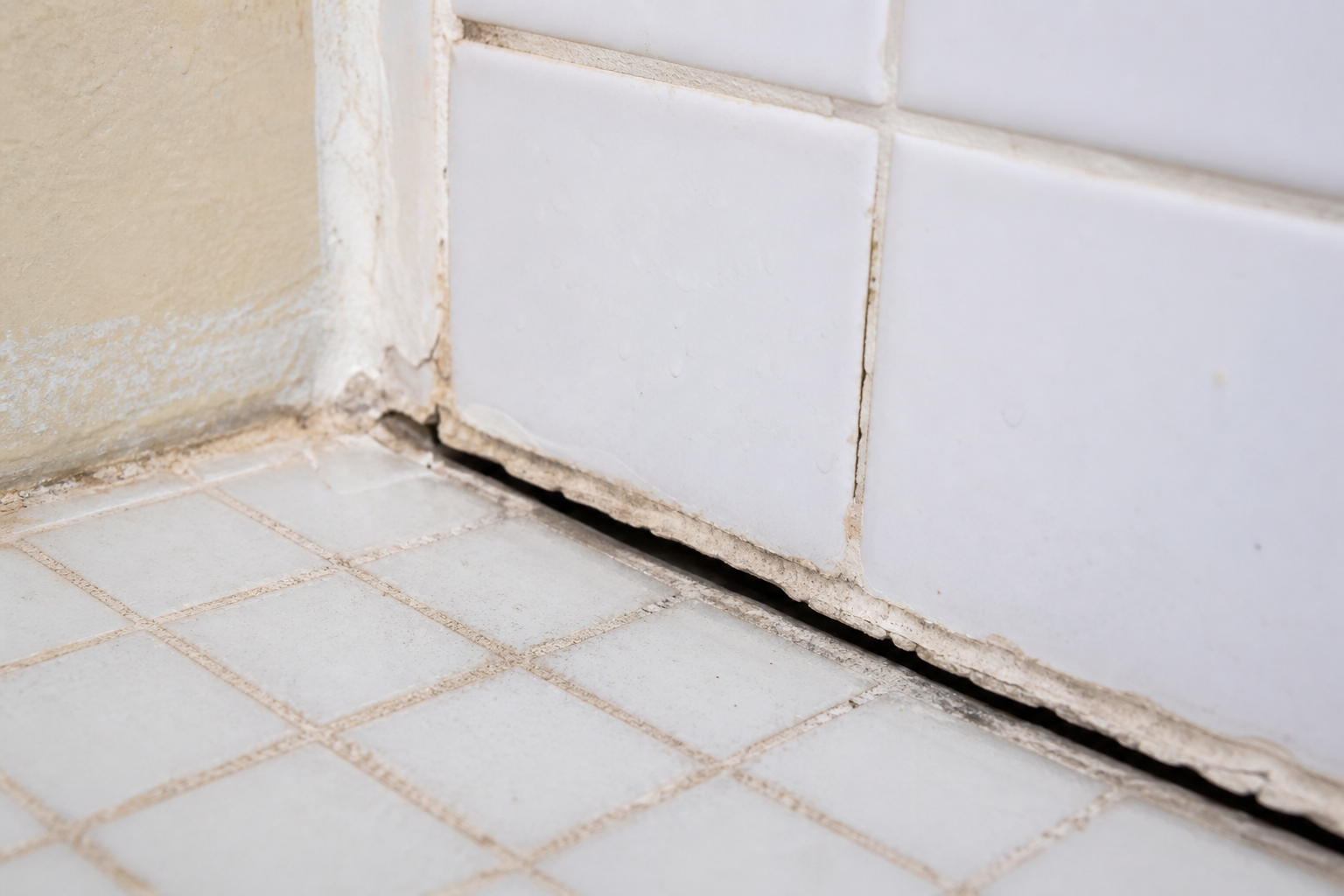
Silicone caulk in a shower or tub surround has a functional lifespan of three to five years under normal use. In a high-use family bathroom with daily showers and limited ventilation, it may last closer to two years before it begins pulling away from surfaces, cracking, or harboring mold that cleaning cannot reach.
This is not a defect. It is the material doing what it does. Silicone degrades through repeated wetting and drying cycles, temperature fluctuation, exposure to cleaning chemicals, and the microscopic movement that happens wherever two different materials meet. The shower pan moves differently than the wall. The tub edge moves differently than the tile. Caulk bridges that movement. Eventually, it cannot.
The reason caulk is the first failure is also the reason it matters: caulk lives at changes of plane. Inside corners, floor-to-wall transitions, tub-to-tile junctions, and fixture penetrations. Those are exactly the locations where water is most aggressive and where the waterproofing system is most vulnerable. When the TCNA Handbook mandates that perimeter joints use a compressible sealant rather than grout, it is acknowledging that these joints will move and that rigid material will crack there. Caulk is the sacrificial layer that keeps movement from becoming infiltration.
When caulk fails and no one replaces it, water has a direct path to the substrate at the worst possible location.
Grout: The Slow Betrayal
Grout does not fail the way most people imagine. It does not suddenly wash out. It deteriorates incrementally: hairline cracks develop, pinholes appear, the surface becomes porous where it was once dense. In a well-built shower with proper waterproofing behind the tile, deteriorating grout is a cosmetic nuisance. In a shower without proper waterproofing, deteriorating grout is the beginning of structural damage.
The mechanism is straightforward. Grout cracks when the substrate beneath it moves more than the grout can accommodate. The TCNA identifies substrate deflection as the primary structural driver for grout failure in floor installations, noting that floors exceeding an L/360 deflection limit under live load will crack tile and grout regardless of product quality. In shower walls, the mechanism is similar but oriented differently: thermal cycling, moisture expansion, and the natural settling of framing create stresses that rigid grout cannot absorb.
This is why movement joints exist. TCNA Detail EJ171 requires that tile installations include movement joints wherever tilework meets a restraining surface, at all inside corners, and at regular intervals in the field. These joints must be filled with an elastomeric sealant, not grout. When a tile installer grouts an inside corner instead of caulking it, they are building in a crack that will appear within months, sometimes weeks.
The practical problem is that most homeowners cannot distinguish between a grout joint that is cosmetically stained and a grout joint that has become structurally porous. Both look tired. One is a cleaning problem. The other is letting water through.
Ventilation: The Invisible Enabler
A bathroom can tolerate brief exposure to water. Every shower puts water on surfaces, and every surface dries between uses. The trouble starts when drying cannot keep up with wetting.
Bathroom exhaust ventilation exists to remove moisture-laden air before it can condense on cool surfaces, saturate porous materials, or raise the ambient humidity high enough that drying slows to a crawl. When ventilation underperforms, every other failure mode accelerates. Caulk grows mold faster. Grout stays damp longer. Paint blisters. Wood trim swells. The materials that might tolerate occasional moisture cannot tolerate sustained humidity.
The IRC requires bathroom exhaust fans to discharge directly to the outdoors, not into an attic, soffit, or concealed space. That requirement exists because venting humid bathroom air into a cold attic creates condensation on roof sheathing and framing, producing mold and rot in exactly the location a homeowner is least likely to inspect. The damage can accumulate for years before it becomes visible as a ceiling stain or a musty smell in the hallway.
Even properly routed exhaust ducts can underperform. A duct that sags, kinks, runs too long, or passes through an uninsulated attic will lose effectiveness. Warm moist air condenses inside a cold duct before reaching the exterior cap, and the condensation drips back toward the fan housing. The homeowner hears the fan running and assumes the room is ventilating. It may not be.
The Home Ventilating Institute recommends a minimum of 50 CFM for intermittent bathroom ventilation, or 1 CFM per square foot of floor area, whichever is greater. For bathrooms with jetted tubs, steam showers, or multiple simultaneous fixtures, the requirement goes higher. But sizing is only half the equation. A correctly sized fan connected to a sagging flex duct with two ninety-degree bends and a bird-screen cap delivers a fraction of its rated airflow. Static pressure matters as much as fan rating.
The simplest test is the tissue test: hold a single ply of tissue against the fan grille with the fan running. If the tissue does not hold, the fan is not moving meaningful air. Most bathrooms that smell musty after cleaning will fail this test.
When we assess an existing bathroom before a remodel, the first things we check are not tile condition or fixture age. We check caulk joints at changes of plane, grout behavior at the base course, fan airflow with the tissue test, and whether the exhaust path actually terminates outdoors. Those four things tell us more about how much life the room has left than anything visible on the finished surface. A bathroom that passes all four has time. One that fails any of them may be closer to a structural problem than a cosmetic one.
What Happens When Water Reaches the Substrate
Steps one through three are prologue. Step four is where the cost changes by an order of magnitude.
When water passes through failed caulk or porous grout and there is no waterproofing membrane behind the tile, it reaches the substrate. In most residential bathrooms, that substrate is cement backer board, drywall (in older homes or poorly done work), or occasionally plywood. Cement board tolerates moisture but does not stop it from migrating further. Drywall absorbs it and begins to decompose. Plywood swells, delaminates, and becomes a food source for mold.
The IIBEC (International Institute of Building Enclosure Consultants) has documented cases where missing secondary waterproofing membranes behind tile allowed water to migrate through poorly lapped cement board joints into wood-framed walls, producing structural rot that was invisible from the finished side of the room. In one multifamily investigation, they found "fully destroyed subfloor assemblies" beneath shower pans where the tile surface still appeared intact.
This is the central problem of bathroom failure: the most expensive damage is always invisible from inside the room. By the time a homeowner notices a soft floor, a swollen baseboard, or a stain on the ceiling below, the water has been traveling for months or years. The repair at that point is not recaulking. It is demolition, mold assessment, framing repair, waterproofing replacement, and full reassembly.
The IRC 2024 notes that shower pan failures are among the most common sources of insurance claims in residential construction and one of the most expensive repairs. A failed shower liner can require demolition of the entire shower, subfloor replacement, joist sistering, and mold remediation. The typical timeline from a shower pan liner failure to visible symptoms is three to seven years, which means the shower may be well past warranty before the problem announces itself.
The Pattern Is Preventable
Understanding the sequence reframes the whole question of bathroom maintenance and construction. The sequence is not random and it is not inevitable. It is a chain, and every link can be interrupted.
Interrupt at caulk. Replace shower caulk on a schedule, not when it looks terrible. Annual inspection and replacement every three to five years prevents water from reaching vulnerable joints. Use 100% silicone rated for wet areas. Remove old caulk completely before applying new material, because silicone does not bond reliably to old silicone.
Interrupt at grout. Ensure tile installations include proper movement joints per TCNA EJ171. Perimeter joints and inside corners must be sealant, not grout. If grout begins cracking at inside corners or at floor-to-wall transitions, that is almost certainly a missing or failed movement joint, and the fix is removing the grout and replacing with flexible sealant.
Interrupt at ventilation. Run the exhaust fan during every shower and for at least thirty minutes after. Verify that the duct runs to the exterior, not into the attic. Check annually that the fan is actually moving air. If you are remodeling, route the exhaust duct with rigid or semi-rigid material, keep runs short and straight, and insulate any duct that passes through unconditioned space.
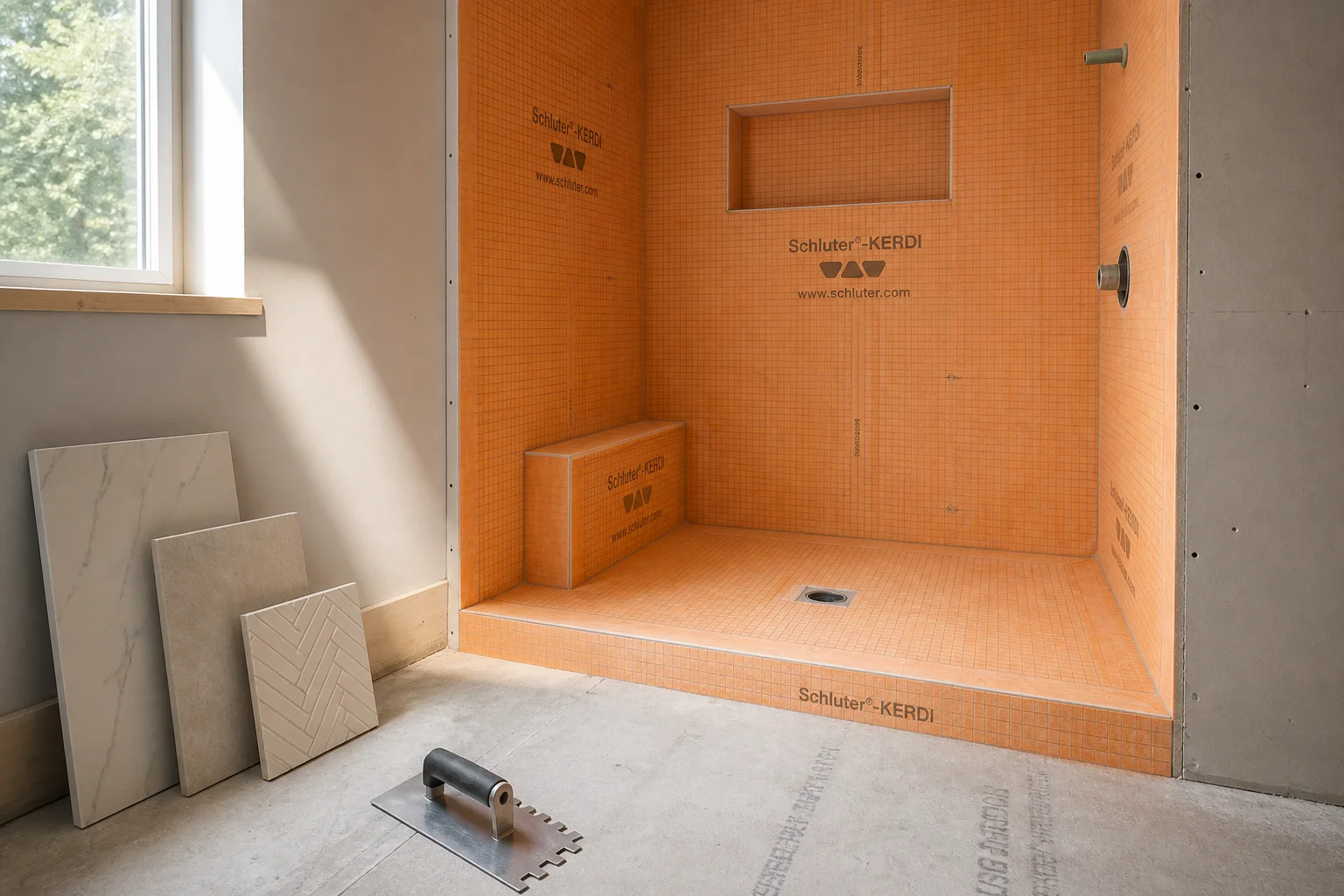
Interrupt at the substrate. This is the construction decision, and it is the most consequential. A properly installed waterproofing membrane behind the tile, continuous at corners and integrated with the drain, means that even if caulk fails and grout deteriorates, water meets a barrier before it reaches the structure. The membrane buys time. It converts an emergency into a maintenance item.
What This Means for a Remodel
If you are planning a bathroom renovation, this failure sequence should shape how you evaluate what you are buying. Not how the tile looks. Not which faucet. Not whether the shower has a niche or a bench. Those decisions matter, but they are finish decisions. They sit on top of a system.
The system questions are:
- Where is the waterproof layer in the shower assembly?
- How are corners, niches, benches, and penetrations integrated into that layer?
- Is the drain designed to work with the membrane, or is it just near it?
- What is the exhaust ventilation path, and does it terminate outdoors?
- Are movement joints specified at all perimeter and change-of-plane locations?
A bathroom that answers those questions well will still need caulk maintenance and grout care. It will still accumulate mineral deposits and soap film. But it will not rot. It will not grow mold inside the wall. It will not produce a soft floor in year seven.
The room will age the way a well-built room should: visibly, gradually, repairably. That is a different kind of bathroom than most people have owned. It is also what makes a renovation worth the investment rather than just a fresh surface over the same old vulnerability.