A bathroom that smells or feels damp right after cleaning is not dirty. The moisture is originating from inadequate ventilation, porous materials that stay damp for hours, or both, and no amount of cleaning addresses either cause.
This is a distinction worth making precisely because the two problems feel so similar. A damp bathroom has an air quality that registers as stale or slightly musty, a coolness on surfaces that lingers after the mirror clears, a sense that the room did not fully recover between uses. Clean bathrooms do not feel this way. But clean bathrooms with inadequate ventilation do. Cleaning removes surface contamination. It cannot remove humidity that the room is not capable of exhausting.
The path to a bathroom that does not feel damp after cleaning runs through the mechanical systems that manage moisture, the materials that either hold or shed it, and the usage patterns that accumulate it. Understanding which combination applies to a given room determines what actually helps.
What "Damp" Is Telling You
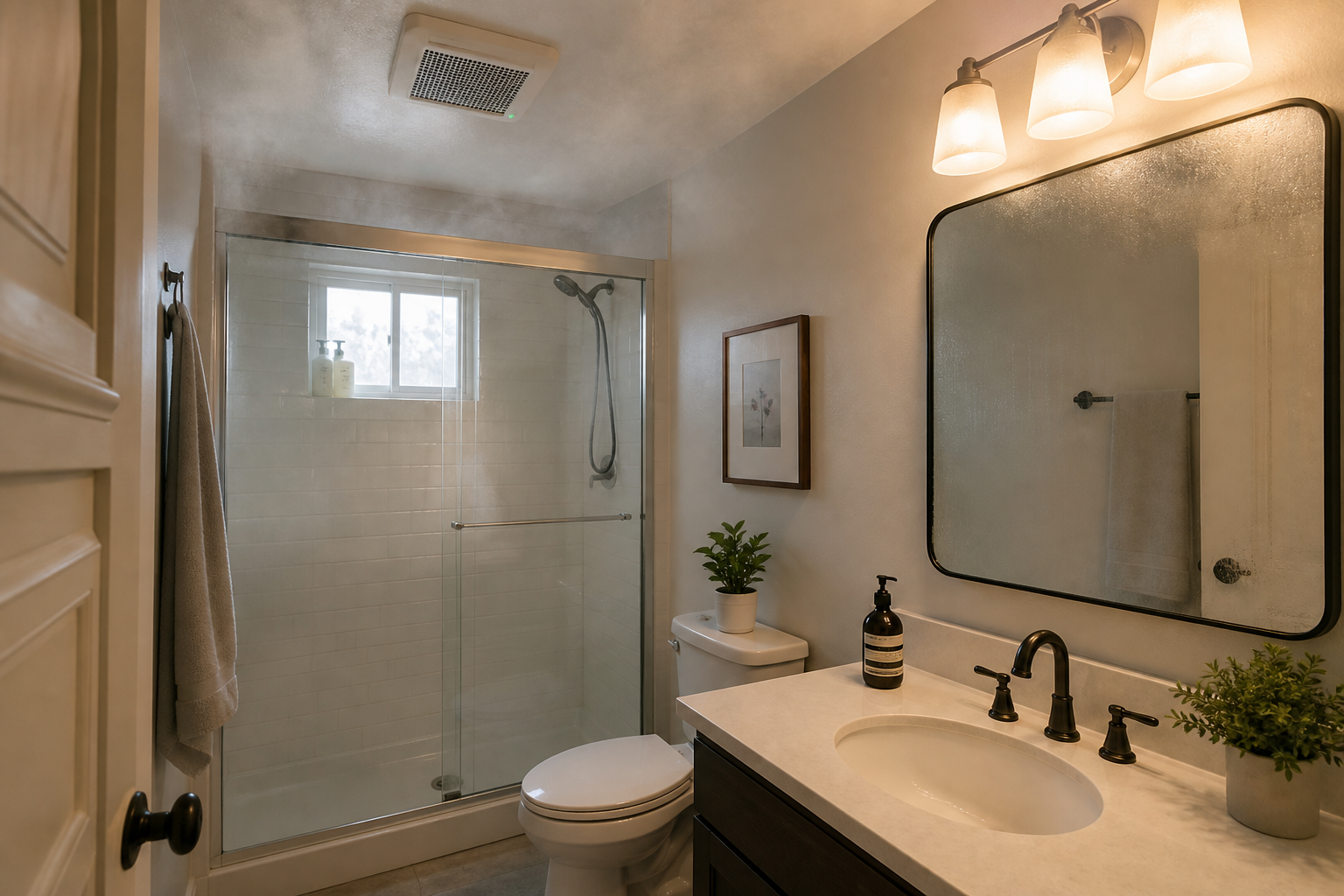
A bathroom that feels persistently damp is usually a room where relative humidity recovers slowly after shower use. Showers are substantial moisture events. A ten-minute shower in a small to medium bathroom raises relative humidity inside the room to near saturation. The bathroom's exhaust fan is supposed to remove that moisture-laden air and replace it with drier air from the house. If the fan is undersized, improperly ducted, or run for too short a time, the moisture removal does not happen fast enough and the room stays elevated in humidity for an extended period after the shower ends.
The Home Ventilating Institute recommends sizing bathroom exhaust fans at a minimum of one CFM per square foot of floor area, with a recommended minimum of 50 CFM for any bathroom regardless of size. For bathrooms with enclosed showers, a larger shower volume, or heavy daily use, the recommendation increases. A master bathroom with a walk-in shower used twice daily is not the same ventilation challenge as a half-bath used rarely.
The critical number that many homeowners do not know is the HVI's recommended post-shower runtime. The fan should run for approximately 20 minutes after the last shower in a session, not for the duration of the shower. The duration of the shower is when moisture is being generated. The 20 minutes afterward is when the accumulated moisture in the air is removed. A fan that runs during the shower and stops when the user exits has done a fraction of the necessary work.
Most bathroom fans are wired to the light switch. When the light goes off, the fan stops. This configuration produces the minimum possible exhaust runtime in most households and is a primary contributor to persistent bathroom humidity.
The Fan Itself
Before examining runtime, examine the fan. A bathroom exhaust fan has a rated CFM that assumes no duct resistance. In practice, every foot of duct run, every elbow, and every termination cap reduces the delivered CFM below the rated value. A fan rated at 80 CFM installed with 15 feet of flexible duct and a standard roof cap may deliver 50 CFM at the register. That is an adequate result for some bathrooms and inadequate for others.
The Home Ventilating Institute publishes guidance on duct length and elbow equivalencies that allow a calculation of actual delivered CFM given a specific installation. The calculation is not difficult, but it requires knowing the actual duct run, and many fans are installed without any measurement. The electrician installs the unit to the code minimum and moves to the next item. Whether the delivered CFM is appropriate for the room is a question that does not get asked.
Older fans present an additional issue. A bathroom exhaust fan installed more than ten to fifteen years ago may have a motor that has degraded to the point where actual delivered CFM is significantly below original rating. The fan runs. It makes noise. It does not move as much air as it once did. Unless someone measures the airflow, the degradation is invisible. An inexpensive anemometer or a simple tissue test can confirm whether a fan is moving meaningful air. Tissue held to the grille should be held firmly against the face with the fan running. If the tissue is barely held or falls away, the fan is failing.
Duct termination is a separate issue. An exhaust fan that ducts to an attic, a crawl space, a soffit cavity, or another interior space is not exhausting to the outside. It is exhausting warm, moist air into the building assembly, which creates the conditions for mold growth and wood deterioration in the receiving space. Bathroom exhaust ducts must terminate at the exterior, period. This is code in most jurisdictions. It is violated constantly, both in new construction and in renovations where a new fan is installed in the existing duct path without verifying where the duct goes.
How Materials Contribute
Even a correctly sized and properly ducted fan cannot compensate for materials that hold moisture and release it slowly over hours after the shower ends.
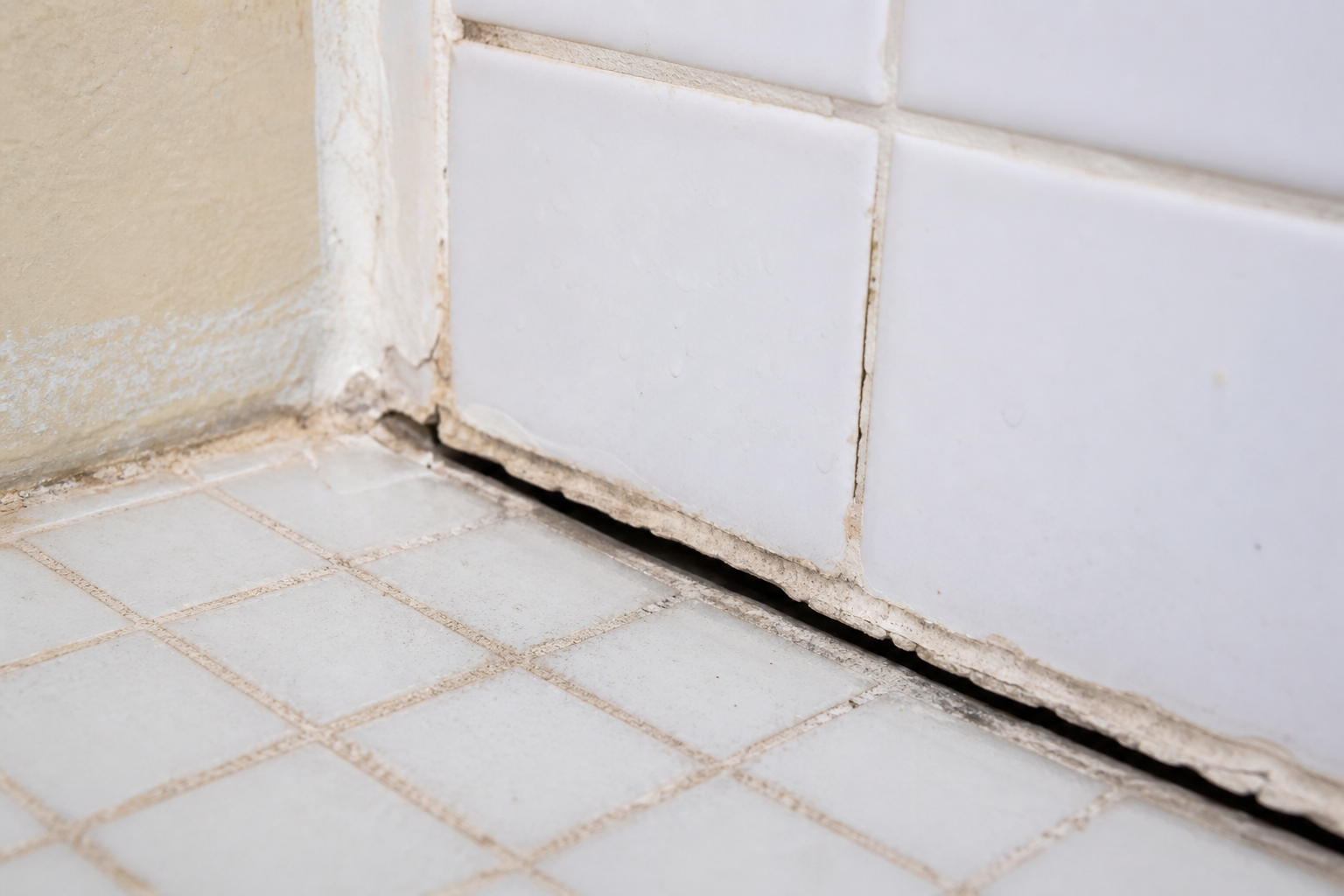
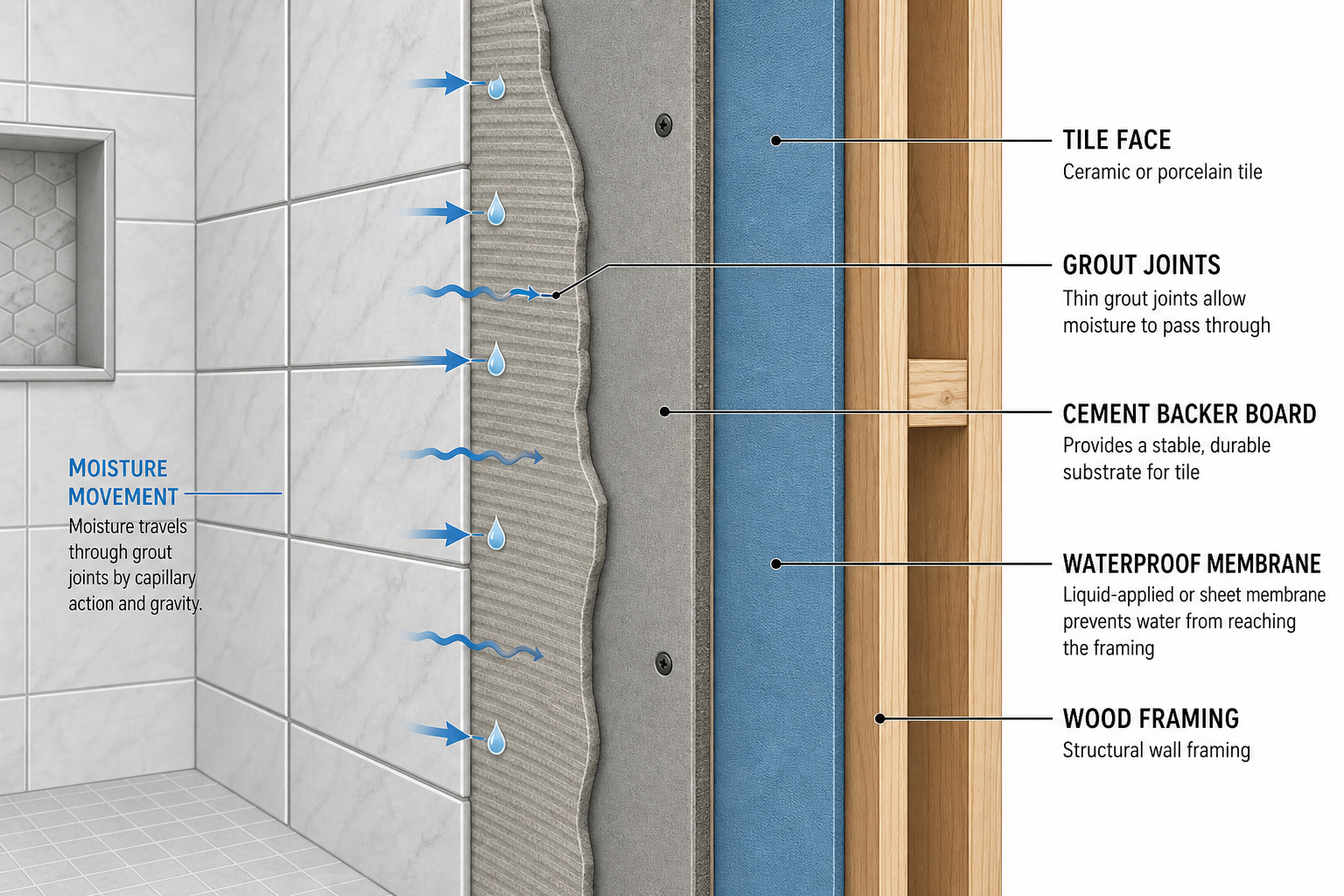
Porous grout is the most common contributor. Standard cement-based grout absorbs water during shower use. After the shower, the grout releases that moisture back into the air through evaporation. In a tightly tiled room with many linear feet of grout joint, this slow release can extend the post-shower humidity spike for an hour or more, well beyond what the fan's post-shower runtime has addressed.
The effect is compounded by tightly spaced grout joints. A large-format tile installation with 1/16-inch joints has dramatically less grout surface area than a small-mosaic installation with 1/8-inch joints across the same square footage. The mosaic installation has more total grout area and more surface area for moisture absorption and desorption. This is not a reason to avoid mosaic tile. It is a design consideration that affects ventilation requirements.
Unsealed grout is worse than sealed grout for moisture absorption. A penetrating sealer reduces the open porosity of the grout matrix and slows water uptake during shower use. The Custom Building Products technical documentation on grout sealers notes that properly sealed grout absorbs significantly less water than unsealed grout of the same type, reducing the moisture load that the grout releases after shower use. Sealers wear and need reapplication, typically every one to three years depending on the product and traffic level.
Porous stone surfaces, including unglazed natural stone tile and marble surrounds, contribute similarly. Stone that has not been sealed or that has been sealed with a worn sealer absorbs water and releases it slowly. Bathroom surfaces that appear dry to the touch may still be releasing moisture into the room air for hours. The effect is invisible but measurable.
Shower curtains and fabric elements retain moisture after every use. A shower curtain that is left bunched against the wall rather than spread flat to dry maintains a microclimate of elevated humidity around itself. Cotton bath mats that do not dry between uses contribute similarly. These are not design failures. They are material behaviors that affect the moisture load in the room and respond to simple interventions: spread the curtain, dry the mat, open the door after the shower to promote air exchange.
The Relationship Between Humidity and Smell
A bathroom that smells slightly off even after thorough cleaning is usually a humidity problem, not a contamination problem. The smell is not dirt. It is the volatile organic compounds and microbial byproducts associated with surfaces that stay damp long enough to support minor mold or mildew growth.
Mold and mildew require moisture and organic material. Bathroom surfaces provide both. Grout contains cement, sand, and sometimes pigment, all of which support microbial growth in the presence of sustained moisture. Caulk, particularly silicone caulk in shower applications, develops surface mold when it stays wet beyond a certain period. The visible pink or black staining on caulk joints is the visible end stage of a moisture problem that has been operating invisibly for some time.
The Environmental Protection Agency's guidance on moisture control in buildings establishes that the threshold for mold growth on most building materials is a relative humidity above approximately 60 percent sustained for more than 24 to 48 hours. A bathroom where post-shower humidity stays elevated for several hours is not necessarily sustaining the 60 percent threshold for 24 hours, but repeated cycles of elevated humidity accumulate in materials that do not fully dry between cycles. Weekly cleaning removes surface accumulation. It does not prevent the next cycle.
Improving ventilation addresses the root cause. Reducing material moisture absorption through sealing reduces the severity. Running the fan long enough after every shower prevents the cycles from accumulating.
Practical Changes That Actually Help
The changes that make the most difference, in rough order of impact:
Duct the fan correctly. If the existing fan vents to a soffit, an attic, or anywhere other than directly to the exterior, that is the first thing to fix. The fan cannot exhaust moisture it is recirculating into the building.
Run the fan longer. Twenty minutes after every shower. A timer switch, which replaces the existing wall switch at minimal cost, allows the fan to run for a set period after the switch is turned off. Some models allow the fan to run on a preset countdown independently of the light. This single change makes a larger difference to post-shower humidity than any other intervention short of replacing the fan with a larger unit.
Verify the fan is moving air. The tissue test takes thirty seconds. If the fan is not moving meaningful air, either service or replace it.
Seal the grout. A penetrating sealer applied to clean, dry grout and reapplied every one to two years reduces the moisture load that the grout deposits into the room air after each shower. The investment is a few hours per year.
Open the door. After the shower, opening the bathroom door allows the house air to dilute the bathroom's post-shower humidity faster than the fan alone. In humid climates during summer months this may be a trade-off; in most Pacific Northwest conditions, house air in the relevant seasons is drier than shower-saturated bathroom air and the exchange is beneficial.
When a client describes a bathroom that feels perpetually damp, our first question is about the exhaust fan: where it ducts, what CFM it delivers, and whether it runs long enough after each shower. Most of the time, the answer is at least partially wrong.